Peter writes his sixth essay on the ‘abusage’ of language, an affliction all too rampant today.
Polonius: What do you read, my lord?
Hamlet: Words, words, words.
Polonius: What is the matter, my lord?
Hamlet: Between who?
Polonius: I mean, the matter that you read, my lord.
(Hamlet, II,ii)

A Dictionary of the English Language, by Samuel Johnson. 1773, Accessed 2026/09/01, https//johnsondictionaryonline.com/1773/lexicographer_ns
- “The Pope has decided to beautify Mother Teresa” –CTV newsreader on local television
- “Tina Woodrow used to wake up terrified the Grand River had swelled and stole one of her children.” –National Post article of February 18, 2018;
- “U.S. flys drone”–CTV on-screen caption to TV news item;
- “Bomb diffused” –CTV on-screen caption to news item on unearthed World War II relic;
- “Peddle Power”–CTV on-screen caption to news item on cycling for charity;
- “She waited for the bus for an hour, only to be rejected from one which finally arrived, as there was no room on it.” –Weather Channel report from a journalist on site after storm;
- “And when did the enormity of your engagement to a royal prince sink in?” –journalist’s question, put to Meghan Markle during an interview before her wedding to Prince Harry;
- “Canadians watch Coronation Street, as do ex-patriots from Britain.” –National Post story
- “I could care less what the city’s recycling rules are.” —disgruntled neighbour during a recent difference of opinion;
- “Disinterested intellectual curiosity is the life-blood of real civilization.”—G.M. Trevelyan, distinguished historian.
- “The brutality of the 1200 murdered, fathers, mothers, and children is incomprehensible”–Avi Benlolo, National Post, Oct. 7, 2025, front-page story.

A Dictionary of the English Language, by Samuel Johnson. 1773, Accessed 2026/09/01, https//johnsondictionaryonline.com/1773/excise_ns
Which of the examples of modern English above are correct as they stand, and which need to be corrected on account of the misuse of the language, and does it matter?
What kind of an Ironist are You?
If you said all but number 10 above, full marks. Of course it matters. For some time now, it has become increasingly apparent to those of us who care about the proper use of language that too many in the chattering classes who depend for their livings on the quality of their communicative skills, however deficient—among them, teachers, broadcasters, academics, politicians and, especially, journalists—have been falling down on the job. This ‘abusage,’ to use a term coined by the lexicographer Eric Partridge, is regrettably epidemic. Some years ago now, the journalist Lynn Truss, outraged by the misuse of punctuation she saw all around her, wrote Eats, Shoots and Leaves, whose title contains the deliberately incorrect placing of the first comma, the effect of which is to change entirely the meaning of the phrase. Read the book to find out how. (Here’s a hint: as a result of the addition of this comma, two nouns have become verbs.) Truss’s bestseller is a corrective to sloppiness in punctuation, but there is more to language misuse than misplaced commas and semi-colons, as the examples above attest. Carelessness is due not only to inadequate teaching and testing of the mechanics of English—its spelling, punctuation, and grammatical conventions—but also to insufficient exposure to good examples of English style from the rich treasury of outstanding writing in English from Shakespeare through to Scruton, from V.S. Naipaul to Mavis Gallant, and a host of others. Other reasons for the decline in literacy include the rise of the permitted, if not encouraged, illiteracies of ‘social media,’ mass immigration from countries where English is not native, lax supervision on the part of editors, broadcasters, and publishers, and most troublingly, a disinclination to read thoughtfully and critically, resulting in a catastrophic decline in both the quality and frequency of reading on the part of the public, which has led to the lowering of standards in public discourse.

A Dictionary of the English Language, by Samuel Johnson. 1773, Accessed 2026/09/01, https//johnsondictionaryonline.com/1773/patron_ns
- In the first example above, the Pope is not, nor has he ever been, a cosmetician. The correct word is beatified, which means ‘consecrated,’ made holy,’ or ‘sanctified.’
- In the second, the past participle of the irregular verbs ‘swell’ and ‘steal’ are swollen and stolen.
- In the third, the intended word is flies. Even my very young granddaughter knows this.
- In the fourth example, bombs cannot be ‘diffused,’ as this is something light can be made to do. The correct word is defused.
- In the fifth, ‘peddle,’ used of travelling salesmen, is the incorrect substitute for pedal.
- In the sixth, the speaker could not have meant ‘ejected from’ as the patient would-be passenger never got on the bus. The bus driver is unlikely to have ‘rejected’ a waiting passenger, but he might have discouraged his entry. The sentence would be more correctly phrased after its comma as “but was unable to board the one which finally arrived, as it was already full.”
- The seventh example contains the word ‘enormity’ which means ‘a monstrous offence or evil’ like the Nazis’ use of concentration camps. It is highly unlikely that Ms. Markle thought her marriage to Prince Harry would be anything like this. The journalist means significance.
- In the eighth example, immigrants from Britain do not cease being patriotic just because they come to Canada, but this is what this journalist claims. The correct word is expatriate. It means they no longer live there.
- If the speaker really could ‘care less’ in the ninth, then he must care somewhat. He means he could NOT care less. He does not care at all.
- In the eleventh example, the writer means “suffered by” or “inflicted upon.” The victims are not brutal! Say what you mean and mean what you say!
- Disinterested in the tenth sentence means ‘impartial,’ ‘free of self-interest.’ It is what a judge should be. It is not a synonym for ‘uninterested.’ The word is used correctly here.
- In #11, the murdered victims were not brutal. The sentence should be corrected to read
- “The brutality suffered by the murdered fathers, mothers, and children…”
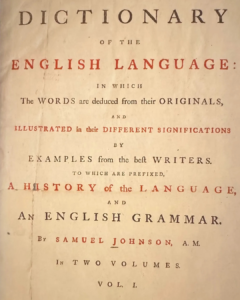
A Dictionary of the English Language, by Samuel Johnson. 1773, Accessed 2026/09/01, https//johnsondictionaryonline.com/1773/titlepage_ns