The Ironist

Differing Perspectives

Meeting Boom-Boom

Peter revisits Jonathan Raban’s Old Glory, a Mississippi odyssey in a 16-foot boat, and the towboat captain who turned out to be the travel writer’s kindred spirit.
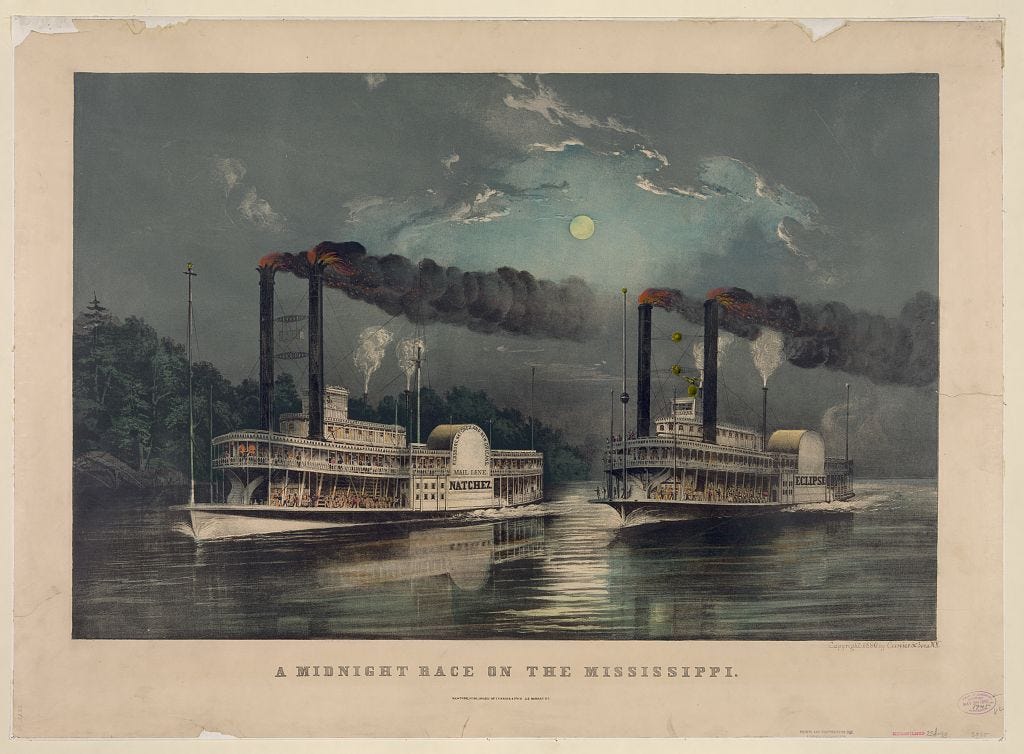
“A Midnight Race on the Mississippi,” Currier & Ives. Library of Congress.

In the course of his epic 1979 trip in a small motorboat down the Mississippi from Minneapolis to New Orleans, an odyssey chronicled in his award-winning 528-page book Old Glory, British travel writer Jonathan Raban saw all too frequently lost and forlorn waterfront towns in a sad state of decline since the days more than a century before this when Huck Finn and Tom Sawyer saw paddle-wheel steamers plying the waters. The Mississippi is full of unexpected whirlpools, eddies and “boils,” all of great peril for a 16-foot motorboat such as his own, and the narrative is full of hair-raising descriptions of these dangers. But Raban’s greatest strength in Old Glory lies in his accounts of the myriads of people he met on his journey south, from evangelical pastors to the would-be mayor of Memphis, from lockmasters, pleasure-boating families, captains of various dredgers, ferries, and other workaday vessels, to a Tennessee racist, a young teacher he briefly takes a shine to, and to one Rush Hudson Limbaugh Sr., in an earlier incarnation as “the oldest practicing attorney in Missouri’s Cape Girardeau.” Raban has a gift for sizing up character from what these people say and think, more than by what they do, and he captures dialogue and even dialect in the process. Perhaps none of his many anecdotes carries greater impact than the one detailing the author’s meeting with Bob Kelley, known to colleagues as “Boom-Boom,” the captain of the ‘Jimmie L.’, a massive ‘towboat’ to whom he is indebted for being able to hitch a ride from Natchez, Mississippi to Baton Rouge, Louisiana

What kind of an Ironist are You?

Take the quiz and find out.

Subscribe now

Boom-Boom, a man of few, but well-chosen, words, tells Raban about himself and his origins. “Now my grandmother, she was pure Choctaw. My grandfather was Irish. He was a horse-trader… I guess there’s a bit of everything in me… bit of Indian… bit of Mexican… But I ain’t never heard of any Italian…” He can quote from Longfellow’s Evangeline, and on his library shelves are books by Steinbeck, and Erskine Caldwell, among others. These stories, Raban tells us, “held some kind of mirror up to Bob Kelley’s own life; stories of solitude, long journeys, hard times. His closest kinfolk were these famous loners of history and fiction, and he talked about them as if they were brothers and cousins.” He could never “settle down.” In literature, Raban continues, “he had found characters who could cast his own brooding restlessness in a heroic light,” and then admits, “Up in the pilot house in the small hours, Bob Kelley and I seemed very alike.” The author has found a kindred spirit. Both are loners, both unsettled, each on very different searches. Eventually, it is time for their paths to diverge, and just before his boat is “to go over the side again,” Raban is handed a piece of folded paper torn from Boom-Boom’s own navigation notes with the instruction “Don’t read that now.” When he opened it later “by the light of a city streetlamp,” he read the following:

“I know very little of writers, but people I do no (sic). You are a good man to ride

The River with, Jonathan Ravan. Bob Kelley, M/v Jimmie L. Dec.7, 1979.”

This is oddly moving, and quite in character. Edith Bunker of All in the Family once said, “There are two kinds of people: the book-smart and the people-smart,” yet some people can be both:

Jonathan Raban himself was one. He won The Royal Society of Literature’s Heinemann Award and The Thomas Cook Award for Old Glory. He continued to write travel literature of merit, and eventually settled down to live in Seattle with his daughter. He died there, aged 80, in 2023.

–

Contributed by

Peter Scotchmer
Author

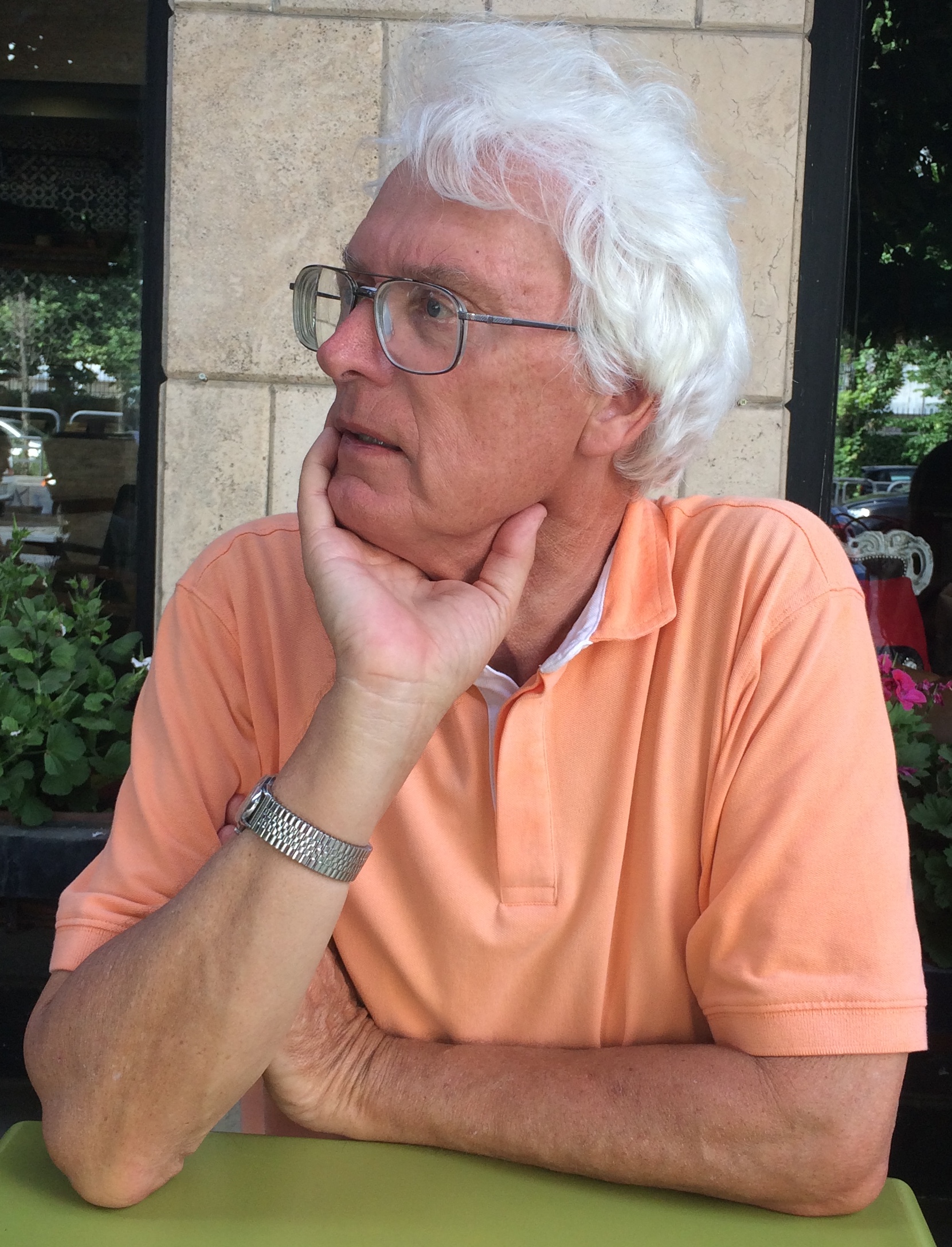
  • Peter A. Scotchmer is a retired high-school and English as a Second Language teacher and former department head of English. Born in London, England, he spent his childhood there and in Venezuela in the 1950s, emigrating with his family (including brother Nigel, above) to Canada in 1963. Educated in private schools and in the Ontario public school system, the possessor of an M.A. in English from Carleton University, he taught for 33 years in four Ottawa high schools, most recently at Canterbury High School for the arts. Since retirement, he has written some 70 short stories, essays and reviews for the on-line magazine Story Quilt, was a judge for five years for the Ottawa Public Library’s ‘Over 50’ Short Story Contest, has taught twice for the Ottawa School of Theology and Spirituality, and is the author of Comfortable Words, a short study of canonical works of literature. He continues to be a champion of wide and critical reading, close examination of text, precision in writing, and informed debate.

    Peter espouses the benefits of reading from his perspective as a writer, a classroom teacher, a father, and grandfather. Ideally, if we are read to as children, and are encouraged to read widely, wisely, and critically on our own in school and beyond, the advantages of a lifelong reading habit reveal themselves unconsciously in our speech, in our writing, and in our relations with others. We read for information, recreation, inspiration, and instruction. When we read, we each expand our vocabulary, exercise our imagination, develop empathy and compassion, share a vast human culture, and better understand the human condition and our place within it. We read, as C.S. Lewis said, “to know that we are not alone.”

    “Reading is self-improvement. It is “the love and resurrection of better minds, “says Rory Stewart, a contemporary academic, diplomat, travel writer and former soldier.

More Irony

The Cuckoo and the Laughingthrushes

The Cuckoo and the Laughingthrushes

At The Hill Station Guest House, the view of the Nanda Devi is divine but nothing ever happens. Spoke too soon! A Himalayan mystery from Nigel inspired by his recent travels... Typical rising mists and fog, monsoon season The cuckoo’s call woke Prabhjit Singh dozing...

The Phantom Tollbooth

The Phantom Tollbooth

Peter writes a review of The Phantom Tollbooth by Norton Juster. Picture Credit: Wikipedia The Phantom Tollbooth is an amusingly clever and highly engaging children’s story written in 1961 by the American architect Norton Juster about a cure for boredom. Like all...

The Boy Who Had No One

The Boy Who Had No One

Aashisha reviews the upcoming biography of David Rhoiney No One’s Coming to Save You, releasing on 8 Dec, 2026. No One’s Coming To Save You by Ed William is the true story of David Rhoiney, a boy who spent his childhood in a homeless shelter and grew up to become a...

Words, Words, Words VII : Comfort Books

Words, Words, Words VII : Comfort Books

Peter writes his seventh essay on his comfort books and a review of The Bookseller’s Tale. Picture Credit: Goodreads Polonius: What do you read, my lord? Hamlet: Words, words, words. Polonius: What is the matter, my lord? Hamlet: Between who? Polonius: I mean, the...

Life in a Pond

Life in a Pond

Read Jim's version of Walden in his meditation on the hidden Oxbow pond. You know the fable and so do I. The homely frog prince-in-waiting, pining away on his lily pad being ignored by all the beautiful princesses, until that fateful day. The moral? Maintain hope,...

Everyone Knows Everyone in Firozsha Baag

Everyone Knows Everyone in Firozsha Baag

Revisiting a Bombay neighbourhood through Rohinton Mistry’s story collection I have a soft spot for books that engage in storytelling for the sake of it. No plot as such. Just a writer at their desk, writing about people they see through their window. The window this...

The Game That Never Happened

AI says that the Leafs game in the 1960s never happened but Jim Sugiyama was there with his dad and remembers every goal. This morning I am thinking about Dad. Yes, it’s three days after official Father’s Day, but truth be told, there isn’t a day that goes by during...

Our Guest is a God – Atithi Devo Bhava

Our Guest is a God – Atithi Devo Bhava

(Taittiriya Upanishad, Shikshavalli I.11.2) Great India #1 Nanda Devi from the Himalayan Writing Retreat I have just returned from nearly a month spread between Delhi and The Himalayan Writing Retreat. The first morning I woke to the screaming chirps of ten green...

Words, Words, Words VI : Watch Your Language

Words, Words, Words VI : Watch Your Language

Peter writes his sixth essay on the 'abusage' of language, an affliction all too rampant today. Polonius: What do you read, my lord? Hamlet: Words, words, words. Polonius: What is the matter, my lord? Hamlet: Between who? Polonius: I mean, the matter that you read, my...

RAMBLINGS #11 – Mañana

RAMBLINGS #11 – Mañana

A rambling on language, leisure, beauty, and the business of accepting what we can't control. Some things we think about, some we ignore. And some are more important than others. Does it matter if we fight against the inevitable? Or should we just accept it? Apse of...