A rambling on language, leisure, beauty, and the business of accepting what we can’t control.
Some things we think about, some we ignore. And some are more important than others. Does it matter if we fight against the inevitable? Or should we just accept it?

Apse of St. Vitale, Ravenna
As I sipped my ale, watching Canada lose to Morocco, I wondered if I would have clean underwear tomorrow. Our bags were missing when we arrived at Heathrow. The airline didn’t know where they were, but my tracker told me they were, somehow, in Ottawa. Not that I could do anything about it. Just like my inability to help the Canadian soccer team. These days, although we may know more facts, sooner than we ever did before, it seems that more and more of our lives are beyond our control. Many fear a giant Orwellian thumb is coming down upon us.
What kind of an Ironist are You?
Perhaps, there is no choice – not just whether our bags will arrive with fresh underwear, or that the Canadians will win, but because the media, the government, and companies are all getting larger and with it, increasingly, reducing choice through enforcing conformity. I mean, some choice remains – I could go commando, or even wear a skirt and pretend to be a Scotsman tomorrow. But those are peripheral delusions, surely…
Some things in life we have to accept. One such inevitability is death. Other things we choose to fight – and we might win or lose. The human condition, in some ways, is about choice and acceptance.
After Canada lost the game, my bags arrived. I helped the driver unload them. He was out of breath, elderly, with an explosion of white hair on both sides of his bald head. He had a lined face. It was late, he was tired, and frustrated. He had had to wait for hours for a parade to pass. As he was self-employed, this affected him more than someone with the luxury of a salary. Clearly no scholar, he expressed his feelings with hands, facial expressions, jokes, and idioms. What he said was expressive, succinct, and funny. It was the humorous acceptance of an individual fighting the world alone and yet totally adrift.
Sometimes people use language to help them cope with life’s frustrations. Ancient Greeks had a language with syntax and semantics that encouraged complex thoughts. The language had options, such as the optative mood, the indefinite article and the middle voice. For example, it permitted the extraordinary effort the Greek-speaking Eastern Church spent in differentiating between homoousios (ὁμοούσιος) and homoiousios (ὁμοιούσιος), obscure concepts about the nature of God most consider to be pedantic and even divisive. Frankly, the two words look and sound funny. And thousands in the 4th Century died over this Arian controversy? Today, most people can’t spot the difference between theological position in these two Churches in Ravenna. Can you?
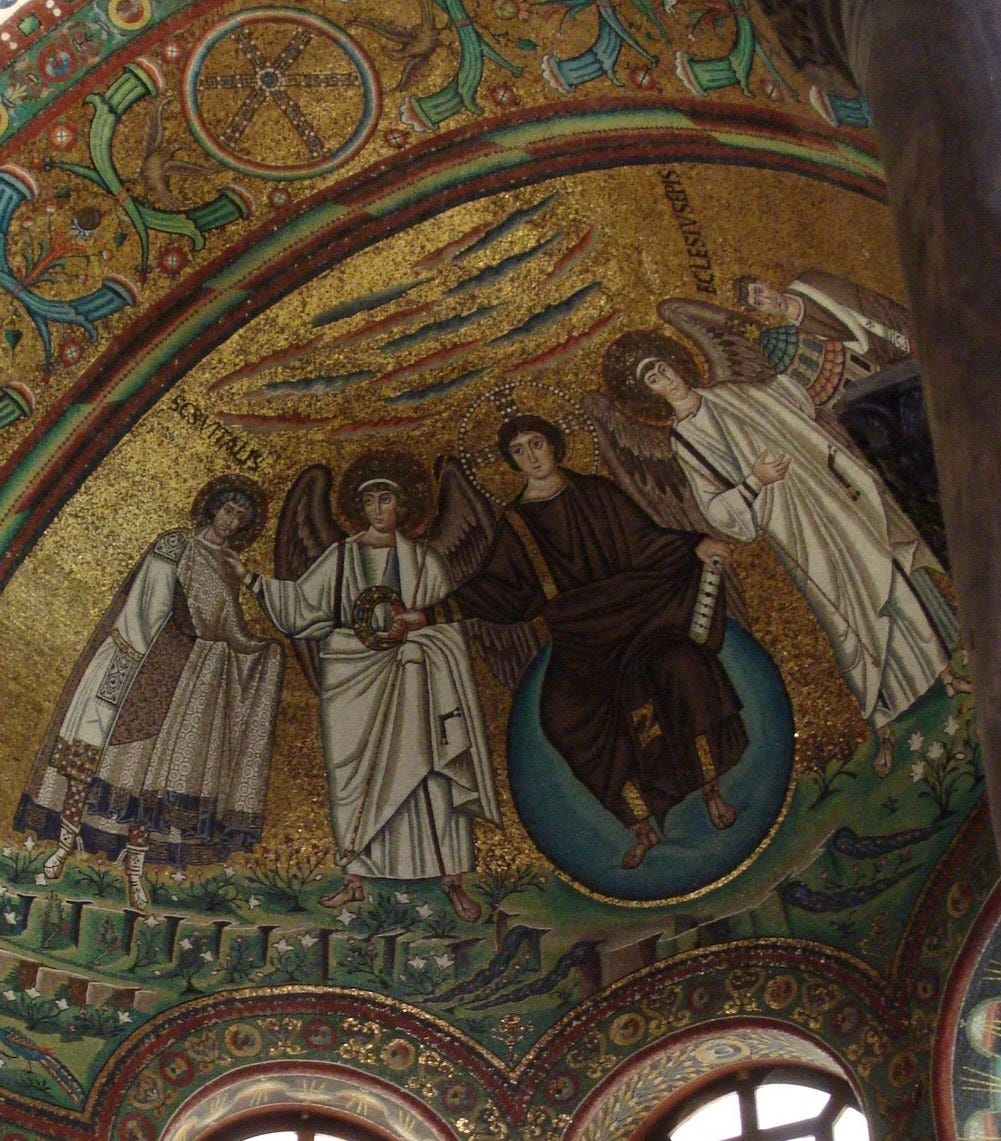
Detail of apse of St. Vitale, with an Orthodox glorified Christ, dressed in purple, surrounded by angels and framed in heavenly gold – homoousios
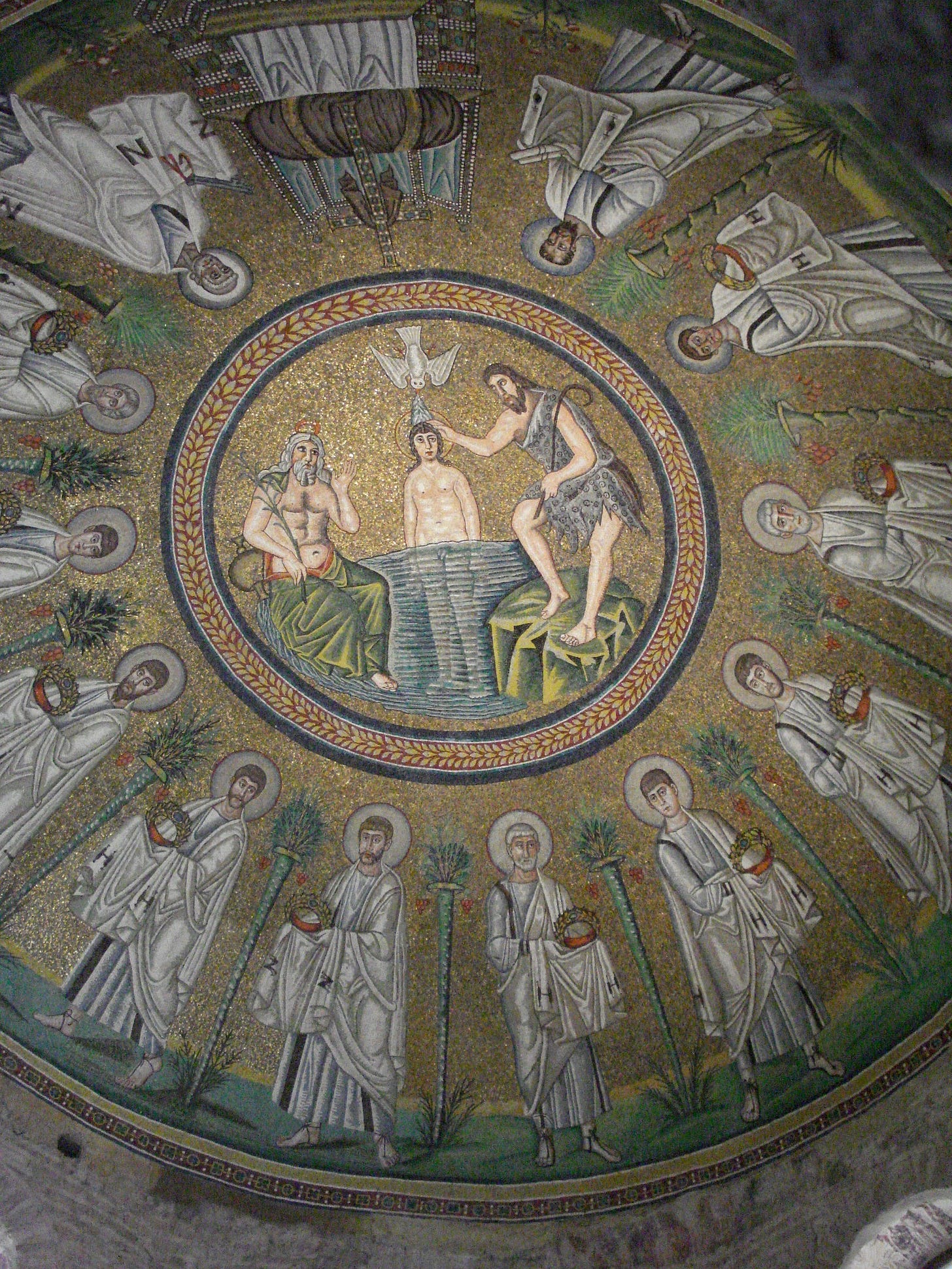
The dome of the Arian Baptistry in Ravenna, where Christ is shown as vulnerable, youthful, and much like a human – homoiousios
Latin, for example, could not easily define such ideas. Certainly, the Greek language helped express philosophical concepts that have enriched Western thought for over two thousand years. This has helped us deal with the inevitability of death. After all, why are we here, and what is, or can be, our purpose? English usage today, for comparison, is often misused as a result of corporations’ and politicians’ desires to obfuscate and this is aided by those not bothered by imprecision.
In addition to language, societies develop a culture around words. It is a way of dealing with the vagaries of life. Mexico is famous for mañana. The cultural mañana (tomorrow) not only means a more relaxed attitude to the clock’s relentless march, but it can also be a polite ‘no’ or ‘later’. In addition, it reflects a counter-argument to a consumer-driven world requiring greater haste and even unending work. Instead, the concept promotes family, relaxation and current happiness to override longer term, and often unnecessary goals.
Of course, generalizations can mislead or oversimplify complex circumstances. But they can be useful – even if they are only humorous stereotypes. We imagine a ‘couch potato’ is not thinking about the inevitability of approaching death, nor will he or she have given much thought to life’s choices. Another take on leisure are the Bengali words adda and lyaadh. My understanding is adda is a socio-cultural tradition of relaxed, earnest, intellectual conversations, while lyaadh incorporates a highly defined sense of doing nothing. This suggests, with a wry smile, perhaps, it is a more intelligent version of a couch potato. It is a way of being lazy, releasing stress, thinking about something alone, and doing it in a more single-minded way. Enjoy the nothingness! It can be a luxury, after all. A relaxed, purposeful time…. Is it a good way to accept one’s mortality without actually thinking about it?
Of course, language and customs are not the only way of dealing with approaching death. Hobbies and objects can be even more effective. Years ago, I was at an ISO welding standards committee in Bologna, Italy. (Yes, imagine the thrill of writing welding standards). I was talking to my brother via emails, describing how great the museum and how ancient the town square was, and he said I should visit Ravenna down the road. I jumped in my little Lancia Ypsilon and zoomed down that vision that haunts many a film, a scene of tall pine trees on either side of a straight road, arching over it, casting mottled shadows of their leaves on a sunny day, the wind in your ears….a memorable drive in itself.
When I got there, I discovered San Vitale. It was an epiphany for me. It is a 6th century masterpiece of art and architecture. I was ‘gob-smacked’. In fact, the whole town overwhelmed me with its beauty. And today we don’t worry whether it is Arian or Orthodox (can you see the difference in the pictures above? Hint: Look how Christ is portrayed.) But these differences aren’t my point. The significance is the beauty of mosaics themselves. We are lucky when we come across such scenes or events in our lives. Such events show how good it is to be alive.
Perhaps seeking such events or achievements – or preserving such memories – is the very secret to life. The monumental fact that we all must die is better grasped when we have undergone some great event in our lives. Why else do we exist, if not to invent, refresh, or preserve something great? In other words, I shouldn’t have been worried so much about clean underwear tomorrow, but the clarity of this dispatch. Yes, you should, I guess, get up and build that bridge, but at least you were temporarily diverted from duty…
Which reminds me, my late mum used to quote from W. H. Davies’ poem Leisure:
What is this life if, full of care,
We have no time to stand and stare?—
–
Contributed by
Nigel Scotchmer