In her third post, Dr. Hara tells us how Seraphim came to outrank Cherubim, and Archangels ended up near the bottom.
In the previous essay, we traced the angel’s transformation from local guardian spirit to cosmic warrior under the influence of Zoroastrian dualism. Yet the question remained: how was this celestial army to be organized? Who outranked whom? What distinguished a Seraph from a Cherub, an Archangel from a mere Angel? The answer came from an unlikely convergence of Jewish apocalyptic literature, ecstatic prophecy, and a mysterious sixth-century Syrian theologian.
The Book of Enoch, written between roughly 200 and 100 BC, survives only in an Ethiopic translation from a lost Greek original, recovered at the end of the eighteenth century and translated by the scholar R.H. Charles in 1912. Enoch introduced the fallen angels – those celestial beings who ‘lusted after the daughters of men’ and brought about the Fall of mankind, establishing the participation of the Prophet Enoch in the glory of the Divine. But more significantly for our purposes, Enoch named and ranked the seven Archangels, assigning each a precise domain: “Uriel is over the world and over the Tartars. Raphael is over the spirit of men. Raquel takes vengeance on the world of the luminaries. Michael, one of the holy angels, to wit, he that is set over the best part of mankind and over chaos. Saraqael is set over the spirits, who sin in the spirit. Gabriel is over Paradise and the serpents and the Cherubim. Remiel, whom God set over those who rise.”
This was a celestial bureaucracy with clear lines of authority. The fallen angels were chained to the Tartarus without mercy, despite Enoch’s plea to the mighty God. And Enoch’s apocalyptic vision of the divine throne drew on the same ecstatic phraseology as Ezekiel and Isaiah: “And I looked and saw a lofty throne: its appearance was a crystal and the wheels thereof as the shining sun, and there was the vision of cherubim. And from underneath the throne came streams of flaming fire so I could not look thereon. And the Great Glory sat thereon, and His raiment shone more brightly than the sun and was whiter than any snow. None of the angels could enter and could behold. Ten thousand times ten thousand stood before Him, yet He needed no counsellor.”
Compare closely the seven Assyro-Babylonian Amesh-Spentas we encountered in the previous essay with Enoch’s seven Archangels, and their functions converge: the Creator in both cases is the pure Spirit of Light, so radiant that even Enoch, the Elect of God, cannot look upon Him. Likewise, St. John in the Book of Revelations refers to the “seven stars” which the Son of God holds in his right hand – a common apocalyptic preoccupation with astrological images that again echoes the planetary symbolism of the older Persian tradition.


What kind of an Ironist are You?
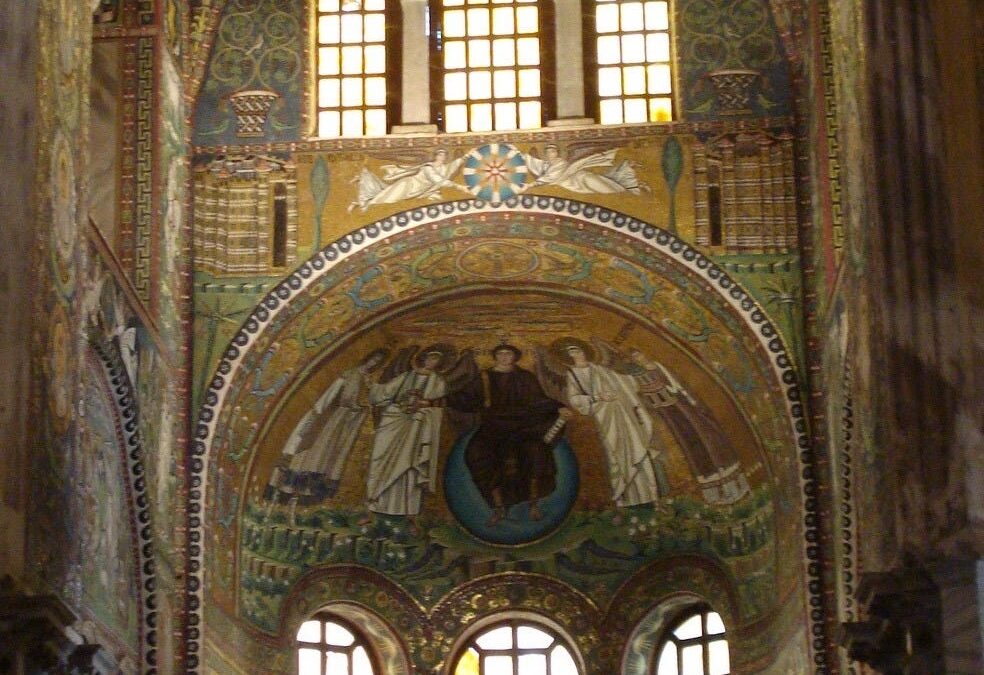
When the Book of Revelations was incorporated into the canonical texts, the domain of Lucifer and its hierarchy was fast established in Western iconography around the ninth century. The mosaic from the Cathedral of Torchello, dating from the twelfth century, shows demons painted dark blue or black mercilessly carrying the damned to the eternal fire of Hell. By the thirteenth century, the extraordinary mosaic attributed to Coppo di Marcovaldo in the San Giovanni Baptistery in Florence – Lucifer Devouring the Damned – had given the Western imagination its most terrifying vision of the infernal.

It fell to a figure known as Pseudo-Dionysius the Areopagite to impose final order on this host. Drawing on the ecstatic visions of Ezekiel, Isaiah, Enoch, and other apocalyptists, Pseudo-Dionysius systematized the Amesh-Spentas and Enoch’s Archangels into the nine orders of the Celestial Hierarchies – a scheme of a fixed universe initiated by the One as the source of Light, with subordinate Angels forming what we might call the Bureaucracy of the Divine. His definition is precise: “Hierarchy is, in my opinion, a holy order and knowledge and activity which, so far as is attainable, participates in the Divine Likeness, and is lifted up to illuminations given it from God, and correspondingly towards the imitation of God.”

Furthermore, as Umberto Eco observed, Pseudo-Dionysius contributed the idea of the Sublime Beauty of the Cosmos as the “diffusion of wisdom” – symmetry of numbers, order and proportions becoming ontological principles, as well as moral and aesthetic ones. “Theology has given to the Celestial Beings nine interpretive names,” writes Pseudo-Dionysius, “and among these our divine initiator distinguishes three threefold Orders.” Nearest to God stand “the most holy Thrones and many-eyed and many-winged ones, named in the Hebrew tongue Cherubim and Seraphim.” The second triad contains the Powers, Virtues, and Dominions. The last and lowest choirs of the Celestial Intelligences are the Angels, Archangels, and Principalities.

Each order received distinctive visual form. Isaiah’s vision of the Seraphim – “burning ones” – gave Christian art its most extraordinary celestial being: “I saw the Lord sitting upon a throne, high and lifted up; and His train filled the sanctuary. Above him stood the Seraphim; each had six wings; with two he covered his face, and with two he covered his feet, and with two he flew.” In Christian iconography, the Seraphim inflame mortals toward Divine love; they are painted in red, their three pairs of wings are red, their swords red as flame.
The Cherubim – from karabu or Kuribu, meaning “propitious, blessed” in Akkadian – are possessors of wisdom. In Ezekiel’s dream, they serve as the chariot of Yahweh: “and he rode upon a cherub and did fly: and he was seen upon the wings of the wind.” In Christian iconography, they carry a single pair of blue wings and are richly garbed as Orthodox bishops. Both Cherubim and Seraphim appear together in the magnificent mosaic of the Cathedral of Cefalu in Sicily, dating from 1148. A rare finding of seven four-winged female terracotta idols, buried at the foundation of the palace of the Assyrian King Adad-nirari III (810–783 BC), may represent early Cherubim figures; their function was apotropaic, and they were called apkallu – the seven sages.


Ezekiel also described the Thrones as wheels of fire – “their appearance and their work was as it were a wheel in the middle of a wheel” – moving through a firmament the color of a “terrible crystal,” around a throne like sapphire on which God sits, suffused in the radiance of the rainbow. Some scholars have suggested that the four-faced god Marduk may have inspired this vision. Their resemblance to the winged sun, the symbol of Ahura-Mazda, is mostly evident.


The lower orders receive plainer dress. Dominions, Virtues, and Powers wear long albs, golden girdles, and green stoles, carrying golden staves in their right hands and the seal of God in their left. The lowest orders – Principalities, Archangels, and Angels – dress in soldier’s garb with golden belts and carry lance-headed javelins and hatchets.


The Archangel Michael will adorn the walls of Greek Orthodox monasteries for centuries to come. A monumental example is the seventeenth-century fresco from the monastery of Xeropotamou on Mount Athos, where Michael chains Satan in a scene of triumphant violence — the celestial bureaucrat become warrior, the hierarchy made flesh and fire.
In the next and final piece, we will turn to how individual angelic figures – Gabriel, Michael, Raphael – were depicted across the Byzantine centuries, and how artists navigated the paradox of rendering beings whose very nature transcends visual form.
–
Contributed by
Dr. Hara Papatheodorou