The Ironist

Differing Perspectives

Polite Revolutions: A Gentleman in Moscow and the Comforts of Confinement

First a bestseller and now a prestige television series, A Gentleman in Moscow invites us to believe that grace and civility might yet survive the twentieth century’s great undoing.
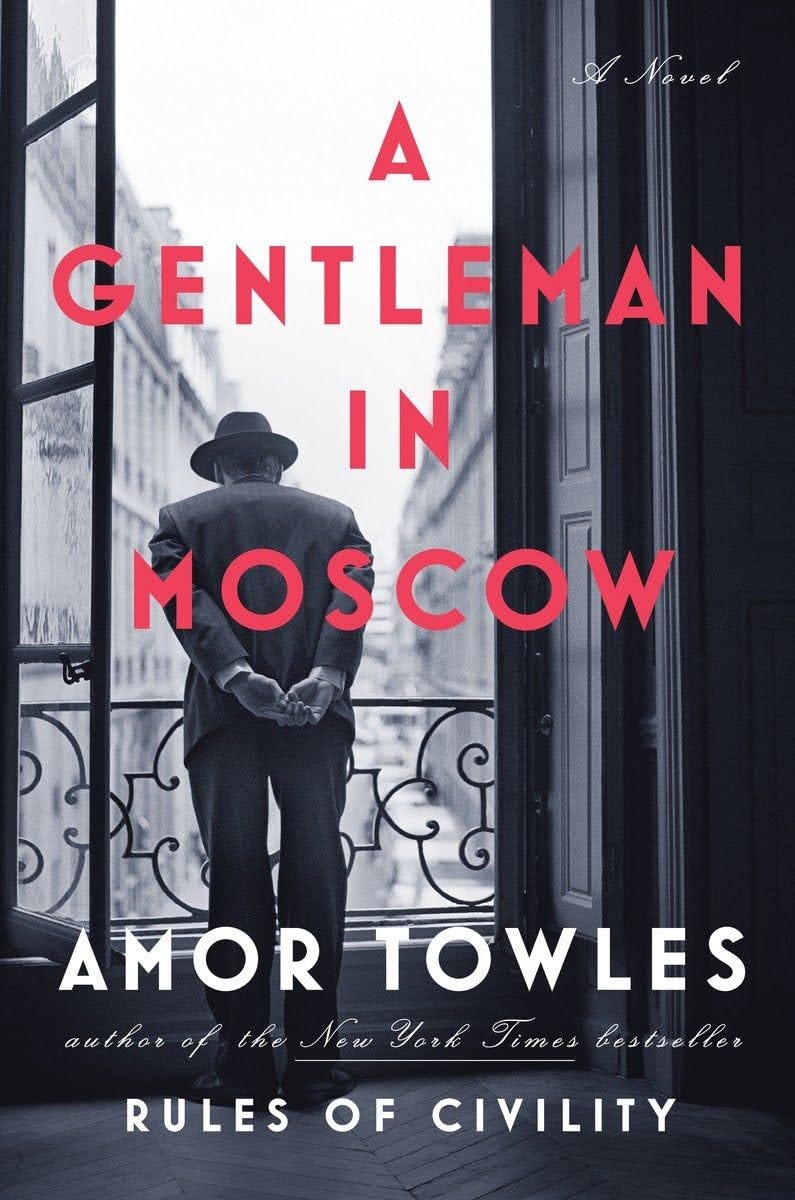
Picture Credits: Amazon


Some months ago, I read A Gentleman in Moscow during a transatlantic flight. My subsequent overseas adventure all but erased the book from my mind at the time. More recently, finding myself in an extended convalescence, I binged on the 2024 TV adaptation. Initially intending to while away virtual imprisonment in a hospital ward with mindless entertainment, I was caught up in the pleasantly charming plot.

In the opening scenes of both the book and series, a displaced Russian count stands before a Bolshevik tribunal, charged with the crime of existing too elegantly. “It is not the business of gentlemen to have occupations,” he explains, and thereby earns himself a sentence as a social parasite. The court, in a moment of revolutionary leniency, spares him the usual bullet-in-basement fate and confines him instead to Moscow’s Hotel Metropol — a palatial cage where he is to live under house arrest for the remainder of his days.

Amor Towles’s 2016 novel takes this premise and turns it into a study in civility under siege. The real Moscow Metropol, built in 1905 in opulent Art Nouveau style, stood through the convulsions of the twentieth century as both a monument to a vanished order and a convenient way of containing foreign diplomats and journalists. Towles transforms it into a terrarium of lost civilisation — a place where the manners of the ancient regime survive the Terror and where one toasts the end of history with a glass of Chateauneuf-du-Pape.

What kind of an Ironist are You?

Take the quiz and find out.

Subscribe now

The novel is graceful, witty, and safe — this is a chamber piece rather than a symphony. It is not really a Russian story but a Western morality play — resilience, adaptation, the meaning of community — papered over with a thin veneer of Russian culture and history. The Bolshevik Revolution and the reign of Joseph Stalin are merely the background décor. The themes are often predictable, and our protagonist is blessed with plot armour thick enough to withstand a blast from a T-34 tank. Still, the book moves with charm and confidence; the prose, like the Count’s manners, never falters.

What distinguishes A Gentleman in Moscow from the usual parade of historical redemption tales is its refusal to humiliate its aristocratic hero for his old-world values. In lesser fiction, the fallen nobleman is chastened, stripped of privilege, and reborn as a cliché of proletarian virtue. Count Rostov, by contrast, remains entirely himself. His dignity, formality, and sense of lineage become his means of survival — not in defiance of change, but as a mode of grace within it. He does not evolve so much as endure, and endurance, here, is the point. As his waiter notes in the first episode, this is a character who “refuses to be beaten”.

Towles understands that civility can be a weapon. In a century that made effusive humility fashionable, Rostov’s old-world pride feels almost radical. He is a man who holds to the rigours of wine pairings and proper table etiquette while the world outside is reduced to bread queues and slogans. Rather than being stripped away, his civility becomes an act of quiet defiance against the utilitarian vulgarity of the age. His humanity is not in spite of his privilege, but because of it.

The television adaptation preserves this spirit, if not always its subtlety. Visually, it is sumptuous: a sepia-lit Art Nouveau ballet of mahogany and polished brass, with Ewan McGregor delivering just enough melancholy charm to make one forgive the occasional historical blunder and the script’s tendency toward aphorism. The supporting cast performs ably, though the production’s gestures toward inclusivity feel more than a little anachronistic — one suspects the Bolsheviks would have been less enthusiastic about equity hiring than Paramount+.

Picture Credits: Goodreads


But this is easily overlooked. Both works succeed on their own terms: as meditations on grace, memory, and the refusal to let barbarism set the tone. The Count’s world shrinks to the confines of the hotel, but within these, he maintains a whole civilisation. In an age allergic to hierarchy and privilege, it reminds us that the nobility of spirit can wear a dinner jacket and know which fork to use.

A Gentleman in Moscow lacks the profundity of the great works of Russian literature it often references, but it offers something equally rare these days: a vision of refinement unembarrassed by itself. In a time when every institution is crumbling and taste is treated with a degree of guilt, the Count reminds us that one may still dine correctly, speak with dignity, and refuse to lose one’s humanity even at the end of the world.
Contributed by
Jonathan Bennett

Author

  • Mr. Jonathan Bennett is a historian by education, a chef by profession, and an ironist by necessity. Once on a trajectory toward a lucrative career in law, he took a sharp turn into the far less profitable (but arguably more flavorful) world of fine dining. After tiring of crafting exquisite dishes for a pittance, he found himself cooking for a less discerning clientele beyond the Arctic Circle - as with most of his life, an existential joke not lost on him.

    His passions lie in history, particularly the Middle Ages, Byzantium, and the Renaissance. As well, he is drawn to religion, art, literature, and certain esoteric interests best discussed over a strong drink (or two). A seasoned traveler, he is equally at home everywhere from fine Viennese cafés to alchemist’s dens beneath the streets of Prague, crumbling ruins high in the Caucasus mountains, and the labyrinthine alleys of Old Damascus.

    Despite being voted in high school as both ‘most likely to become a third-world dictator’ AND ‘most likely to become a monk’, neither fate has yet come to pass. He resides part of the time in Montreal, where he continues to indulge in debates – usually defending causes long since lost.

More Irony

Guardians Before God: The Sumerian Origins of Angels

Guardians Before God: The Sumerian Origins of Angels

Dr Hara's research on the winged messengers of Western faith starts with these wingless creatures guarding Sumerian doorways. This is the story of angels and how they learned to fly... When we think of angels, we conjure images refined by centuries of Christian art:...

RAMBLINGS #10 – Goodbye Mt. Parnassos, Hello War

RAMBLINGS #10 – Goodbye Mt. Parnassos, Hello War

A drive down from myth-haunted Mt. Parnassus into the passes, graveyards, and battlefields Picture Credits: Edward Dodwell, Public domain, via Wikimedia Commons   It is said that Zeus, the great philanderer, lay with Mnemosyne (Memory), a Titan, for a marathon...

Inspiration

Inspiration

This is the second essay by Peter on the intricacies of the English language. Here, he writes on where inspiration comes from, and why no amount of effort can quite summon it. My first piece in the English language series talked about the quality of writing that...

The Last Puritan

The Last Puritan

Alexander Montgomery writes a fleeting, intimate glimpse of Glenn Gould, the genius and the strange solitude of his greatness. Glenn Gould’s sitting in Fran’s Deli, St. Clair East, and I sit here, watching him from the pub across the street. There he is, the bastard,...

The Awkward One: Rediscovering Mary Bennett

The Awkward One: Rediscovering Mary Bennett

About the most forgettable Bennet sister and a retelling of Pride and Prejudice... “There are few people whom I really love, and still fewer of whom I think well. The more I see of the world, the more am I dissatisfied with it; and every day confirms my belief of the...

The Little Tanagra: Part 2

The Little Tanagra: Part 2

Previously in Part 1, Hara writes about young Arsinoe growing into a woman of remarkable talents at the sanctuary of Artemis at Brauron. But longing for freedom, she begins to plan her escape.     Arsinoe took longer each day to return from her...

The Little Tanagra: Part 1

The Little Tanagra: Part 1

We are delighted to introduce a new serialized work of literary fiction from Dr. Hara Papatheodorou: a fairy tale that reimagines the origins of the celebrated Tanagra figurines in ancient Greece.   In the small village of Tanagra, in Boeotia, there lived a poor...

Words, Words, Words

Words, Words, Words

Starting in April 2026, The Ironist is starting a running monthly series of articles on the English language written by our very own contributor Peter Scotchmer, a retired English teacher. Polonius: ‘What is the matter you read, my lord?’ Hamlet: ‘Words, words,...

Skinny Legs and All: The Seriousness of the Absurd

Skinny Legs and All: The Seriousness of the Absurd

Talking objects, messy love, art, philosophy, and global conflict. All in one book. “In the haunted house of life, art is the only stair that doesn’t creak.” Over time I have come to believe that the higher the element of fantasy in a book, the more serious it often...

Utopian Delusions

Utopian Delusions

Peter Scotchmer writes about the enduring lure of utopia and why humanity’s attempts to build perfect societies so often end in dystopia.   I will not walk with your progressive apes, Erect and sapient. Before them gapes The dark abyss to which their progress...