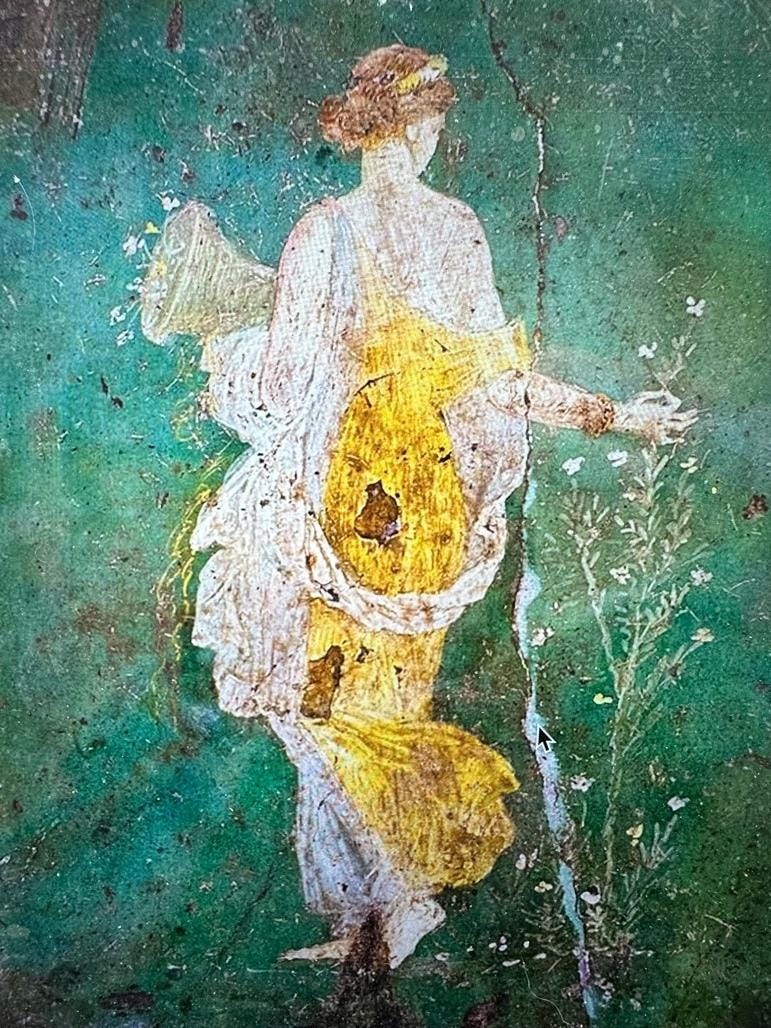
A fresco in the triclinium, Villa Ariana, Stabia
Come, let me tell you about Sappho’s writing. Her work is daring, mixing the expected with the unexpected. Confessional and shocking at times. It combines unashamed passion with universal themes of marriage, kin, hope and loss with sharp images from the natural world. She takes the personal and makes it universal.
We have only a small fraction of her work. A few lines, or a few words, sometimes only quoted by someone else. We are teased by the fact that so much is lost, that there are so many lacunae and gaps that we do not know what we are missing. But we want more. What we do have is vivid and immediate. She uses simple adjectives, employing hyperbole like a child. Writing in the first person, she reveals her heart.
What kind of an Ironist are You?
Her poetry was performed. But we have lost her music, her singing and her dance. We assume she used the lyre, reed pipes, and castanets. She writes of “silvery divine echoes, high and sweet.” Of “laughter in the sky.” Of singing soft voices and throngs of girls, with “slender ankles” and “delicate hands.” She wrote in Aeolic Greek, which even in its day was considered difficult. It has its own pronunciation and verse forms. Like other lyric poetry, her metre and rhyme are complex and daunting to capture in English.
But her poems intoxicate. They are filled with adventure and life. She says “passion is the light of life.” Human weaknesses – like jealousy – lurk in them. Eroticism pulses through them. She can mix plain, simple, everyday fun with wild, uncontrolled fire. Her limbs “tremble with desire”. She wants to “loosen her limbs” and to “open her knees.” It is very personal.
We expect – and hope for – the private joys shared by a couple on their wedding day. Of course, as observers to weddings, we wish the happiness to continue in their married life. Sappho expresses this intimacy between a husband and wife as the most natural human pastime of all. To her, there cannot be too much activity on the “soft cushions” of the marriage bed. To her, being open about sharing and enjoying each other is essential. This celebration can be between a man and a woman, or, indeed, between women. Her openness about sharing love can be unexpected. Sappho is honest – and direct, very direct – about her own desires, wants and needs. “Good times in bed.” “Trembling seizes me, desire flutters around me.” Sometimes you can feel her hot breath behind you. She can “rend her clothes” with desire. Perhaps we glimpse our own past – or were they our dreams? And we want more. Reading Sappho is an individual experience; no two readers will feel exactly the same. But it feels immediate, real.
Many fragments of hers are celebratory wedding songs, or epithalamia, and follow clear patterns. These are happy, joyous poems, filled with hope for the married couple. They are public expressions, praising the institution of marriage, with invocations to the gods to aid them in life, filled with references to the cultural icons of her time. There are refrains of ritual cries to Hymenaeus the marriage god, everyday images of village life, flowers, garlands, song, and food. “Unwed men yoked the horses” is a haunting line.
These celebratory songs are a continuum that existed for centuries. This is her culture. In her world, there are mythic gods that can aid love. Gods are immortal, like the mountains and the “fragrant brine sea”, and are in contrast to the uncertainty facing mortal humans and short-lived flowers and animals. Images like the “wind crashing on mountain oaks” highlight these themes. Other images such as the “rattle of millet seeds”, the smells of cinnamon, frankincense, freshly-cut green grass and singing birds add an immediacy. And sometimes, profound ambiguity.
One line can have a beautiful metaphor drawn from nature, and the next line can seem ironic. The more you read her, the more you see she is not merely autobiographical, she is a highly skilled, deliberate artist writing of universal, cosmic forces. Sappho takes the individual act and makes it universal, it is human – she is not acting from self-indulgence, weakness or creating a sense of victimhood. She is in control.
She seems just like you or me. Perhaps a stronger you or me – and that’s why we like her. We can look up to her. Her poems have the worries, hopes and memories we all have. There is a poignancy when she says, “I loved him once, long ago.” She is not larger than life – insecurity, uncertainty, jealousy, and desire make her more human. But she “dares all!” And we admire that fortitude.
And at the same time, we meet the expected and the unexpected. When we are rejoicing for the happy couple, she alludes to the marriage of Hector and Andromache. Now Hector is the hero of the Iliad, and Andromache the ideal wife, but…Hector is killed by Achilles, Andromache is enslaved and her son thrown from the walls of Troy. Perhaps the Fall of Troy is not the first choice for a happy wedding song. So what does she mean here? Ambiguity arises again when she asks if she misses maidenhood. But not for long – soon her knees buckle, and she seeks less sleep in “night-long celebrations.” You feel for her in her “short dress”, as she bemoans, saying “I sleep alone, the Pleaides have set, the night half gone.” How we have bemoaned the passing of time.
Love is universal. And she understands it. Perhaps the greatest metaphor for unrequited love – or love beyond our reach – is her description of the perfect apple on a high branch, beyond the apple pickers’ reach. That image haunts. In fact, she more than understands love.
She captures it. Love never ends. That perfect apple on the branch beyond our reach will be perfect forever. We all seek love. To break free of troubles and to surface, basking in sunlight. To breathe freely. And there will always be troubles with love. You give – to receive. Damned to love. Yet wanting to be free. To be wild. To escape. To receive love back. But Love has pain. Rejection. Misunderstandings. Distance. We need help…. Pain descends upon us. Cruel lovers? Sappho speaks of “the dripping of my pain”, and “my anguish take those who complain.” Rejected? She speaks of how “her wings fall slack.” She can’t soar. What a fantastic image!
Sappho writes of love, the gods, of the guileless innocence of youth, and of old age’s wisdom steeped with memories. When you read her poems, they will stand out, just as how she describes the moon at sunset, reflecting the dying rays of the sun, and outshining all the stars around her.
–
Contributed by
Nigel Scotchmer