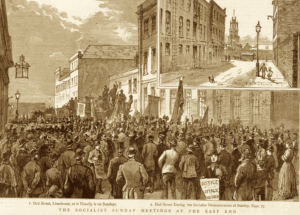
 William Morris, Eleanor Marx, George Bernard Shaw et al. gave speeches nearby
I am sitting on a wooden bench by the Limehouse Cut, the oldest canal in London, built in 1770. It is a Sunday morning, and there are only a few passers-by on Commercial Road that crosses the canal beside me. Watching these passers-by, who are wrapped in their own world of interests, I was reminded of the casual “passers-by” at Thermopylae, who are see the famous epitaph of Simonides in praise of the Spartans who died there defending their homeland from the Persian army in 480 BC:
Go back and tell the Spartans, passer-by, / That here, fulfilling their commands, we lie.
The Spartans did not give up the fight, even though their lonely stand bought only a few DAYS’ delay for the Greeks. Perhaps more importantly, the Delphic oracle had predicted the death and defeat of King of the Spartans, Leonidas, even before they bravely marched to their deaths. Yet they still marched north to meet the Persians. Today, when we see how life seems harder, more disordered, such acts of courage can provide us with optimism – or at least a purpose for continuing to struggle. Arthur Hugh Clough wrote:
Say not the struggle nought availeth,
The labour and the wounds are vain,
The enemy faints not, nor faileth,
And as things have been they remain.
If hopes were dupes, fears may be liars;
It may be, in yon smoke concealed,
Your comrades chase e’en now the fliers,
And, but for you, possess the field.
For while the tired waves, vainly breaking
Seem here no painful inch to gain,
Far back through creeks and inlets making,
Comes silent, flooding in, the main.
And not by eastern windows only,
When daylight comes, comes in the light,
In front the sun climbs slow, how slowly,
But westward, look, the land is bright.
Perhaps such inspiration could lessen a potential suicide’s despair? Or at least provide a kick in the pants to the rest of us to get back to work after staring off into space, as I have done here in Limehouse.
Two large common garden snails are on the bench beside me, and they haven’t stopped their travails, either. I think they are helix aspersa – and with the sun coming out now, they are looking for place to retire to. It is quite amazing to watch as they move from one slat of the bench to the next, their little eyes wiggling on stalks as their little bodies prove to be much longer than you might otherwise think as they stretch to the next slat! And those eyes on stalks are really cute!
At the next table, a young lady is talking to an older lady who is preparing a letter for her in Spanish. I ASSUME the young lady fell in love with a young Spanish man in Ibiza after a recent trip there and wishes to continue their friendship with a letter to him. It is hard, I am sure, for the translator to catch the nuances of the young lady’s desires. Imagining a torrid passion FOR THEM, I think it would be great if it were to continue …
Behind them is a high wall of typical London brick. Before the sun came out, the bricks were preponderantly Luton grey and brown, with a few Tudor reds and coal spots. The surface texture is uneven; the bricks must have been handmade and handcut. Just now the sun burst forth from between the clouds, and the whole wall was transformed as the greys and browns faded to a much brighter redder hue with a touch of orange. It was lovely; the transformation completely unexpected. The wall is part of the bridge of Commercial Road over the canal, and is, technically, interesting. The Victorian Age is remarkable for many advances, and this bridge is one of them, as it permitted the use of standard-sized bricks – greatly reducing construction costs. I understand standard masonry bridges are built at right angles; if the item being spanned is at a different angle than 90 degrees, then bricks must be carefully cut to ensure loads are spread correctly over the arch or arches. In this case, the clever Victorians employed the helicoidal skew arch (see below), and it is fun to think that this otherwise boring bridge today was at one time considered a marvel.
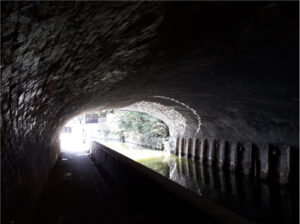 The skew-arch bridge where Commercial Road crosses the Limehouse Cut
And this marvel is in an area of London that in Victorian times was considered downright awful. There was immense poverty, outbreaks of cholera and smallpox were horrific, and considerable crime abounded. At the top of this article is a picture, and the site of this picture only a minute’s walk from where I am. It is the site where would-be revolutionaries and socialists gave rousing speeches on Sunday mornings to the downtrodden. William Morris, poet, author, artist, classicist, socialist, anti-imperialist, businessman, inventor, (https://en.wikipedia.org/wiki/Arts_and_Crafts_movement), Eleanor Marx, daughter of Karl Marx (https://en.wikipedia.org/wiki/Eleanor_Marx), and George Bernard Shaw, polemicist, (https://en.wikipedia.org/wiki/George_Bernard_Shaw), and others, spoke here. These political activists were also successful users of media attention to allay the discriminatory practices of the Establishment which, just like today, used the police to intimidate and reduce free speech. They would ensure innocent bystanders were arrested by the police, at least one a day, and so clog the courts, to eventually create enough fuss with the public to bring attention to the Establishment’s illegal acts…Alphonse Karr’s 1862 aphorism, plus ça change, plus c’est la même chose, (“the more things change, the more they stay the same”), couldn’t be more relevant when we think of social issues being manipulated by marketing today. It is ironic how upset we are by activists depends upon our opinion of the views of those activists…
One last interesting note before I get on with the day (my coffee is getting cold, too): besides being a poor area of London, rife with disease, crime, and social disadvantage, this area was also a world-class manufacturing centre. Entrepreneurs led the world with its production of standardized lifeboats, torpedo boats, various types of complex stationary steam engines, floating fire engines and even sea-borne desalination plants….and now all of that innovation is gone today, in a mere 100 years! More, if you are interested, at https://en.wikipedia.org/wiki/Limehouse_Cut
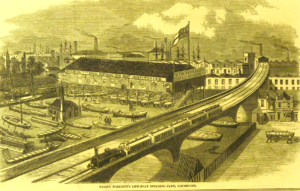 Forrest’s shipyards, builders of the first self-righting lifeboats, at Limehouse.
There are few like Spartans sacrificing their lives for others these days, or entrepreneurs seeking new ways of building bridges economically, or indeed better lifeboats, but we do have many “victims” seeking government handouts for their suffering, perceived or real. We certainly don’t read much today about fighting for the “Greater Good of All” amidst the surfeit of bragging individuals’ 15 second Reels and TikTok videos. Rather we should be inspired by King Leonidas’ heroic response to Xerxes’ entreaties for him to lay down his weapons….to which he replied, “Come and get them!” (μολὼν λαβέ, molṑn labé). What FABULOUS defiance!
Yet, all is not lost. Jennifer Worth wrote impressive books of this area, (https://en.wikipedia.org/wiki/Jennifer_Worth) and the pendulum swings back. This area, now denuded of its docks and ‘manufactories’, is now home to young, up-and-coming international financiers, lawyers, and hi-tech entrepreneurs, all eager to rush from their glittering condos here, and near here in Canary Wharf, to the City to continue their upward mobility in the heart of London’s financial district which is only a few Tube stops away by the Docklands Light Railway and Underground. There is much to hope for in renewal, and rebirth!