About The Ironist

ISSN 2817-7363

A Tonic for the Age

The Ironist is an open forum to encourage discussion and reflection upon the written word and the world around us to promote critical analysis.  Irony, “the recognition of incongruities” (Cleanth Brooks), is a tool that permits differing perspectives to be considered about a passage or event.  Irony is notoriously hard to define, and its importance in a passage can vary upon the reader’s own views.  Hence the purpose of our blog/newsletter.  By encouraging constructive criticism and discussion, we hope complex issues can be better understood, or appreciated, by exploring ideas presented by the use, intended or otherwise, of irony.

In our age of misinformation and the polarization of views, the importance of standing back to employ the sober second thought cannot be more important.  At the same time, the ironic viewpoint is rewarding and enjoyable.  Although, to be fair, when Jesus reflected upon the cross about his dying for the thankless millions of the human race, enjoyment of his ironic offering might not be categorized as enjoyment.
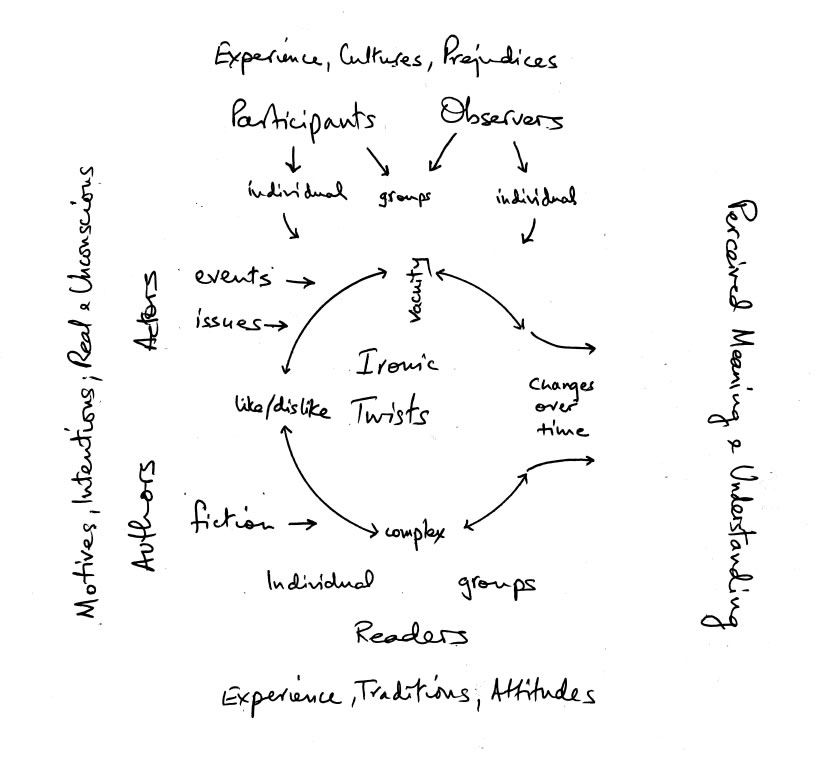
The Politician, the Painting, the Cosmic Event; all can be Ironic.

This drawing attempts to show diagrammatically how irony can be created, intentionally or unintentionally, and considered by observers and participants, and that the message delivered can be perceived and understood differently.

Irony’s effectiveness lies in the twists in meaning of what has been viewed, said, or written and what has not been viewed, said, and written.  Irony creates uncertainty and contrary meanings.  Created by such vehicles as humour, horror, doubt, omission, exaggeration, paradoxes and aporia, irony can be an effective iconoclastic tool against the cruelty, corruption and hypocrisy of the world; a moral and effective weapon to destroy disillusion and despair by inspiring good deeds.  Irony is satisfying to those who use it – and those who recognize it.  In fact, ironically, it can be more than that – it can be a civilized game of intelligence and fun!

“I come to bury Caesar, not to praise him….

For Brutus is an honourable man;”

Said Mark Anthony in Shakespeare’s Julius Caesar.  Of course, he was praising Caesar and damning Brutus.

Copyright. The TheIronist.org 2023 all rights reserved.

Author

  • Nigel Scotchmer

    Nigel’s peripatetic path in life gives him, he believes, a unique perspective on the world around him. He has worked at many occupations over the years from driving a truck, writing welding standards, to being an international salesman,\ accountant and business owner. Brought up in a family that believed that Antigone in the Greek myth was correct to stand up and die for her belief that fairness and truth were more important than the ranting raves of the unthinking mob – his father accepted the consequences of refusing to fire a homosexual in the 1950s – Nigel believes irony is the greatest tool for both encouraging equity and our enjoyment of life. Since irony involves the interplay between emotions, reality and chance, its appreciation can provide meaning to the often inexplicable world in which we live. He said, when interviewed for this summary: “No, we can’t all be heroes, and too often we make the wrong choice, for the wrong reasons – but at least irony can bring peace to us by helping reconcile the warring elements.”

    Nigel loves literature – especially books and poems that deal with universal themes such as love, war, and justice – and is now happily retired from the world of business. Ironically, (like countless retirees before him!), he says he has the ambition to be a great writer and is currently writing fiction full-time….

    Visit him at https://nigelscotchmer.com/

More Irony

The Last Puritan

The Last Puritan

Alexander Montgomery writes a fleeting, intimate glimpse of Glenn Gould, the genius and the strange solitude of his greatness. Glenn Gould’s sitting in Fran’s Deli, St. Clair East, and I sit here, watching him from the pub across the street. There he is, the bastard,...

The Awkward One: Rediscovering Mary Bennett

The Awkward One: Rediscovering Mary Bennett

About the most forgettable Bennet sister and a retelling of Pride and Prejudice... “There are few people whom I really love, and still fewer of whom I think well. The more I see of the world, the more am I dissatisfied with it; and every day confirms my belief of the...

The Little Tanagra: Part 2

The Little Tanagra: Part 2

Previously in Part 1, Hara writes about young Arsinoe growing into a woman of remarkable talents at the sanctuary of Artemis at Brauron. But longing for freedom, she begins to plan her escape.     Arsinoe took longer each day to return from her...

The Little Tanagra: Part 1

The Little Tanagra: Part 1

We are delighted to introduce a new serialized work of literary fiction from Dr. Hara Papatheodorou: a fairy tale that reimagines the origins of the celebrated Tanagra figurines in ancient Greece.   In the small village of Tanagra, in Boeotia, there lived a poor...

Starting in April 2026, The Ironist is starting a running monthly series of articles on the English language written by our very own contributor Peter Scotchmer, a retired English teacher. Polonius: ‘What is the matter you read, my lord?’ Hamlet: ‘Words, words,...

Skinny Legs and All: The Seriousness of the Absurd

Skinny Legs and All: The Seriousness of the Absurd

Talking objects, messy love, art, philosophy, and global conflict. All in one book. “In the haunted house of life, art is the only stair that doesn’t creak.” Over time I have come to believe that the higher the element of fantasy in a book, the more serious it often...

Utopian Delusions

Utopian Delusions

Peter Scotchmer writes about the enduring lure of utopia and why humanity’s attempts to build perfect societies so often end in dystopia.   I will not walk with your progressive apes, Erect and sapient. Before them gapes The dark abyss to which their progress...

Forgotten Heroes #8 – Pauolos Paella the Peacemaker

Forgotten Heroes #8 – Pauolos Paella the Peacemaker

In this Forgotten Heroes story, Alfred Russel Wallace, flying whales called linanders, and a peace-making dish collide in an improbable history of the world’s most famous rice pan.   Recently discovered petroglyph of a linander assisting ancient boy scouts...

Miscellaneous Ramblings #9 – Part 1, Recognizing Evil

Miscellaneous Ramblings #9 – Part 1, Recognizing Evil

“The line separating good and evil passes through every human heart.” Aleksandr Solzhenitsyn, The Gulag Archipelago I was in Budapest when I heard about the mass shooting at Tumbler Ridge, British Columbia. One of the worst things about this horror is how quickly it...