Peter revisits Jonathan Raban’s Old Glory, a Mississippi odyssey in a 16-foot boat, and the towboat captain who turned out to be the travel writer’s kindred spirit.
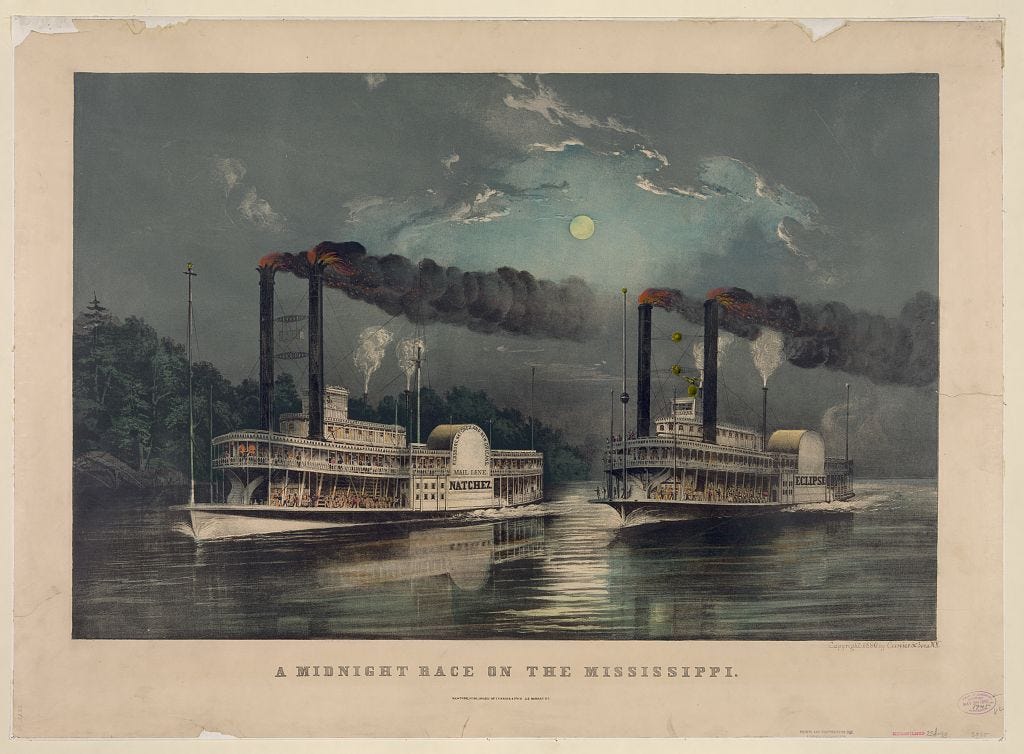
In the course of his epic 1979 trip in a small motorboat down the Mississippi from Minneapolis to New Orleans, an odyssey chronicled in his award-winning 528-page book Old Glory, British travel writer Jonathan Raban saw all too frequently lost and forlorn waterfront towns in a sad state of decline since the days more than a century before this when Huck Finn and Tom Sawyer saw paddle-wheel steamers plying the waters. The Mississippi is full of unexpected whirlpools, eddies and “boils,” all of great peril for a 16-foot motorboat such as his own, and the narrative is full of hair-raising descriptions of these dangers. But Raban’s greatest strength in Old Glory lies in his accounts of the myriads of people he met on his journey south, from evangelical pastors to the would-be mayor of Memphis, from lockmasters, pleasure-boating families, captains of various dredgers, ferries, and other workaday vessels, to a Tennessee racist, a young teacher he briefly takes a shine to, and to one Rush Hudson Limbaugh Sr., in an earlier incarnation as “the oldest practicing attorney in Missouri’s Cape Girardeau.” Raban has a gift for sizing up character from what these people say and think, more than by what they do, and he captures dialogue and even dialect in the process. Perhaps none of his many anecdotes carries greater impact than the one detailing the author’s meeting with Bob Kelley, known to colleagues as “Boom-Boom,” the captain of the ‘Jimmie L.’, a massive ‘towboat’ to whom he is indebted for being able to hitch a ride from Natchez, Mississippi to Baton Rouge, Louisiana
What kind of an Ironist are You?
Boom-Boom, a man of few, but well-chosen, words, tells Raban about himself and his origins. “Now my grandmother, she was pure Choctaw. My grandfather was Irish. He was a horse-trader… I guess there’s a bit of everything in me… bit of Indian… bit of Mexican… But I ain’t never heard of any Italian…” He can quote from Longfellow’s Evangeline, and on his library shelves are books by Steinbeck, and Erskine Caldwell, among others. These stories, Raban tells us, “held some kind of mirror up to Bob Kelley’s own life; stories of solitude, long journeys, hard times. His closest kinfolk were these famous loners of history and fiction, and he talked about them as if they were brothers and cousins.” He could never “settle down.” In literature, Raban continues, “he had found characters who could cast his own brooding restlessness in a heroic light,” and then admits, “Up in the pilot house in the small hours, Bob Kelley and I seemed very alike.” The author has found a kindred spirit. Both are loners, both unsettled, each on very different searches. Eventually, it is time for their paths to diverge, and just before his boat is “to go over the side again,” Raban is handed a piece of folded paper torn from Boom-Boom’s own navigation notes with the instruction “Don’t read that now.” When he opened it later “by the light of a city streetlamp,” he read the following:
“I know very little of writers, but people I do no (sic). You are a good man to ride
The River with, Jonathan Ravan. Bob Kelley, M/v Jimmie L. Dec.7, 1979.”
This is oddly moving, and quite in character. Edith Bunker of All in the Family once said, “There are two kinds of people: the book-smart and the people-smart,” yet some people can be both:
Jonathan Raban himself was one. He won The Royal Society of Literature’s Heinemann Award and The Thomas Cook Award for Old Glory. He continued to write travel literature of merit, and eventually settled down to live in Seattle with his daughter. He died there, aged 80, in 2023.
–
Contributed by
Peter Scotchmer