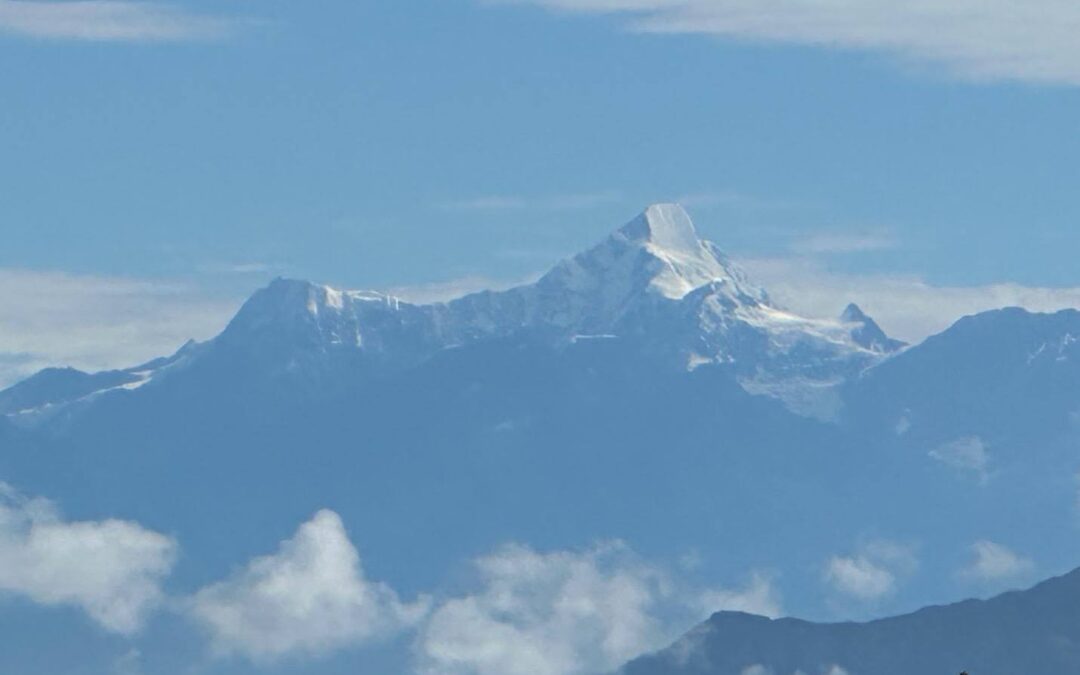
At The Hill Station Guest House, the view of the Nanda Devi is divine but nothing ever happens. Spoke too soon! A Himalayan mystery from Nigel inspired by his recent travels…

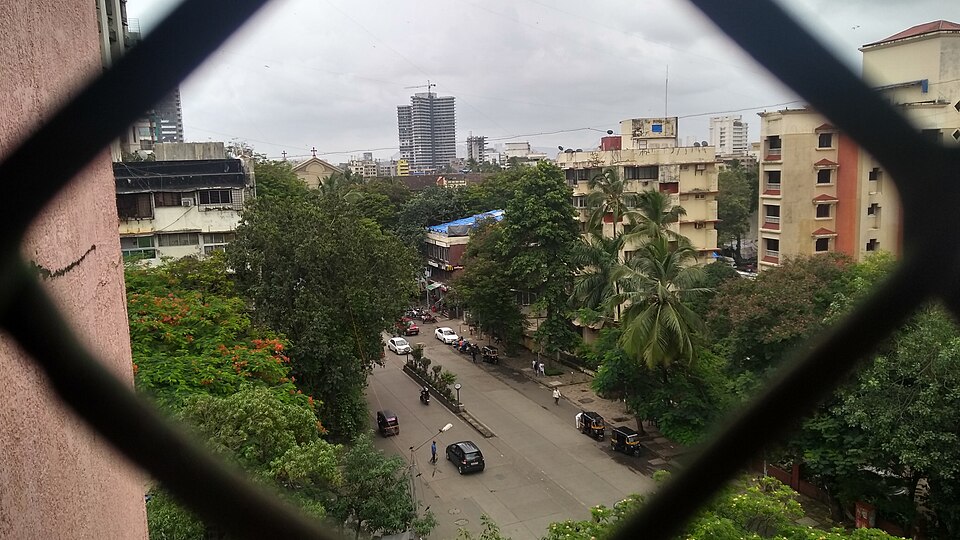
Typical rising mists and fog, monsoon season
The cuckoo’s call woke Prabhjit Singh dozing in his chair. He looked at his watch. Soon, the bus would be arriving with another load of guests for the coming week. In fact, he thought he heard the sound of the bus now, as it struggled over ruts coming up the hill. It was the monsoon season, and there would be few guests. Prabhjit, officially only the cook, really ran the guest house, since Adolf the owner had not returned from a bird watching trip with him. He stood up on the verandah and moved to the cedar steps. The lodge was quite small. It stood on a hill overlooking the Himalayas, some hundred kilometers north of Bhimtal, Uttarakhand. In the offseason, rooms were booked and guests came as a group, usually by bus from Kathgodam, the end of the railway line from New Delhi.
Adolf and his wife Sabrina had built the guest house in the 1970s when they had moved from Heilbronn, near Stuttgart, in Germany. They planned to build a series of lodges around the top of the hill, but after Sabrina lost two children in childbirth and then died herself quite unexpectedly, Adolf had reduced his ambitions. “He seemed to shrink each year until he disappeared altogether”, Mala would say to anyone who asked. Mala was the groundskeeper, and he would shake his head sadly when he thought of Adolf and Sabrina. “They tried so hard, and then they disappeared. First Mrs. Sabrina, and then Mr. Adolf. It was strange how it happened.”
Now Mala himself wondered how long he could continue the long climb every day up to the lodge from his home in the valley. Every day was a challenge for him, and it was with a great feeling of accomplishment when he made it home at night to his simple and plain hut. But, while he worked, he knew his garden was the best. Adolf had loved his gardening, but he was long gone now.
The changes over the years to Prabhjit’s job description had all been agreeable to him, especially as the larger dining room and kitchen needed for the additional lodges was never built. In fact, the couple that did the housekeeping at the guest house referred to Prabhjit as the parjivi, the parasite, as he never seemed to do any work at all. They thought they did the cooking now. They compared Prabhjit to a cuckoo parasitically laying an egg in Adolf and Sabrina’s venture. As far as Prabhjit was concerned, if anyone asked him why the hotel had never been enlarged – and many of the guests did ask – he would say it was because nothing ever happened at the Hill Station Guest House.
What kind of an Ironist are You?
He had found this response ‘nothing ever happened at the lodge’ was the best way to deal with questions about Sabrina and Adolf, too. A couple of times German officials had come all the way from Heilbronn to ask questions, and it had made him quite uncomfortable.
He had scratched his forearms until they bled. He knew they had noticed, too.
Prabhjit had been the cook since the beginning. He had left the Royal Bombay Cricket Club after some allegations, or as Prabhjit said, some misunderstandings, about a young boy in his room. Anyway, people kept coming to the lodge as the view of the mountains was divine, the climate was refreshing after the heat and dirt of the plains, and the flora and fauna were quite unspoiled.
During the monsoon, of course, the rains fell every day, but for many guests the rains brought another type of magic. Mists and clouds would cover and then reveal the views of the mountains, which were spectacular. It wasn’t raining as the bus pulled up. Mala appeared from under the fruit trees (the place had originally been a terraced orchard) to act as porter. Prabhjit stepped forward to welcome with a ready smile and handshake. His eyes darted from side to side in a frenzy.
First off the small bus was Ambika Doval, a short, pretty, thirty-something girl travelling alone. She was wearing a straight, white cotton kurta with ankle-length cigarette pants. She wore open toe shoes, gold bangles, a necklace, earrings in both ears, and had an expensive handbag on her arm.
Prabhjit was at the bus’s door, his head and hands moving, as he vigorously shook her hands. He liked pretty girls. Prabhjit had a high opinion of himself, and was looking forward to flirting with her – if not more. They had met on Facebook, and he had spent months trying to wheedle his way into conversations with her. In fact, as time progressed he thought he was succeeding as now she was always asking questions. If anything, he felt she was now asking too many questions. But he had high hopes his work would pay off now that she had come.
Behind her came a couple clearly very much in love, Daksh Banu and Saanvi Kumar. Both were slimmer than Ambika, and about the same age and slightly taller. They were South Delhi IT workers, dressed more Western than Indian, and had that ubiquitous corporate look. This trip was their trial marriage. They shook hands with Prabhjit and stepped aside, making room for the next passenger while still standing close to each other.
Rishi Sutradha was the next passenger — an architect, forty-ish, wearing heavy plastic glasses, with a triple chin and no surplus belly. He wore a polo shirt and straight jeans. Rishi seemed preoccupied, standing stiffly and expressionless at Prabhjit’s zealous greetings and vigorous head bobbing.
Last off the bus came an older Canadian couple, Bob and Marie Hall, dressed a la Tilley Catalogue. Marie emerged first, and seeing that the rain had stopped, flicked her vibrant silvery hair into position, snapping a selfie for her Oakville friends back home. She wore the catalogue’s emerald-green safari dress, which strikingly coordinated with the colour of her long, braided pigtails, set low behind her ears. Bald Bob in the ‘quick-drying travel’ shirt and coordinated ‘relaxed fit’ trousers, came behind, as usual, carrying their matching hats. He stumbled on the last step off the bus.
“Careful, Bob, we don’t want you to fall again,” reminded Marie. Bob sighed at the unhelpful comment and felt the pitter-patter of rain begin. He looked up towards the lodge as though it might be an escape.
“Come, come my friends,” Prabhjit began, motioning towards the entrance, a few steps behind him. “Mala will bring your bags.” The door banged shut behind them as they entered. From the front, the lodge was a bungalow, with sweeping semi-circular arches along the full-length, deep, verandah, leading to the rear, where a lower, second story, appeared, hugging the steep drop-off of the hill. This permitted more rooms to capture the glorious western views of Nanda Devi in the distance. The lime-plaster building tried to mix classical symmetry with a nod to local building styles and materials, with extensive use of open rafters, unstained cedar floors and wooden doors and windows. “It’s now four o’clock, and you may want to rest a bit before dinner. Dinner is buffet style and will be available from 7:30 pm onwards,” concluded Prabhjit after the guests had received their keys.
***
Dawn opens quickly in the mountains. Colour reaches across the sky and the vast milky way disappears almost immediately. Today was going to be a clear day. It was still deathly quiet. Then a lone rooster crowed, a dog barked, and cattle lowed deep down in the valley. The dawn chorus came some minutes later, starting with the hidden cuckoo calling again.
Prabhjit had moved rooms so that he could listen to Daksh and Saanvi make love. Lying in the bed next to the wall, he had counted three times. He was still smiling to himself as he walked into the reception room. He replayed in his mind Daksh trumpeting thunderously in the metal bathtub. “Why are men so disgusting?” wailed Saanvi, with an inevitable reply from Daksh, “Women fart too, ten times a night.” His smile disappeared as Ambika came in from the gardens.
She was in a plain t-shirt, blue jeans and hiking boots, carrying a trowel and little plastic bags of dirt. “Oh, you were in the garden watching the sun come up?” he asked nervously.
“Yes, and I looked at the gardens. They are extensive.” Prabhjit suddenly felt cramps in his belly and knew his bowels would be acting up today. He turned to feign interest in the breakfast buffet being prepared. “Ah, the coffee should be here any minute.”
When he turned back, Ambika had gone, and Rishi had appeared. Rishi had a serious look on his face. “Mr. Singh, you have a serious problem. As I told you last night, I am an architect, and I am also a Fellow of the Indian Institute of Architects. This morning, Ambika and I were outside. This building is built on the beautiful, shiny, phyllitic shale of one of the Krol synclines. Rock here is folded, sheared, and structurally weak. As I am sure you are aware, it is susceptible to landslides. Your problem is much worse. The gardens that you have built for the last forty or so years have altered the run-off from the rains, and as a result the old orchard terraces have been expunged. There is nothing holding up your hotel.”

Typical neglected terraced farming
“Was Ambika looking at the foundations, too?”
“Mr. Singh, you need to hire an engineer immediately. You may get away with friction piles. You must have noticed the cracks on the western side of the hotel?”
“Did Ambika help you?”
“No, she seemed more interested in your composting dump.” At this news, Prabhjit almost doubled over in pain and sat down, trying to look away from Rishi to hide his panic.
“…you know the Templetons’ son got a job at Ward and MacGillarvary. It is a pity you didn’t work for the best…” Marie was saying over her shoulder to Bob as they came into the breakfast room together. She continued, “Good morning, Mr. Singh and Mr. Sutradha. It looks as though it will be a fine day. Now Bob, you must not forget…”
“It may rain later, Mrs. Hall,” Prabhjit offered.
“So you will look into this, Mr. Singh?” Rishi asked again.
“Yes, of course, and thank-you. But we don’t use mudbricks here as you do in Rajasthan,” countered Prabhjit.
Insulted, Rishi turned away, wondering why Prabhjit was so upset. At that moment, Ambika returned, dressed professionally, at the same time as an official-looking car drove up to the front door. Ambika left in the car. The lovebirds arrived and soon three tables were covered with dishes from breakfast.
***
A light rain started to fall, and the pitter patter of rain drops on the leaves replaced the rhythmic sweep of the maid’s broom on the stone paths. A mist descended, coddling the entire hilltop, the arching branches of the trees, and all seemed asleep.
All except Rishi. Rishi at breakfast had watched and listened to Daksh and Saanvi hold hands and talk of the wonder of seeing the moon rise, dim, and then outshine the stars around it. They smiled and squeezed each other’s hands. She had such delicate hands, and slender ankles. He was happy for them. He had tried to ignore Marie’s non-stop instructions to helpless Bob. She had smelled of alcohol at breakfast. But most of all he was perturbed by Ambika’s behaviour and Prabhjit’s defensiveness. He had watched Ambika in the garden – she had spent just too long looking at such things as a half-eaten apple under a table. She was on some type of mission. And as for Prabhjit, his unease was palpable, and he was clearly frightened of something.
Rishi saw the world with a clear moral purpose and order. Everything had its place; justice and liberty were to be forever elusive, but it was his object in life, his destiny, to push all in that direction, even if, in the end, for all his efforts, he achieved nothing. He walked back to his room along the broken path and thought of how he had failed to win the election to be chair of his architects’ chapter – again. He was destined to be a failure in life, he feared.
Time passed, and a small flock of white-throated laughingthrushes alighted in the fruit trees, singing and cavorting amongst themselves. It was approaching dinnertime, and their calling and whistling was a precursor to their roosting. It was an enchanting, melodious sound of busyness and camaraderie – just like the happy time of guests chatting amongst themselves as they ate.
Then the cuckoo called again – that soft, distinctive, mountain forest call.
***
By the time a jhingur cicada started its deafening song at sunset, warning all the crepuscular predators to stay away, it was too late for Prabhjit Singh, the cook. Ambika and her police had taken him away cuffed and downcast, and all the guests were still assembled on the verandah, their initial shock replaced by rapid flights of speculation as to what had happened at the hill station where nothing ever happened. The rain had started again, harder now, drumming on the metal roof, and echoing along the verandah.
Rishi looked down at the broken shale at his feet, marvelling at the myriads of lichens and mosses. And the cicada sang on.

Typical plants and lichens on shale
–
Contributed by
Nigel Scotchmer