This final essay traces how artists dressed the divine in imperial robes, gold sashes, and red shoes, and produced, in the Angel with the Golden Hair, one of the most beautiful faces ever painted.
In the previous essay, we traced how Pseudo-Dionysius organized the celestial host into nine orders arranged in three triads. Yet it is a revealing irony that of all these ranks, it is the last and lowest, the Angels and especially the Archangels, that are most depicted in art. As no order can advance to the status of the one above it, we are dealing with a static and fixed image of authority, one that suited the Byzantine Empire and the feudal governments of the West alike. And so, the Angels and Archangels would soon don the imperial costumes of the Byzantine Emperors and their dignitaries, their celestial rank mirroring earthly power.
But before the angel became an emperor, he was a Victory.
During the Early Christian era, the iconography of the angel was connected with funerary art and the Resurrection of the soul, following classical prototypes. A beautiful example is the child sarcophagus of Sariguzel, from the third or fourth century, in the Archaeological Museum of Constantinople. Two carved winged angels, reminiscent of the triumphant figures of Victories and Eros of Greco-Roman art, bring aloft the tabula ansata, a medallion inscribed with the name of the dead. The classical form persists, only its meaning has changed.

What kind of an Ironist are You?
Yet another, older influence shaped the early iconography of angels within churches: the worship of the Sun-cult of the East. The theme of the Axis-Mundi, the axis of the world, appears on the domes and groined-vaults of the early churches, revealing the astrological origins and beliefs of the period. In the mosaic from the Archbishop’s Chapel in Ravenna, dating from 404-519, four Caryatid-Angels support the sphere of the sun with the initial of Jesus Christ within, while the symbols of the four Evangelists – the tetramorph – complete the composition.

The obsession of the artists with the symmetry of the number four – the four points of the horizon – sets the pattern for this Axis-Mundi iconography. It is worth noting that the initial X within a sphere is also the symbol of Mithra, indicating the “precession of the equinoxes”, another planetary conception drawn from the Platonic Cosmogony of the Timaeus.


The idea is even older. In Egyptian cosmogony, the goddess of the sky Nut arches her naked body above the Earth to accommodate the daily course of the Sun. In the lid of the sarcophagus of Ankh-ness-Nefer-ib-Re, daughter of Psamtik II, dating from 663-525 BC, Nut is depicted as another caryatid, directing the Sun above – a prototype the Byzantine mosaicists would have recognized.

In the mosaic from San Vitale in Ravenna, dating from 546-548, four Caryatid-Angels in the groined-vault support the symbol of Christ – the Lamb – within a sphere, like the sun. Flowery ribbons divide the space in the letter X. The Angels step on blue spheres, and their appearance reminds us of classical Victories; their frontality, however, transcends reality. By the mosaic of St. Zenon’s Chapel in Rome, dating from 820, the four Caryatid-Angels stretching out to support the Pantocrator still resemble classical Victories. But the pagan elements are steadily being shed as the Greek Orthodox Church imposes its iconographic rules.

What follows is a remarkable evolution across the great domes. In the mosaic from Santa Sophia in Thessalonica, from the ninth century, the theme is adapted to that of the Ascension, with two flying angels lifting a colorful circle indicating the seven spheres of the universe.


In the fresco from Santa Sophia in Ochrid, dating from 1037-1056, four flying angels support a sphere with seven concentric circles in pure white, indicating the seven spheres in which the Almighty has Ascended. And in the mosaic from Santa Sophia in Kiev, circa 1037, the Pantocrator as Logos is surrounded by four Archangels wearing imperial costumes, their chests crossed by the loros, painted as individual portraits. The celestial and terrestrial dominions have merged into one and the same.


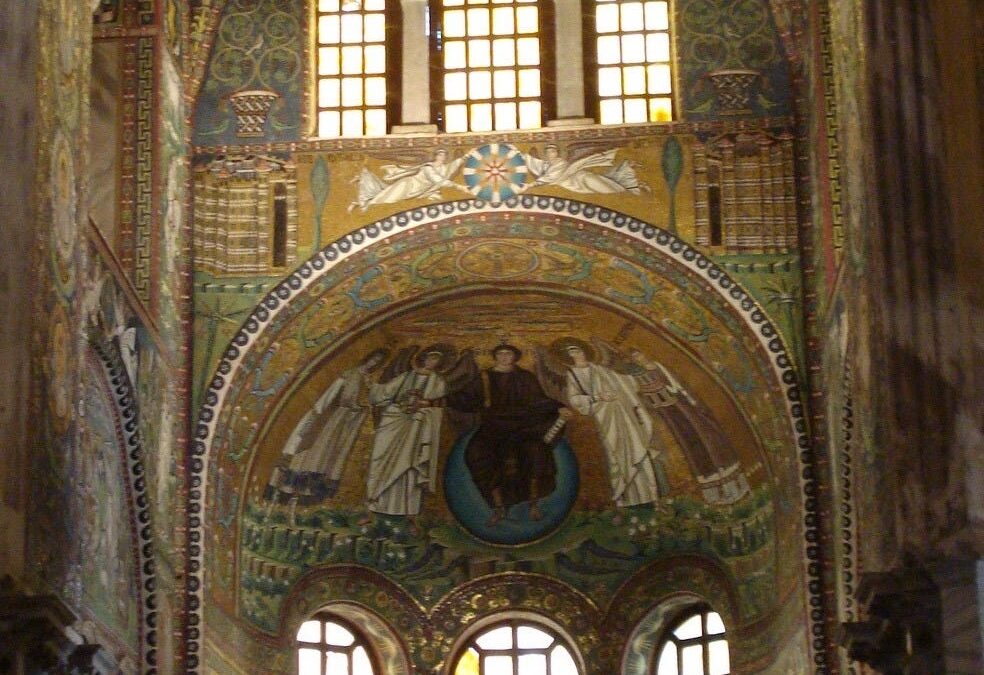
This merging finds its most explicit expression in the mosaic from St. Apollinaire Nuovo in Ravenna, from the sixth century, which shows Jesus Christ in Glory flanked by Archangels clad in white with the clavus, the patrician stripe, in their chiton. Christ is seated and holds a lamp. The frontality and rigidity of the figures denote the Byzantine protocol of the imperial court translated directly into sacred art.

Eventually, Angels will multiply in this composition, which takes on a new liturgical form: the Synaxis of the Asomatoi – the Congregation of the Incorporeal Ones. All the Celestial Hierarchies, holding the Christ child painted into a mandorla, participate in the celebration of mass. Orthodox liturgy had to include the Angels in its ritual, for they are, after all, the messengers with whom humankind will placate the Numinous. Christ serves in the twin role of the King of Kings and the Archpriest, presiding over the liturgy of both men and Angels. The fresco from Mystras depicts Angels, Principalities, and Dominions in a choir around God’s throne, dressed in chiton and mantle with the strip of purple colour, like the outfit of the Roman patricians, indicative of their nobility. The white ribbon around their hair symbolizes their purity, and their anonymity is the sign of their multitudes and power.

Among all the celestial host, it is the Archangel Michael who commands the most attention. Assigned the role of Stratilatis, Commander of the armies of the Lord, his warrior’s outfit was based on the Consular Diptychs of the period, such as that of Probus Anicius from the fourth century. If we compare the depictions of Michael across the centuries, a striking evolution emerges: in the ivory of the sixth century, he resembles a Roman Victory. In the marble plaque from the twelfth century, the Archangel wears the klapoton loros – the studded ceremonial sash – and resembles a priest; here the portrait transcends the physical beauty of the Archangel into the otherness of the divine. In Ravenna, Michael and Gabriel are garbed like the Emperor Justinian himself, with mantle and tavlion, wearing red shoes studded with precious stones. By the eleventh and twelfth centuries, the Archangels resemble more and more the Byzantine Dignitaries in similar costumes.


Pseudo-Dionysius in his Celestial Hierarchies offered many details for the iconography of Angels, and it was in these descriptions that the hagiographers found their inspiration. The sublime beauty of the Angels moved artists to portray them more often than other figures from the Bible. Few realistic depictions, however, are able to do justice to their radiance. The icon of the Angel with the Golden Hair is a superb exception. Dating from the twelfth century and housed in the State Museum of Leningrad, the hagiographer has captured not only the physical beauty of the face but also the otherness of the divine beauty, that quality which distinguishes the celestial from the merely beautiful.


According to ancient belief, messages were delivered by the flying wind; hence the angels were given wings. It is a thought worth pausing on. We began this series with wingless bulls carved in steatite, fixed to the thresholds of Sumerian temples four thousand years ago – heavy, earthbound guardians whose power lay in their mass and their refusal to move. From there, the angel acquired wings from the Assyrians, moral purpose from the Zoroastrians, rank and hierarchy from the apocalyptists and Pseudo-Dionysius, and imperial splendour from the Byzantine court. Yet what the Angel with the Golden Hair finally captures is something none of those traditions, on their own, could have produced: the intuition that the divine does not announce itself through terror or spectacle, but through beauty. That a painted face, gazing out from a twelfth-century panel, can still stop a viewer in the twenty-first century is perhaps the most persuasive argument the angels have ever made.