The Ironist

Differing Perspectives

Some Marginalia from Somerset Maugham II: The Double Life

Trying to uncover how Maugham wove himself into his fiction, be it through The Razor’s Edge, Of Human Bondage or The Moon and Sixpence

The writer is more concerned to know than to judge.”

— W. Somerset Maugham

The primary reason I admire Somerset Maugham is because I can spot him in his writing. I don’t know what literary device it is but it is pretty masterful. Writing himself into a book without giving away too much is an elegant skill which writers like me would trade quite a lot for.

Maugham did this most clearly in The Razor’s Edge, where he appears as a character: aloof, observant, almost invisible. But even when he isn’t literally present, we can spot his signature. An author peering at the world with a kind of amused restraint.

Born in 1874 in Paris, orphaned by the age of ten, raised by an emotionally distant uncle in England, Maugham learned early how to survive by observing. He trained as a doctor, was closeted for most of his life, and surrounded by people who expected him to be many things. No wonder that his fiction is full of watchers, exiles, travelers, and cynics. His writing is free of judgment, carefully detached, cleverly restrained and instinctually ambivalent. Using that duality, he probably tried to keep himself safe.

One of the highest-paid writers of his time, Maugham was widely read and widely respected and yet, perpetually exiled from England. In an era when openness came at great social cost, he had to hide his homosexuality. His writing, therefore, often features characters with private truths they must hide, be it Philip Carey from Of Human Bondage, Charles Strickland from The Moon and Sixpence, or Larry Darrell from The Razor’s Edge.
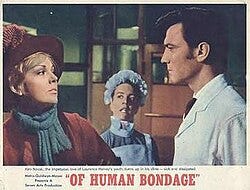
Of Human Bondage (1964 film) - Wikipedia

Source: Wiki

He wrote—

“I have an idea that some men are born out of their due place. Accident has cast them amid strangers in their birthplace, and the leafy lanes they have known from childhood or the streets they played in seem rather to belong to someone else than to themselves.”

He writes about people who want more than what the world offers, even if they don’t always know what that “more” is. Effectively capturing the tension between what the society expects and what the soul craves, he wins the title of the master of moral ambiguity.

Premium AI Image | a path through a forest with a man walking in the fog.

Source: Freepik

Maybe a part of him wanted to be Larry in Razor’s Edge, someone who could be his own liberated self, unburdened by reputation, performance, or structure. However, Maugham, for all his wealth and brilliance, could only watch from the margins, living cautiously, cleverly, always in tension with the life he might have chosen.

Perhaps that’s why the novel bears its title so well.

The Razor’s Edge.

Maugham did always live on the edge.


Contributed by
Aashisha Chakraborty

Author

  • Aashisha Chakraborty

    Author of ‘Mis(s)adventures of a Salesgirl’ and ‘The 13-year-old Queen’, Aashisha moonlights as a marketing strategist and content professional. A computer engineer and MBA with 8 years of marketing experience and a globetrotter with 30 countries stamped on her passport, she is currently working on her third novel and a collection of free verses. She trusts Charles Bukowski when he said,"Some people never go crazy. What truly horrible lives they must lead."

    Connect with her @aashisha_themindbin on instagram or visit her at www.aashisha.com.

More Irony

From San Blas to Oxford: A Review of Shooting Up

From San Blas to Oxford: A Review of Shooting Up

A missionary family raises four boys in one of Madrid's most drug-ravaged neighbourhoods. Jonathan Tepper's memoir traces an extraordinary journey. Jonathan Tepper’s Shooting Up is much more than the account of four brothers in a missionary family growing up in Spain...

The Celestial Bureaucracy: Hierarchies of Angels

The Celestial Bureaucracy: Hierarchies of Angels

In her third post, Dr. Hara tells us how Seraphim came to outrank Cherubim, and Archangels ended up near the bottom. In the previous essay, we traced the angel’s transformation from local guardian spirit to cosmic warrior under the influence of Zoroastrian dualism....

WORDS, WORDS, WORDS III

WORDS, WORDS, WORDS III

Polonius: What do you read, my lord? Hamlet: Words, words, words. Polonius: What is the matter, my lord? Hamlet: Between who? Polonius: I mean, the matter that you read, my lord. (Hamlet, II, ii) As part of The Ironist’s continuing series of articles on language and...

Guardians Before God: The Sumerian Origins of Angels

Guardians Before God: The Sumerian Origins of Angels

Dr Hara's research on the winged messengers of Western faith starts with these wingless creatures guarding Sumerian doorways. This is the story of angels and how they learned to fly... When we think of angels, we conjure images refined by centuries of Christian art:...

RAMBLINGS #10 – Goodbye Mt. Parnassos, Hello War

RAMBLINGS #10 – Goodbye Mt. Parnassos, Hello War

A drive down from myth-haunted Mt. Parnassus into the passes, graveyards, and battlefields Picture Credits: Edward Dodwell, Public domain, via Wikimedia Commons   It is said that Zeus, the great philanderer, lay with Mnemosyne (Memory), a Titan, for a marathon...

WORDS, WORDS, WORDS II: Inspiration

WORDS, WORDS, WORDS II: Inspiration

This is the second essay by Peter on the intricacies of the English language. Here, he writes on where inspiration comes from, and why no amount of effort can quite summon it. My first piece in the English language series talked about the quality of writing that...

The Last Puritan

The Last Puritan

Alexander Montgomery writes a fleeting, intimate glimpse of Glenn Gould, the genius and the strange solitude of his greatness. Glenn Gould’s sitting in Fran’s Deli, St. Clair East, and I sit here, watching him from the pub across the street. There he is, the bastard,...

The Awkward One: Rediscovering Mary Bennett

The Awkward One: Rediscovering Mary Bennett

About the most forgettable Bennet sister and a retelling of Pride and Prejudice... “There are few people whom I really love, and still fewer of whom I think well. The more I see of the world, the more am I dissatisfied with it; and every day confirms my belief of the...