The writer recently returned from Greece sunburnt, overfed, and spiritually re-aligned by the hum of ancient stones and overly affectionate cats.

I stood beneath an olive tree outside the ruins of Delphi, not far from where Pythia, the high priestess of the oracle once sat, inhaling vapors and mumbling prophecies. The view was a gorgeous sprawl of mountains, cypress trees, and history.
This was my first trip to Greece. And what I realized was that everything is earthy and welcoming. The stone paths, the sun-washed walls, the stray cats on church steps. There’s a warmth to the air (and I’m not saying that just because I flew in from Canada) and a kind of grace that makes even the ruins feel like they’re waiting just for you.
Delphi is a couple of hours northwest of Athens, tucked into the slopes of Mount Parnassus. Unlike the Parthenon, which is constantly swarmed and Instagrammed, Delphi feels a bit severe. What struck me wasn’t the temple or the theatre or even the museum with its smug bronze statue that clearly knows it survived more than I ever will. It was the absurdity of it all. That once, people believed a woman in a trance could speak the truth of the universe. And even more absurd…that sometimes, she did.
There’s something honest about a country that honors its ruins. In a world chasing perfection, it felt freeing to stand somewhere that embraced imperfection as part of its story.
It makes you wonder:
what are we ignoring today just because they are cracked and imperfect?
The Echoes You Can’t Miss
If Delphi is the oracle of Greece, then the rest of the country is her louder, more dramatic family. Every island, ruin, and sun-drenched staircase has something to say.
Athens
Start here. Its cracked marble and graffiti and ancient columns defiantly standing in the middle of traffic will beckon you warmly. The Acropolis will make you feel small in the best way. The Museum will remind you how sophisticated humanity was before Twitter. And in the Plaka, you’ll realize that even in the birthplace of democracy, a good taverna still holds more power than any parliament.
Cape Sounion
Where do you go to worship both gods and sunsets? Sounion. Poseidon’s temple sits at the edge of the Aegean, wind-swept and cinematic. Lord Byron carved his name here. You can arrive at dusk and watch the sea swallow the sun.
Mykonos
Ancient Delos (the birthplace of Apollo and Artemis) is just a boat ride away, a sacred archaeological site that once rivaled Delphi (the seat of the oracle of Apollo). But Mykonos itself is mythical in its own right. Hedonism (all the party animals are found here), history (with Venetian, Byzantine and all types of influences), and glamour blend beautifully. One moment you’re photographing the windmills, the next you feel like Dionysus himself, drunk out of your mind.
Santorini
Yes, it’s as beautiful as they say. No, the photos aren’t lying. Built on the rim of a volcanic caldera, Santorini is a geological reminder that beauty often comes from catastrophe. Highly recommend the cruise that takes you across the different colored beaches and the hot springs surrounding the caldera.
You can visit Akrotiri, the Minoan Pompeii, stand before the frescoes and marvel at the artistry of a civilization lost to the sea.

Rhodes
Rhodes Old Town is saved in time. Walk through the Street of the Knights and you’ll forget what century it is. Visit Lindos for a sun-drenched acropolis.
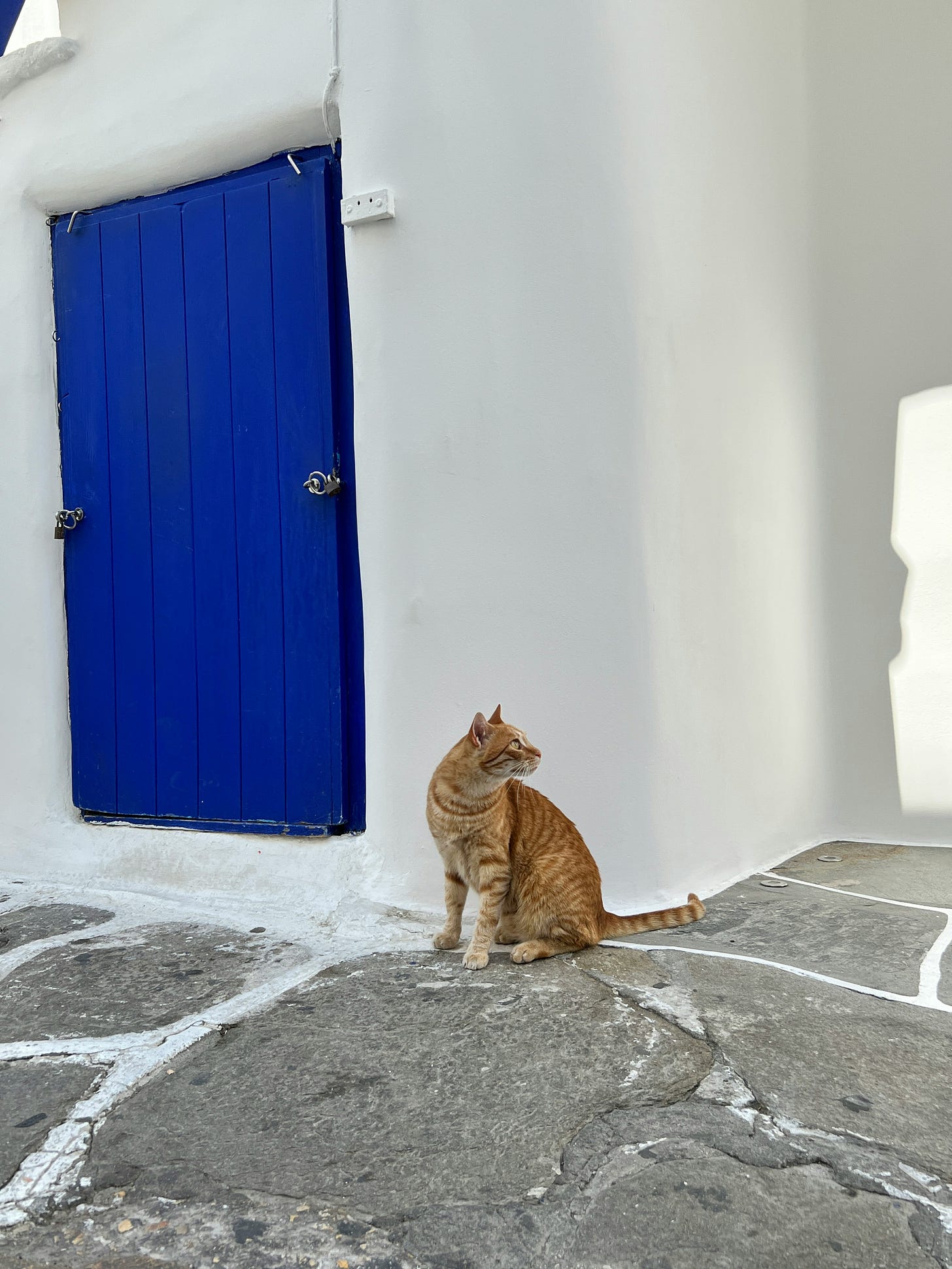
Greece is that sweet destination where you will lose track of time, life, routines, basically anything that ties you down. So, don’t plan too much. Let a fisherman redirect your day. Accept that a ruin might close early (we didn’t know Hadrian’s Library closed at 4 and were quite disappointed after hurrying there, sweaty and flushed…yeah it was sweaty in March!) or a cat might demand your seat (those cuties can be found literally everywhere!).
Forget the filters, follow the feta. Order without knowing. Walk without GPS. Listen for music. Something or someone will always be playing.
And above all, take your time (maybe I should tell that to myself)…
Greece isn’t going anywhere.
It already outlasted empires.
–
Contributed by
Aashisha Chakraborty