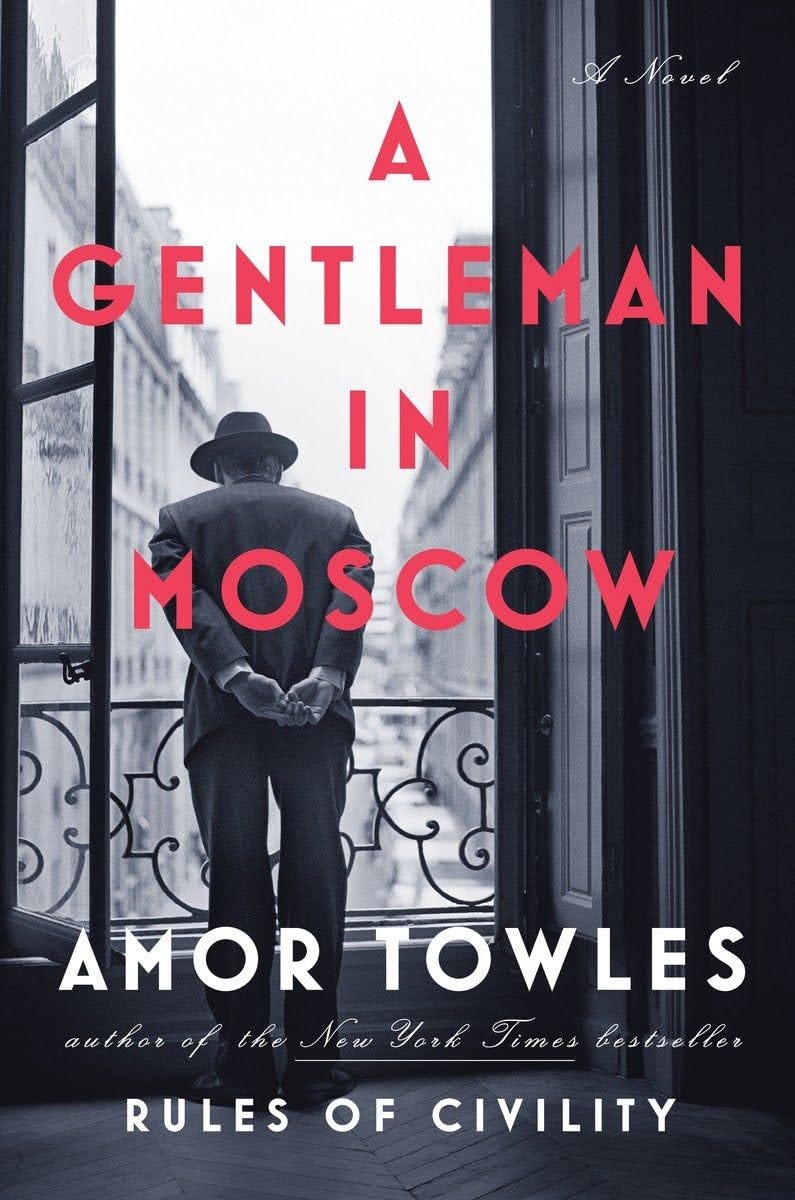
Some months ago, I read A Gentleman in Moscow during a transatlantic flight. My subsequent overseas adventure all but erased the book from my mind at the time. More recently, finding myself in an extended convalescence, I binged on the 2024 TV adaptation. Initially intending to while away virtual imprisonment in a hospital ward with mindless entertainment, I was caught up in the pleasantly charming plot.
In the opening scenes of both the book and series, a displaced Russian count stands before a Bolshevik tribunal, charged with the crime of existing too elegantly. “It is not the business of gentlemen to have occupations,” he explains, and thereby earns himself a sentence as a social parasite. The court, in a moment of revolutionary leniency, spares him the usual bullet-in-basement fate and confines him instead to Moscow’s Hotel Metropol — a palatial cage where he is to live under house arrest for the remainder of his days.
Amor Towles’s 2016 novel takes this premise and turns it into a study in civility under siege. The real Moscow Metropol, built in 1905 in opulent Art Nouveau style, stood through the convulsions of the twentieth century as both a monument to a vanished order and a convenient way of containing foreign diplomats and journalists. Towles transforms it into a terrarium of lost civilisation — a place where the manners of the ancient regime survive the Terror and where one toasts the end of history with a glass of Chateauneuf-du-Pape.
What kind of an Ironist are You?
The novel is graceful, witty, and safe — this is a chamber piece rather than a symphony. It is not really a Russian story but a Western morality play — resilience, adaptation, the meaning of community — papered over with a thin veneer of Russian culture and history. The Bolshevik Revolution and the reign of Joseph Stalin are merely the background décor. The themes are often predictable, and our protagonist is blessed with plot armour thick enough to withstand a blast from a T-34 tank. Still, the book moves with charm and confidence; the prose, like the Count’s manners, never falters.
What distinguishes A Gentleman in Moscow from the usual parade of historical redemption tales is its refusal to humiliate its aristocratic hero for his old-world values. In lesser fiction, the fallen nobleman is chastened, stripped of privilege, and reborn as a cliché of proletarian virtue. Count Rostov, by contrast, remains entirely himself. His dignity, formality, and sense of lineage become his means of survival — not in defiance of change, but as a mode of grace within it. He does not evolve so much as endure, and endurance, here, is the point. As his waiter notes in the first episode, this is a character who “refuses to be beaten”.
Towles understands that civility can be a weapon. In a century that made effusive humility fashionable, Rostov’s old-world pride feels almost radical. He is a man who holds to the rigours of wine pairings and proper table etiquette while the world outside is reduced to bread queues and slogans. Rather than being stripped away, his civility becomes an act of quiet defiance against the utilitarian vulgarity of the age. His humanity is not in spite of his privilege, but because of it.
The television adaptation preserves this spirit, if not always its subtlety. Visually, it is sumptuous: a sepia-lit Art Nouveau ballet of mahogany and polished brass, with Ewan McGregor delivering just enough melancholy charm to make one forgive the occasional historical blunder and the script’s tendency toward aphorism. The supporting cast performs ably, though the production’s gestures toward inclusivity feel more than a little anachronistic — one suspects the Bolsheviks would have been less enthusiastic about equity hiring than Paramount+.

But this is easily overlooked. Both works succeed on their own terms: as meditations on grace, memory, and the refusal to let barbarism set the tone. The Count’s world shrinks to the confines of the hotel, but within these, he maintains a whole civilisation. In an age allergic to hierarchy and privilege, it reminds us that the nobility of spirit can wear a dinner jacket and know which fork to use.
A Gentleman in Moscow lacks the profundity of the great works of Russian literature it often references, but it offers something equally rare these days: a vision of refinement unembarrassed by itself. In a time when every institution is crumbling and taste is treated with a degree of guilt, the Count reminds us that one may still dine correctly, speak with dignity, and refuse to lose one’s humanity even at the end of the world.