Irony and the human condition: Peter Scotchmer on why double vision matters more than ever.
“…the ironist is caught in a boundary zone between two opposed and mutually exclusive perspectives… between the necessity to believe in the world as it ought to be, and the compulsion to acknowledge the ugly reality of the world as it is.” – Shiela Burbridge

A body louse, public domain
The poet Robert Burns’ To A Louse is a corrective for the many who are self-centred. In the poem, Burns is seated on a church pew behind a woman blissfully unaware that a louse is climbing up her hair in front of him. The sight causes him to utter a fervent prayer: ‘O if some Power gave us the gift / To see ourselves as others see us / It would free us from many a blunder and foolish notion.” To be able to do this, to put oneself simultaneously in the position of the unknowing beheld as well as the beholder himself is a gift that would provide the beholder with the ability to see things as they are, and not as wishful thinking, to see beyond ideology, above the mob’s simple-mindedness and the secular culture’s uncritical gaze, to be in possession of an elevated perspective rather than mere ‘single vision.’ This double vision is the preserve of the ironist. And, speaking of “seeing”…
“Get thee glass eyes,” Shakespeare’s King Lear tells blind Gloucester, “and like a scurvy politician, seem to see the things thou dost not.” Politicians could not be trusted then; they should not be trusted today. For Shakespeare, as Stephen Greenblatt has shown in his study Tyrant : Shakespeare on Politics, “the word politician was virtually synonymous with hypocrite…. Populism may look like an embrace of the have-nots, but in reality it is a form of cynical exploitation.” Politics has always been downstream of culture; the further upstream, the higher the culture. The river flows pure and natural until it encounters muddied human mediocrity. Like Gloucester’s blindness, the blindness of politicians is due to defective vision. They cannot see themselves as others see them. All too often, they suffer from the ethical blindness of their ‘single’ vision: surrounded by sycophants to whom they owe favours, their commitment to the truth is suspect, yet they remain confident in their own preening self-satisfaction. Most damagingly, they lack a sense of irony.
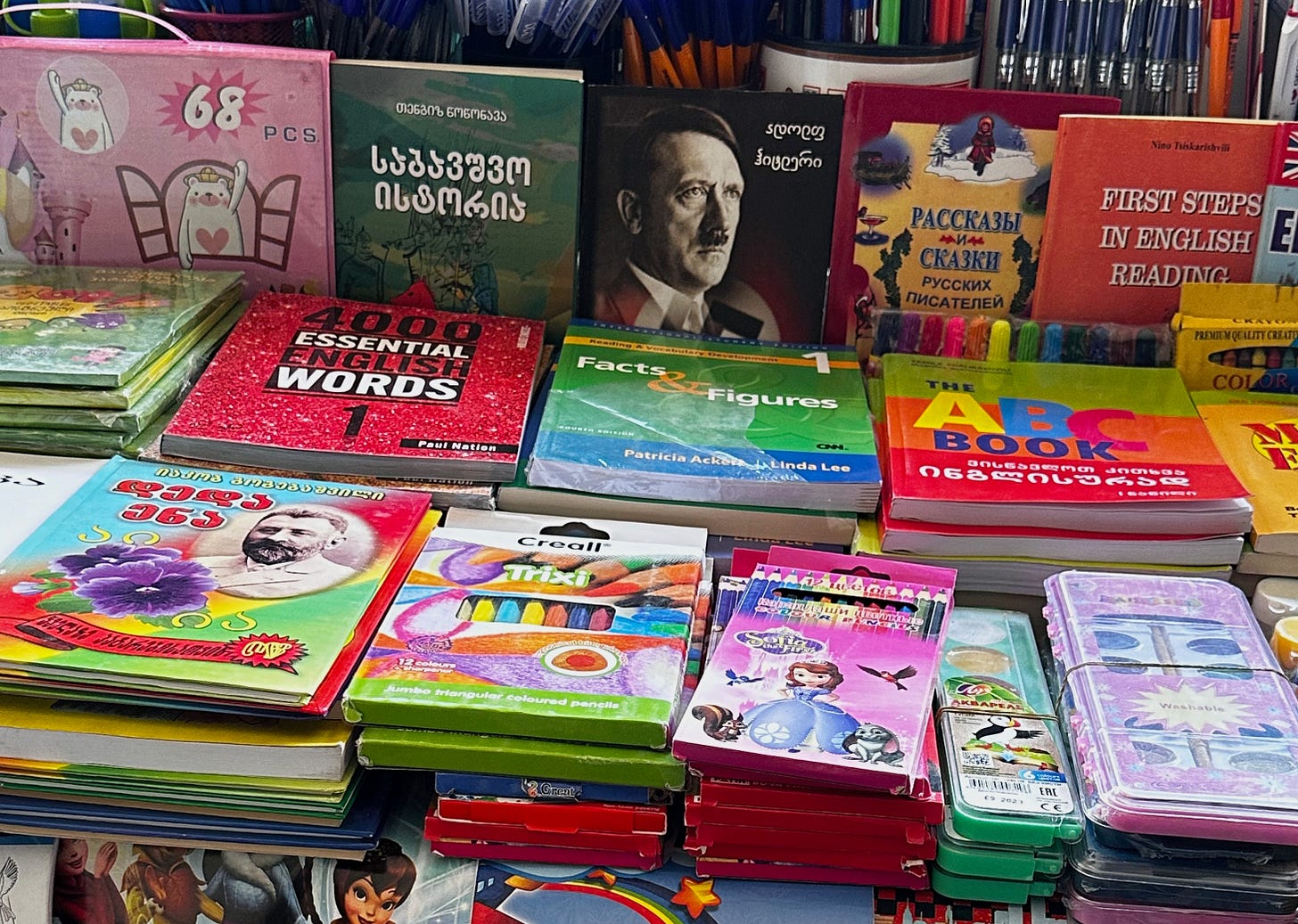
Irony of Ironies- mein Kämpf amidst children’s books
Ironists are thinkers, artists, novelists, dramatists, teachers, academic, medical and legal professionals, philosophers and scientists. They are not ideologues. They are familiar with what Thomas Hardy called ‘life’s little ironies.’ Truth, they know, both from their education and life experience, is seldom simple, rarely black or white, often composed of various shades of grey, deserving of thoughtful debate and counsel, and requiring freedom of speech both to hear dissent and to voice it. In fact, central to all forms of irony, whether as a technique or as a moral perspective, is a dual, or ‘double’, vision, a surface meaning accompanied by a deeper concealed meaning that is at variance with it, or even in flat contradiction of it, “the bringing in of the opposite,” in order to focus understanding. The following are some simple illustrations of this phenomenon.
When a player throws a baseball that goes wildly astray to a fellow-player, breaking a neighbour’s window, and causing the intended recipient to call out, “Brilliant!” the speaker does not of course mean this. He has used sarcasm or verbal irony. He means the opposite of what he says. The offending player is unlikely to interpret the comment as applause. When a long-serving employee, having regaled his colleagues with the details of how he will spend his retirement, drops dead at the bus-stop minutes after having said his farewell, this is also ironic: it is called irony of events. Expectations are thwarted by their opposite: unsuspected circumstances that some might call fate. When a character in a play or film is unaware of a terrible truth that the audience or other characters know, the tension is said to be full of dramatic irony. Once again, a victim of his own ignorance is unaware of his peril. All three of these are examples of irony, a discrepancy between appearance and reality, or between a fact and the value attached to it.

Juxtaposing the old and the new, Istanbul
Irony is not merely a clever literary technique, but a way of life. Ironists are not made, but born. They are contrarians at odds with popular sentiment, outsiders in self-imposed exile from their own societies, observers and commentators rather than participants, detached from the fever of the busy world around them, many of whose activities seem to them to border on the absurd.
The absurd “may be taken to symbolize the incurable and chimerical hoax of things” of life, and not its “corrigible deformities,” says Morton Gurewitch; “the vanity of vanities that informs the world’s irony is beyond liquidation.” In an era like our own, threatened nuclear or climate catastrophe, sexual confusion, economic and social disparity, despoiling of the planet, “ethnic cleansing”, the ironist cannot accept the mantra that “progress” will bring utopia. He (or she) is not a reformer. “The modern ironist, “ adds Charles Glicksberg, “is aware that the human condition is beyond remedy.” He “allows contradictions to co-exist and entertains a multiplicity of perspectives.” He is not enslaved to fads or fashions, or to ‘single vision.’ According to Marjorie Perloff, the ironist and philosopher Ludwig Wittgenstein came to understand that “one cannot change society; one can only change oneself.”
Irony “directs itself not against this or that particular existence but against the whole given actuality of a certain time and situation,” declares Soren Kierkegaard. Whatever their personal allegiances or prejudices, ironists stand apart from the world they perceive, somewhat like absentee landlords surveying with detachment the private squabbles of their tenants, making no judgements, appearing neither to condemn nor condone their fractious behaviour, in a stance calculated to provoke the thoughtful reader into a deeper examination of the human condition. Continues David Lodge, “When culture is seen as a process of continual decline, nothing is invulnerable to irony.” This ‘myth of decline’ is part of the view of life of many ironists who reject the opposing ‘myth of progress,’ which holds that what is new and untested must be better than what it replaces.
F. Scott Fitzgerald in his The Great Gatsby, wrote that only an intelligent person can “hold two opposed ideas in the mind at the same time and still retain the ability to function.” Sheila Burbridge goes further, crediting the ironic view of life with this very capacity of holding “two opposed and mutually exclusive perspectives” in the mind simultaneously. The ironist, she says, is one “caught in what Soren Kierkegaard calls the boundary zone between the necessity to believe in the world as it ought to be and the compulsion to acknowledge the ugly reality of the world as it is.”
Irony’s enduring merit is to tell the often-unpalatable truth about moral dilemmas and the myth of human perfectibility in order to oppose the smugness of the complacent and willfully ignorant, the simple-mindedness of the zealot, the condescension of the utopian progressive, the camp follower of the propagandist, the dupe of deceptive slogans and the false promises implied in the omnipresent images of actors paid to smile in slick advertisements. Buyer beware. Exposing dishonesty may mean having recourse to such discomforting means as exaggeration, cruel humour, paradox, ambiguity, and contradiction. The writer may not mean what he appears to say. Indirection and obliqueness typify this double vision. Voter beware.
As a reflective and serious outsider, Prince Hamlet, the heir to the throne of Denmark, yet estranged both from his own family, from his true love Ophelia, and from the values of his own society, is a victim of a situation fraught with irony in the form of a serious moral dilemma. Urged on by a supernatural agency to avenge his father’s murder at the hands of his brother, Hamlet’s hated uncle Claudius, Hamlet is by his temperament and university education a rationalist disinclined to trust the word of a ghost. He knows he must act, but he also knows his own limitations. He is a thinker given to intellectual paralysis, and he castigates himself relentlessly for his inaction. How is he to proceed?
The unsuspecting reader unacquainted with or immune to irony takes at face value Jonathan Swift’s revolutionary recommendation to ease the suffering of the hungry Irish poor. The cheerfully enterprising narrator of his famous essay, entitled A Modest Proposal, appears to advocate the butchering and marketing of the flesh of the family’s own infants by their own parents, thereby reducing the number of dependents each family must feed, while simultaneously generating additional family income and providing variety for the palates of the wealthy. Swift’s bitterly ironic joke was in fact angry social criticism designed to awaken the untroubled or indifferent consciences of uncaring readers unmindful of those in Ireland suffering from grinding poverty, failed harvests, and grasping absentee landlords, when he published this essay anonymously in 1729. Swift is in good company. George Orwell, William Shakespeare, Alexander Solzhenitsyn, Jane Austen, Herman Melville, Mark Twain, Joseph Roth, Evelyn Waugh, Soren Kierkegaard, and many others also had similar diets of ‘unpalatable’ truths to share. The great prophets were ironists. So was Socrates, who as Clare Carlisle has noted, “was the master of irony,” for whom it was “even a way of life.”

Regarded today as the first ‘existential’ writer, by which is meant one who grapples with the meaning and purpose of life, and predating Sartre and Camus by many decades, Soren Kierkegaard (1813-1855), was a Danish theologian, philosopher, and committed Christian aware that “no genuinely human life is possible without irony,” yet he insisted in his doctoral dissertation The Concept of Irony that irony itself was only an intermediate stage in the development of human ‘authenticity.’ The final stage in someone’s moral evolution can only be attained by transcending irony and replacing it with his or her acquisition of a life-affirming religious belief system representing the triumph of wisdom, the end-point of all soul-searching, and the answer to the central question that bedeviled Kierkegaard’s own troubled life, “How can I be human in this world? What is it to live well?” There is no easy answer to such a question, but the search for it must begin with the self-knowledge derived from an honest, rigorous, and profound examination of oneself. “Not until he has inwardly understood himself and then sees the course he must take does his life gain peace and meaning; only then is he free of that irksome, sinister travelling companion– that irony of life which manifests itself in the sphere of knowledge,” wrote Kierkegaard in a diary entry on August 1, 1835. We must understand ourselves first, and come to an understanding of our own shortcomings before we can alleviate the problems of others. Elsewhere he wrote that a person’s “work of soul-searching, exploring his own anxiety and suffering” will have “deepened his understanding of being human, giving his philosophy the power to affect others.”
We must live with the demands of our imperfect human condition, making use of the skepticism of irony to assess and dismiss simple-minded ‘remedies’ to difficult dilemmas.
–
Contributed by
Peter Scotchmer