The Little Tanagra: Part 2

Previously in Part 1, Hara writes about young Arsinoe growing into a woman of remarkable talents at the sanctuary of Artemis at Brauron. But longing for freedom, she begins to plan her escape.


Arsinoe took longer each day to return from her herb-gathering and she ventured further and further into the open countryside and the vineyards. She knew that these pilgrimages took place every four years, starting with a procession from the Temple of Artemis at Brauron in the Acropolis of Athens to the sanctuary at Brauron, and back again to Athens.

What kind of an Ironist are You?

Take the quiz and find out.


One late summer afternoon, after her participation in the mysteries of the Goddess, she decided to stay out in the fields, and join a poor family of pilgrims who were going to the Temple of Artemis at Brauron in Athens.

Arsinoe thought that she would be safer if she followed them at a distance. Eventually, after a week’s hardship of hunger and sleeping in the open countryside, Arsinoe arrived at the great city of Athens, to be dazzled by the beautiful temples on the Acropolis hill.


At the same time, she was confused by so many people milling about that she did not know where to turn. After a moment’s hesitation, she tugged at the sleeve of an old lady who was selling pottery carrying it in a basket and asked the way to the potters’ quarters in the city. The old lady, seeing Arsinoe’s state of hunger, offered her a piece of bread and cheese and then took her by the hand and led her to the outskirts of Athens. As it happened, she was the mother of a famous young sculptor, who was very devoted to his mother. Arsinoe was surprised to find a large marble statue, chiseled in honor of the old lady, exposed in the courtyard of their house! But Arsinoe would have more surprises!


When Arsinoe mentioned the name of her father, no one seemed to know his whereabouts. Eventually, she found out that her father had left Athens and taken a boat to Miletus, a very prosperous city on the Ionian coast.


In the beginning, she thought of joining him, but the poor girl did not have any money to pay her fare. So, Arsinoe offered her services to the old lady to help with selling her wares to keep herself from starvation.


She was so good at singing the merits of the pots and vases that she attracted numerous customers and the old lady was more than pleased to have Arsinoe as her helper.

Arsinoe, then, stayed with the old lady and her son for a year. She also applied herself to pottery, learning the trade of her father. The young sculptor taught her how to knead and prepare the clay, how to turn the potter’s wheel, and most of all, how to bake and glaze her pottery in a big kiln at the back of the house. Arsinoe was happy for a while and her melodious singing filled the neighborhood!

One day, as she was singing her wares at the marketplace, a man stopped to listen to her. He was so bewitched by her voice, that he asked her, where she had learned to sing so beautifully. Did she know how to play the double flute, as well?

Arsinoe was taken aback and a bit afraid to share her secret, but then seeing that the man did not mean any harm, she told him of her training at the Brauron Sanctuary.

Next day, the man appeared in the market place accompanied by a beautiful lady. They asked Arsinoe, if she wanted to come and stay with them and become a musician. She only had to sing and play the flute to the guests at the banquets. She would earn more money than selling pots and pans in the market place. Arsinoe considered their offer for a while and then accepted it.

From then on, Arsinoe became very famous for her beauty, charm and talents. Many people sought her out to entertain their guests at feasts and in no time, she became very prosperous.

Arsinoe was not ungrateful to the old lady and her sculptor son, and she often visited them with gifts of fruits and sweets. She had introduced a dance in a peplum, which created lovely folds around the body, and asked her sculptor friend if he wanted to make a statue of her. So, they started an enterprise and both of them began to create little terracotta figurines of dancers, and ladies wrapped in mantles with hats and fans. And thus, they became the famous Tanagra idols!


Editorial Note

Thus concludes our serialized tale of Arsinoe—a story that reveals itself as a creation myth for one of the ancient world’s most beloved artistic traditions. The Tanagra figurines that Arsinoe and her collaborators produce within the narrative are, of course, real historical artifacts. Excavated in the necropolis near the village of Tanagra in the late nineteenth century, these terracotta figures genuinely date from the Hellenistic period (approximately fourth to first centuries BCE) and represent a remarkable tradition of small-scale domestic sculpture.

Contributed by
Hara

Author

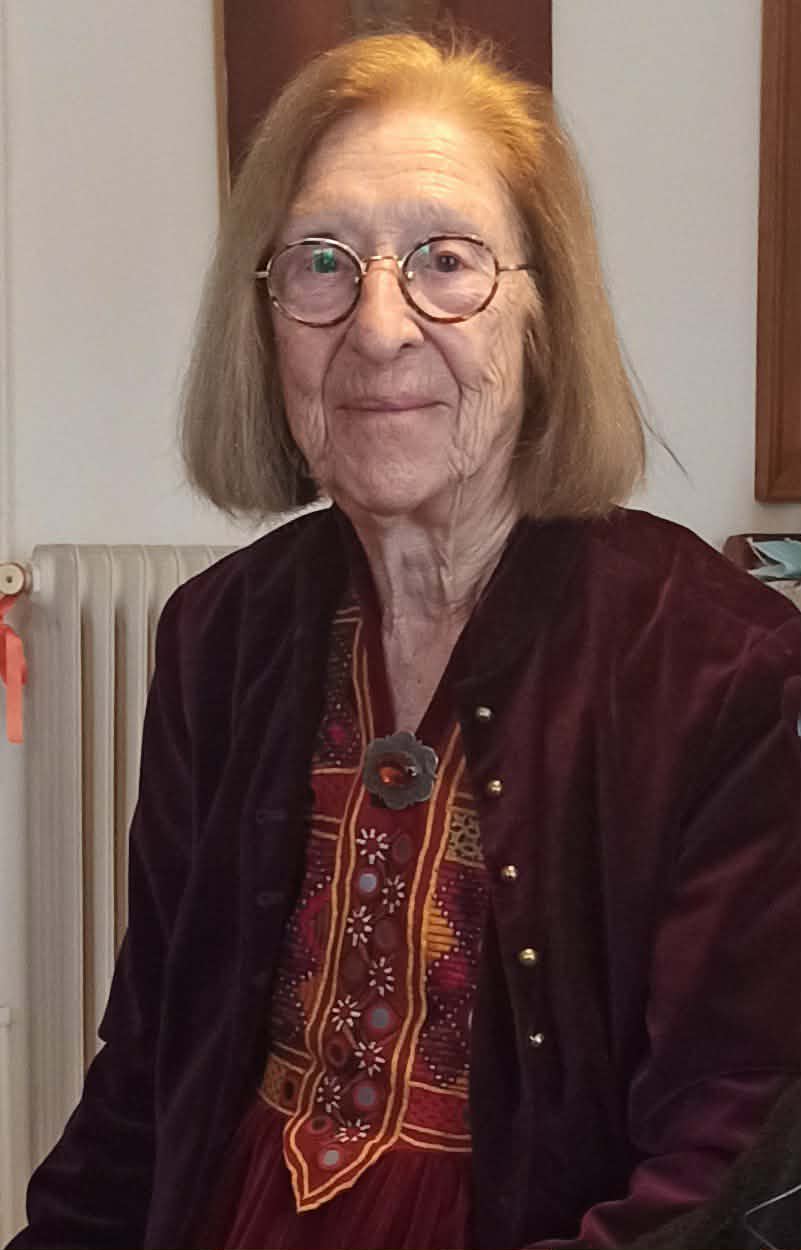
  • Dr. Hara Papatheodorou was born in Athens. She studied in Montreal, Canada, and in her return to Athens, she taught Art History and the Visual Arts for a number of years at the American College of Greece (DEREE), in Athens.

    She earned her degrees in Fine Arts and Art History from McGill University, in Montreal, Canada, where she taught as well.

    Her doctorial research dealt with The Iconography of Angels in the Byzantine Art, and was accomplished at the University of Ioannina, in Greece.

    She is a practicing artist with many international exhibitions and distinctions for her art. In 1972 won the Silver Medal, in Brussels. In 1973, she was among the finalists for the Grand Prize of Rome, and she is an Associate Member of the French Artists. She has exhibited twice in The Salon of May, at the Grand Palais de Champs Elysee, in Paris.

    She has written many articles on Greek artists, and has participated in a number of conferences, referred to art history aesthetics.  Among them were Essex University in UK (2004), where she delivered a topic on Fairytales in Art: The Shock of the Marvelous, at the Piraeus University in Greece (2008) and The American Women’s Club in Athens (2008), where she delivered a topic on Women, Art and Society: The Dinner Party, dealing with the discrimination on women artists.

    She has recently retired from teaching, but she continues to lecture locally as well as abroad. One of her recent lecture on Body and Death: When I touch your Body with my Hands, was delivered in February 2009, at the American College of Greece. It was part of a Philosophical Seminar on Death and Metaphysics, and her research dealt with the depiction of death in the art of 20th-21st century Art.

    She has traveled extensively in Africa, Central Asia, Europe, North America and Mexico, as well as in India, where she lived for a number of years.

    She resides in Athens, Greece, where she paints and exhibits her work. She is publishing shortly a book on a deceased Greek artist Paschalis Haralampides. Apart from her research on Art History Aesthetics, she writes artistic fairytales, like Fairytales of the Brush, which will be published soon.

    She has a son and two lovely grandchildren, who live in London.

More Irony

The Little Tanagra: Part 1

The Little Tanagra: Part 1

We are delighted to introduce a new serialized work of literary fiction from Dr. Hara Papatheodorou: a fairy tale that reimagines the origins of the celebrated Tanagra figurines in ancient Greece.   In the small village of Tanagra, in Boeotia, there lived a poor...

Starting in April 2026, The Ironist is starting a running monthly series of articles on the English language written by our very own contributor Peter Scotchmer, a retired English teacher. Polonius: ‘What is the matter you read, my lord?’ Hamlet: ‘Words, words,...

Skinny Legs and All: The Seriousness of the Absurd

Skinny Legs and All: The Seriousness of the Absurd

Talking objects, messy love, art, philosophy, and global conflict. All in one book. “In the haunted house of life, art is the only stair that doesn’t creak.” Over time I have come to believe that the higher the element of fantasy in a book, the more serious it often...

Utopian Delusions

Utopian Delusions

Peter Scotchmer writes about the enduring lure of utopia and why humanity’s attempts to build perfect societies so often end in dystopia.   I will not walk with your progressive apes, Erect and sapient. Before them gapes The dark abyss to which their progress...

Forgotten Heroes #8 – Pauolos Paella the Peacemaker

Forgotten Heroes #8 – Pauolos Paella the Peacemaker

In this Forgotten Heroes story, Alfred Russel Wallace, flying whales called linanders, and a peace-making dish collide in an improbable history of the world’s most famous rice pan.   Recently discovered petroglyph of a linander assisting ancient boy scouts...

Miscellaneous Ramblings #9 – Part 1, Recognizing Evil

Miscellaneous Ramblings #9 – Part 1, Recognizing Evil

“The line separating good and evil passes through every human heart.” Aleksandr Solzhenitsyn, The Gulag Archipelago I was in Budapest when I heard about the mass shooting at Tumbler Ridge, British Columbia. One of the worst things about this horror is how quickly it...

RETVRN to Casablanca

RETVRN to Casablanca

The inconvenient Liberalism of a "traditional" classic “I’ve often wondered why you don’t return to America.” When the French police chief says this to Rick, we learn he’s an exile. We never learn why, but we get hints of communist leanings. “You ran guns to Ethiopia....

The Reading Chair: Falling in Love with The Sirens of Titan

The Reading Chair: Falling in Love with The Sirens of Titan

…and the Joke That Explains Everything “A purpose of human life, no matter who is controlling it, is to love whoever is around to be loved.” Famous words by Malachi Constant, the man who gets rich by chance and ends up in space by chance, feels extraordinarily deeply...

The Zambian Dream

The Zambian Dream

Kachingo Sondo is a corresponding freelancer originally from a village outside of Garampande, near Livingstone, Zambia. Zambian village, by Tom Chiponge, Pixaby Call me Phiri. I drive a taxi in Lusaka. That is, when I have money, I rent a taxi to try and make more...