Dr Hara’s research on the winged messengers of Western faith starts with these wingless creatures guarding Sumerian doorways. This is the story of angels and how they learned to fly…
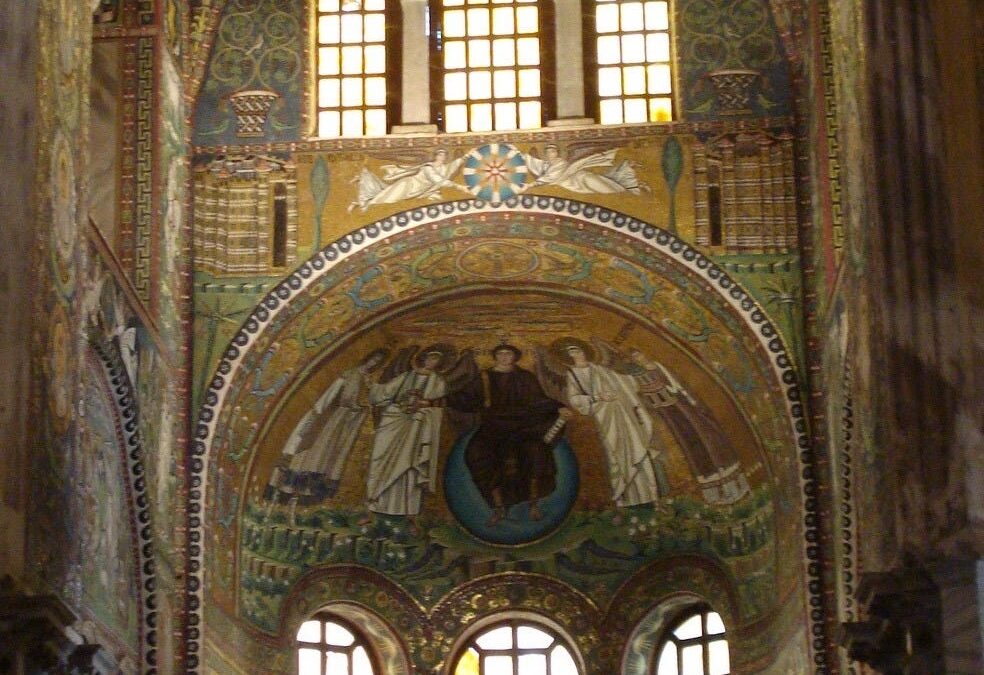
When we think of angels, we conjure images refined by centuries of Christian art: luminous beings with gossamer wings, robed in white, emerging from clouds to trumpet divine tidings. Yet this aesthetic – intimate, humanized, almost domestic in its piety – obscures a far more ancient lineage. The winged guardian was shaped by existential and quotidian fears and evolved across millennia, emerging first in the dusty temples of Mesopotamia.
The philosophical genealogy begins, as so much does, with Plato. In the Phaedrus, he writes with characteristic boldness about the soul’s ascent: “The function of the wing is to take what is heavy and raise it up into the region above, where the gods dwell; of all things connected with the body, it has the greatest affinity with the divine.”

«Πέφυκεν ή πτερού δύναμις το εμβριθές άγειν άνω μετεωρίζουσα ή το των θεών γένος οικεί, κεκοινώνηκέ δε πή μάλιστα των περί το σώμα του θείου ψυχή, το δε θείον καλόν, σοφόν, αγαθόν και πάν ότι τοιούτον»
For Plato, the wing was a mechanism of transcendence, the material fact by which mortal consciousness could touch the divine. Yet Plato understood that gods did not harangue mankind directly. Between the divine throne and the human petitioner stood intermediaries: daemons, as he called them, beings of a different order entirely. “The immortal is eternal and deathless and ageless,” he notes, “but the mortal is always perishing and changing.” These daemons occupied the space between the two.
What kind of an Ironist are You?
The concept of a personal guardian spirit, that is, a being assigned to shepherd the individual through a hostile cosmos, originates not in Greece but in ancient Mesopotamia. An Akkadian inscription from the second millennium BC captures the anxiety behind this theology with startling plainness: “He who has no god or a guardian angel when he walks in the street wears a headache like a garment.” The image is visceral: to walk unprotected through the city, through the unpredictable world, is to bear an invisible burden, a chronic malaise of the spirit.


The scholar Thorkild Jacobsen has argued persuasively that this theology emerged from genuine fear. The Sumerians and Akkadians inhabited a world they experienced as saturated with supernatural hostility. Demons prowled the streets at dusk. Capricious deities demanded appeasement. The natural world – the river that flooded, the sun that burned, the wind that howled – seemed animated by malevolent intention. In response, they cultivated the concept of a personal deity, a god assigned to one’s particular household or body, whose chief function was to protect the people. These guardians were called uttuku, and they were divided into categories: the benevolent shedu (male) and lamassu (female) served as protectors, whereas other uttuku harbored hostile intent.


The lamassu is particularly central to our visual history. In the imagination of the ancient Assyrians, she was winged – a hybrid creature combining the head of a woman with the body of an anthropomorphic bull, often horned and majestic. Yet this iconic form did not emerge fully realized. The Sumerians, the cultural ancestors and linguistic precursors of the Assyrians, carved recumbent anthropomorphic bulls with horned tiaras into the temples of Girsu around 2150 BC. These creatures bore no wings. They were terrestrial guardians, bound to the threshold, their power residing in their massive weight and their fixed watchfulness.
The transformation from wingless bull to winged hybrid reveals a conceptual evolution. Wings, in this context, signify the capacity to transcend material limitation and to move between worlds. As populations merged and empires absorbed the religious iconography of their predecessors, the figure of the guardian evolved to accommodate new philosophical demands. By the time the Neo-Assyrian King Sargon II commissioned his palace at Korsabad in the early eighth century BC, the colossal lamassu – now magnificently winged and carved from single blocks of limestone standing over twelve feet—had become the preeminent emblem of divine protection and imperial power.

The palace reliefs of Assurnazirpal II, Sargon’s predecessor, depict these winged deities in a new context: they pollinate the Tree of Life, participating in a cosmic regeneration. Here we encounter perhaps the earliest systematic depiction of winged guardian figures in something approaching human form – beings who are neither gods nor demons, but intermediaries, facilitators of divine will. Instead of ruling and commanding, they tend and enable.
This iconographic tradition, refined through conquest and cultural synthesis, traveled far beyond the walls of Assyrian palaces. It infiltrated the visual culture of surrounding empires and religions. When we examine the question of how angels came to look as they do, we are tracing a thread that leads back to the moment when a Sumerian sculptor decided that a bull, guardian and fixed, needed wings to communicate across the growing distance between earth and heaven.
The theological and artistic foundations were now laid. But the story grows far more complex when another civilization’s spiritual sophistication enters the arena: Zoroastrianism, the ancient Persian religion, would prove decisive in transforming these local guardian figures into the systematized angelology that would shape Judaism, Christianity, and Islam. That transition from protective spirit to cosmic combatant in an eternal struggle between good and evil is where our investigation will turn next.
Stay tuned for the next piece that will expand on the dualism that would reshape Western theology.
–
Contributed by
Dr. Hara Papatheodorou