Nigel writes about a long-forgotten chapter of Roman history: the rise and recipes of Rattus Romanus, consul, Stoic, and father of fusion cuisine.
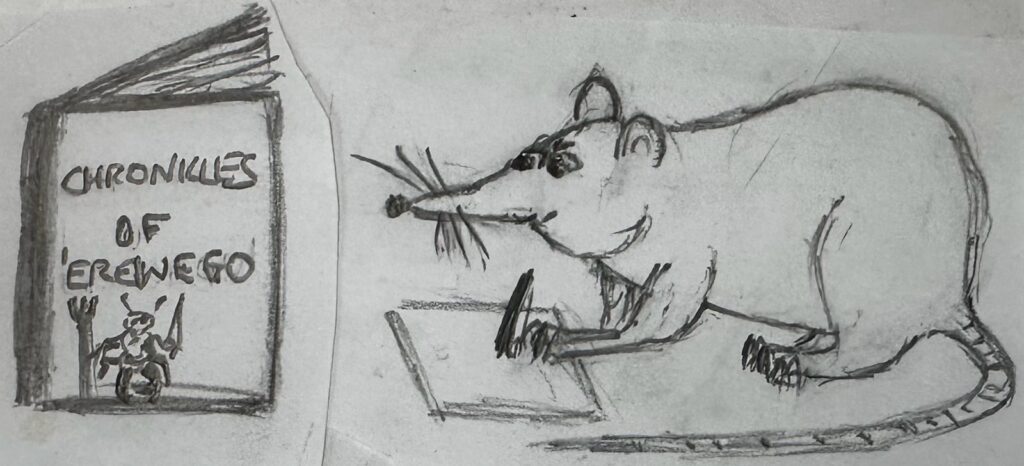
Drawing of Rattus Romanus transcribing adventures of the Capt. ’Erewego, a Phoenician pirate earwig, 2nd century scroll, found at Oxyrhynchus, Egypt.
Everyone knows the great suffering rats endured during the Black Death. For centuries, historians, poets, attractive widows and mangy cats have bemoaned the rats cut down by the bacterium Yersinia pestis. Whether it is the Old English epic poem Beorat, where the hideous Grendel pushes dying rats down the slippery stairs of the Wapping docks, or the elegy for the colony of rat-pup choristers (‘les choristes pinkies’), crying in agony, hurling themselves down the curving stone steps of the choir loft in Arles Cathedral, or even the folk tale of the immolation of Ali Baba and his four hundred rats in the winding alleys of Old Aleppo, there are many tales of tails wrapping themselves around bloated, screaming, bleeding, rats, slowly dying. It was, indeed, the town of Hamelin, that, after having lost its children, found the money to pay for a pied statute of a giant, swollen rat playing his pipe in the town square.
What is less well known is the story of Rattus Romanus, the greatest of the rat polymaths and fast-food cooks. It was he who split the first atom, or rather the first macadamia nut, which had been brought to Rome by barbarians from Cambria Nova Australi (New South Wales, Australia). Caligula, highly impressed, appointed him to the senate in AD 39, becoming the first rat consul. Rattus was a Stoic, a highly disciplined rat. Petronius mentions one of his recipes in his Satyricon: “dormice rolled in honey and poppy-seed, stuffed with pork…grilled with damsons and seeds of pomegranate.” His recipes were creative and resourceful. After Caligula’s assassination, during the long famines of Emperor Caludius a few years later, he came out of retirement to help with his most famous recipe. Today, it is known by its Chinese name, Fotiaoqiang, 佛跳牆 or 福寿全 meaning blessings and long life, and, since this is in the Fujian dialect, it sounds like Buddha Jumps Over the Wall.
The story of how Rattus’ Omnia in Ollam (‘everything into the pot’) got to Fujian province in China is short, but interesting. A notoriously hedonistic rat, Pamender Punjabi, was brazenly nibbling on oat biscuits being unloaded from a Roman corbita (sea-going Roman merchant vessel) from Caledonia (now Scotland) at Muziris, on the Malabar coast (now Goa and Kerala), and overheard sailors describing its ingredients:
· shark fin, fish maws, sea cucumbers, scallops, abalone, clams, conch meat, etc.
· chicken leg, pork tendon, prosciutto ham
· chicken or fish stock
· mushroom, spices, such as ginseng, radish, yam, Solomon’s seal (from the asparagus family), gingko berries
· if any ingredients are dehydrated, they are soaked first
· then steamed
Pamender Punjabi, the El Chapo of the Malabar Syndicate, sent his extended family to gather the ingredients, thieving from as far as Pataliputra (now Patna). These thieving rats, known locally as ‘lobbyists’ and ‘politicians’, talked widely of their task. Overheard by travelling Nestorian rats, the recipe was taken to China. Rats being less stoic in China became more numerous, and thus the Chinese version has overtaken Rattus’ version.
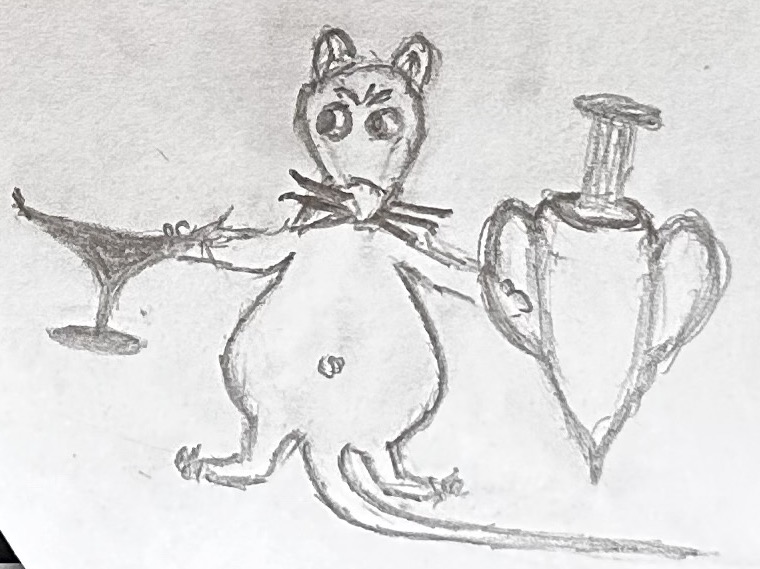
Fresco-secco painting on the sarcophagus of Pamender Punjabi, illustrating his rebirth after safe passage to the Cat-free World in the funerary ‘Drinking Ritual’, holding a kylix and an amphora, 4th century, Rat Necropolis of Muzrilis
To-day, there is no need for shark fins, and most rats find sea cucumber bland, easily overcooked, and of little use except to pick up stronger flavours. Pasta can be substituted. The major secret is to concentrate flavours, so a double boiler is essential for cooking – the wealthier, more urban rats use the fancy electric steamers that use a vacuum to draw liquids out, (popularized by the chefs like Ah Po, using such machines as the Forge by Pacifica), and will cook this dish in as little as an hour and a half.
Ingredients can be switched for what you like. Seafood, fish, chicken and pork taste well together so it is easy to prepare and to substitute. Serve with green veggies like bok choy arranged around the serving plate. It is good, very tasty, and smells divine!
(I had this once in Guangdong and my host kindly pointed out the rat bones to me – they were off-white, harder and denser than chicken bones; the small incisor teeth were quite distinctive).
It is probably safe to say that Rattus Romanus remains the only consul whose recipes outlived his empire.
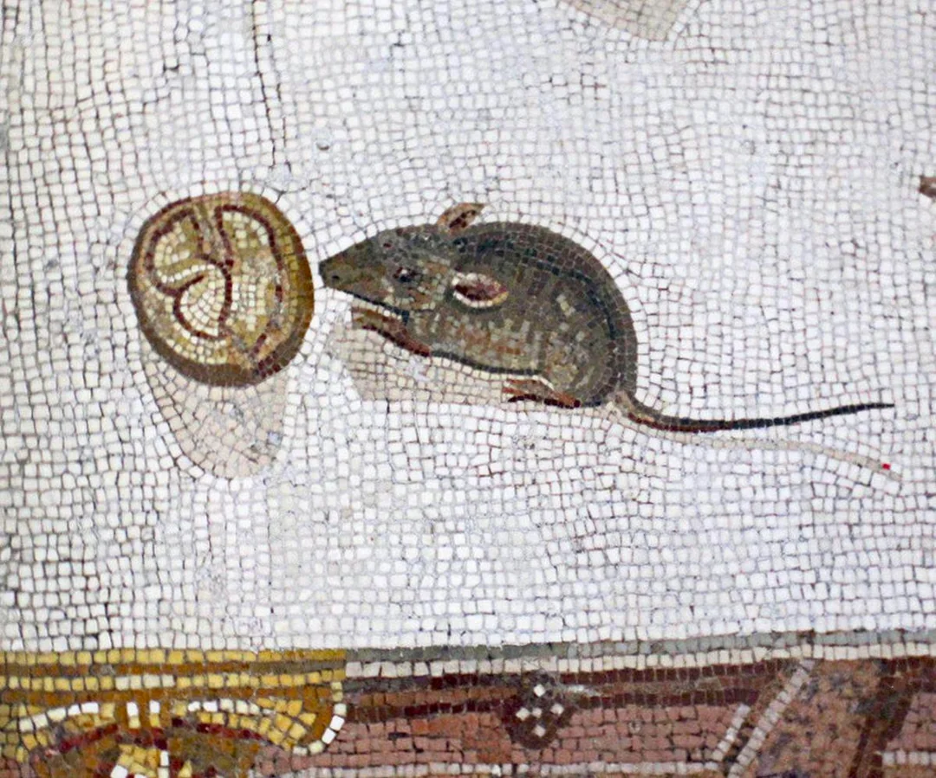
2nd century floor mosaic of Rattus eating a nut, Vatican Museum