A drive down from myth-haunted Mt. Parnassus into the passes, graveyards, and battlefields

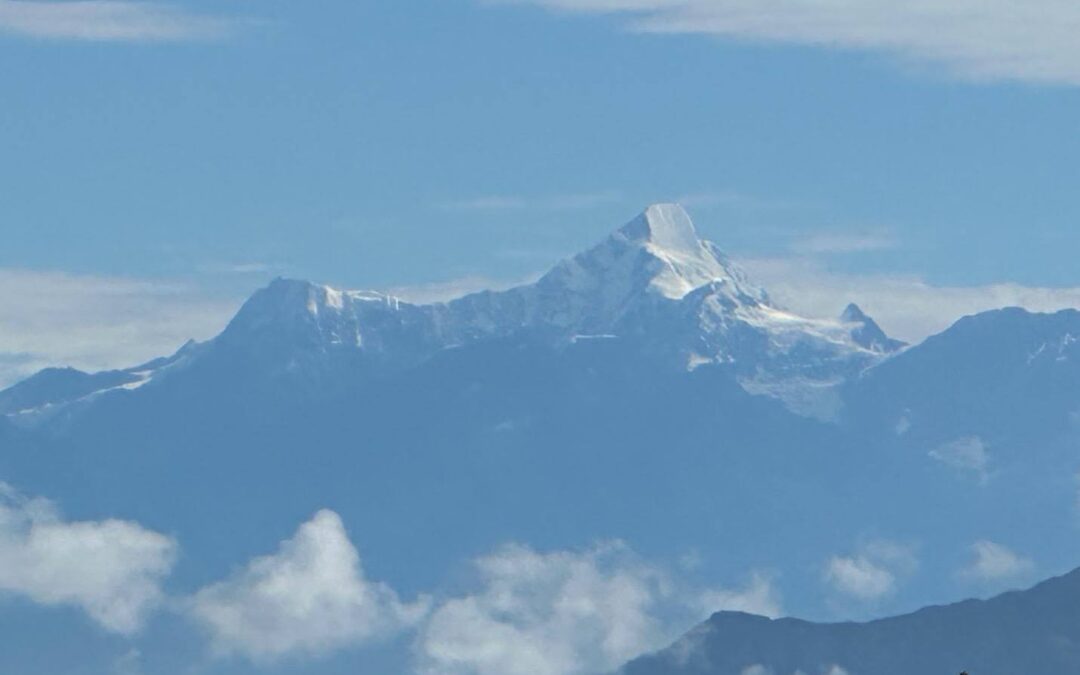
It is said that Zeus, the great philanderer, lay with Mnemosyne (Memory), a Titan, for a marathon nine-day, ‘sexathon’ on top of Mt. Parnassos. The Titans were colossal, and this romp must have been exhausting. In due course, she bore nine daughters – the Muses. These daughters were the goddesses of literature, science, and the arts, representing divine creativity. When you invoke them, they whisper inspiration in your ears. The Greeks integrated memory with history and cultural identity. Poets and orators combined education with the power of imagination.
Mt. Parnassos is not only massive, but it seemed to become magical and mythic as I drove around it. Some think the name itself comes from the Luwians, the shadowy antecedents of the Trojans. Zeus was purported to have declared it the centre of the world. Such was its imaginative power that students in the 17th century called part of the Left Bank in Paris ‘Montparnasse.’
The Greeks believed that imagination, tradition and analysis should play a large part in their lives. Today we may have too many ephemeral thirty-second reels and social media posts, rendering our culture excessively banal and eliminating the need for thinking. There is a tendency to regard only the ‘new’ as worthwhile. Too many seek instant gratification and too few seek self-reflection.
In contrast, the contemporary audience of Aeschylus’ Oresteia would have known the story of Agamemnon’s murder by his wife Clytemnestra. In that story of the wooden horse, the priests said Agamemnon had to sacrifice his daughter Iphigeneia before he could sail for Troy. Such an act raises the moral imperative – can you kill your own daughter for a greater purpose? The audience weighs the culpability of Agamemnon, who had to choose between differing requirements – those of kingship, family, religion, moral and personal pride. Agamemnon was damned no matter what action he took. Ironically, the great king had become a pawn.
All the characters in the play endure the consequences of their actions; even the innocent suffer. Like life itself, there is a universality to the inevitability of submitting to forces beyond our control. Iphigeina, whose name ironically means “Strongly-Born,” obediently submits to her sacrifice at Aulis, her warm blood running over the cold stone of the altar. Thus, imagination aids our understanding of the hard world around us. Even the ‘happy’ ending of the play offers no redemption – there is now ‘Law’, no longer merely ‘Vengeance’ – but the audience knows that there are inadequacies in the Law when a Tyrant rules…
I drove down from Mt. Parnassos through the Brallos Pass with a profound sense that much of our modern world has lost the awareness of moral complexity. Things aren’t black and white. When we think, we see that most things have shades of grey – and that is what makes it hard for us to choose. And we are wiser for seeing the shades of grey.
There was a rising morning mist and a light rain falling that day. Intermittent views of soaring mountains and deep valleys appeared and disappeared in spectacular randomness. It felt as though nature was sentient; watching. The narrow road twisted, turned, rose, fell and swept down to the sea. I loved using the gears of my little Fiat, the engine singing as it worked up the inclines and braked bravely on the declines. It was fun – and the Muses had kindly cleared the road of traffic.
In places I could see concrete footings of a future, bland, four-lane highway. I am sure there will be some great architectural, sweeping bridges. (In Europe, unlike so much of North America, they do spend money on good design). But it will be sad to see the two-lane road gone. Is life worth living if we have everything simplified for us?
Or is it that, perhaps,many want an anaesthetized life? Surely the ruling class prefers a less demanding electorate? Maybe this is why we get the governments we deserve. Continuing that idea, perhaps boring lives lead to the popularity of extreme sports? Possibly we are coddled to avoid challenges. Why exert or learn if a handheld AI-controlled telephone provides the answers? Is there a danger we could become the Eloi of H.G. Wells’ Time Machine? The Eloi lived a life without cares, but were raised to be eaten by the Morlocks. If so, what a future we have.
Certainly, as the little engine in my Fiat struggled on inclines, I had to double de-clutch and heel-and-toe to try and maintain a constant speed. These days, most cars are automatics, and the fun of a manual transmission has been lost. No ‘virtual’ computer game is as thrilling as go-karting in an empty parking lot…our lives are indeed drugged with gimmicks of induced indolence.
I stopped in Brallos. Exactly 85 years ago to the day in 1941, Australian and New Zealand battalions fought a fighting retreat here from advancing Germans. Back then, trucks had no synchromesh and no air conditioning – let alone power brakes and steering. I felt for the farmers from the flatlands Down Under who had to fight the German mountain battalion that had trained in the Austrian Alps.
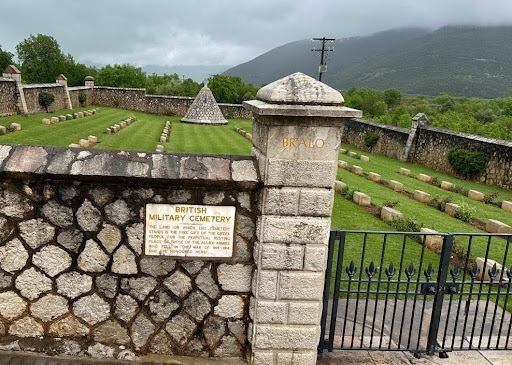
A military cemetery caught my attention – but it was from another war. In WWI, the 49th Stationary Hospital was established beneath Mt. Parnassos for soldiers of the Gallipoli campaign. It had an impressive view of the mountains, and was quiet and beautifully maintained. Many graves were from 1919. Perhaps some of the patients lingered here with war injuries before being carried off by influenza. How far from home they are buried. Seven were from the Labour Corp, Russians continuing to fight for the Allies after the Bolsheviks pulled out of the war. I was touched by Sapper R.H. Gibbons’ epitaph: “A noble death. Far from friends and family. Death divides but memories cling.” I wonder if those were his thoughts as he slipped away. It was tragic. Imagine losing a son or father. The loss for those people is no less from being so long ago.
I think for many of us the years have allowed us to reconsider the irrecoverable cost of WWI. The mindless wastage of young lives. Do we really need to fight so many wars? Have you noticed that the proponents of war avoid discussing the cost of a war?
It is only twenty miles to one of the most famous battlefields in recorded history – the stand of King Leonidas and his Spartans, Thespians and Thebans against the Persians at Thermopylae. Greatly outnumbered, the Greeks fought to the death, hacked by swords and skewered with arrows. The Persian King of Kings, Xerxes the Great, was a megalomaniac who had famously lashed, branded and shackled the sea after his pontoon bridge across the Hellespont had been destroyed in a storm. That was a delightfully extravagant act of hubris.
Although it may seem these battles and wars are far away and long ago, new wars loom over us now. As Wilfred Owen says of Horace’s Ode, ‘the eternal lie’ is yet repeated, dulce et decorum est pro patri mori (it is noble and just to die on behalf of your native land). We need to remember the cost of war, to analyze the consequences, employing our imagination and our memory. Most of the time, wars are fought for greed, and achieve nothing – except death and destruction.
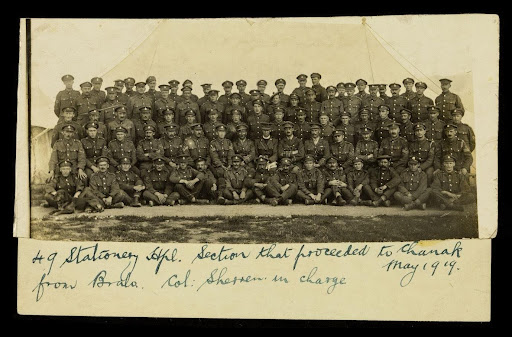
49th Stationary Hospital at Brallos, Phthiotis, Greece, 1919. Attribution-NonCommercial 4.0 International (CC BY-NC 4.0). Source: Wellcome
–
Contributed by
Nigel Scotchmer