ISSN 2817-7363
Irony: A Tonic for the Age
The Ironist is an open forum to encourage discussion and reflection upon the written word and the world around us to promote critical analysis. Irony, “the recognition of incongruities” (Cleanth Brooks), is a tool that permits differing perspectives to be considered about a passage or event. Irony is notoriously hard to define, and its importance in a passage can vary upon the reader’s own views. Hence the purpose of our blog/newsletter. By encouraging constructive criticism and discussion, we hope complex issues can be better understood, or appreciated, by exploring ideas presented by the use, intended or otherwise, of irony.
Find out the kind of ironist you are.
Take The Irony Index quiz
In our age of misinformation and the polarization of views, the importance of standing back to employ the sober second thought cannot be more important. At the same time, the ironic viewpoint is rewarding and enjoyable. Although, to be fair, when Jesus reflected upon the cross about his dying for the thankless millions of the human race, enjoyment of his ironic offering might not be categorized as enjoyment.
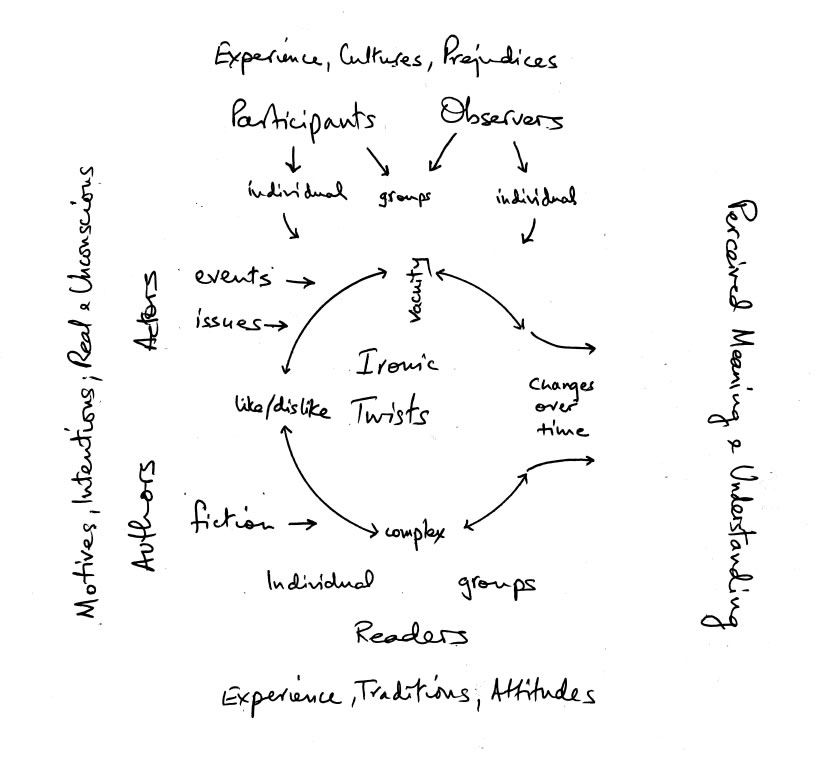
The Politician, the Painting, the Cosmic Event; all can be Ironic.
This drawing attempts to show diagrammatically how irony can be created, intentionally or unintentionally, and considered by observers and participants, and that the message delivered can be perceived and understood differently.
Irony’s effectiveness lies in the twists in meaning of what has been viewed, said, or written and what has not been viewed, said, and written. Irony creates uncertainty and contrary meanings. Created by such vehicles as humour, horror, doubt, omission, exaggeration, paradoxes and aporia, irony can be an effective iconoclastic tool against the cruelty, corruption and hypocrisy of the world; a moral and effective weapon to destroy disillusion and despair by inspiring good deeds. Irony is satisfying to those who use it – and those who recognize it. In fact, ironically, it can be more than that – it can be a civilized game of intelligence and fun!
“I come to bury Caesar, not to praise him….
For Brutus is an honourable man;”
Said Mark Anthony in Shakespeare’s Julius Caesar. Of course, he was praising Caesar and damning Brutus.