Shelley’s sonnet Ozymandias uses the Greek name for Ramesses II, the most famous of Egyptian pharaohs, and was written as a great statute of him was in transit to the British Museum in a wave of awe and Orientalism sweeping Europe. The poem captures both the power and majesty of a great King of Kings and the inevitability of his mortality and demise:
I met a traveller from an antique land,
Who said—“Two vast and trunkless legs of stone
Stand in the desert. . . . Near them, on the sand,
Half sunk a shattered visage lies, whose frown,
And wrinkled lip, and sneer of cold command,
Tell that its sculptor well those passions read
Which yet survive, stamped on these lifeless things,
The hand that mocked them, and the heart that fed;
And on the pedestal, these words appear:
My name is Ozymandias, King of Kings;
Look on my Works, ye Mighty, and despair!
Nothing beside remains. Round the decay
Of that colossal Wreck, boundless and bare
The lone and level sands stretch far away.
When we think of ancient Egyptians we think of what they left behind; their pyramids, their formal and impressive stone statutes, hieroglyphics and their wall carvings and paintings. Given the obvious resources spent on their pyramids and tombs, at first glance we may think that they were rather preoccupied with death.
But it is exactly the opposite. It was Life they wanted. They regarded a statute, or picture of an object, (or a hieroglyph), as more than a symbol of that thing; a picture was, in a sense, alive. A representation of that thing itself assumed the power of the object it depicted and had the essence of what it represented. The sun-god Ra that tumbled across the sky daily was also evident and manifested in the dung beetles that rolled balls of dung containing their brood of children. From the dung itself came life as hatchling beetles emerged…thus the god of the morning sun, Kepri, junior to Ra, was depicted as a dung beetle.
The representations of ancient Egyptians’ lives on tomb walls were to enrich their life in the afterlife. Therefore, paintings depict plentiful food from hunting, fishing, farming – bumper crops, animals abandon, and a surfeit of goods – many servants, slaves; children; wives; parties with their friends, even pictures of the dead and departed. Let the good times roll – forever!
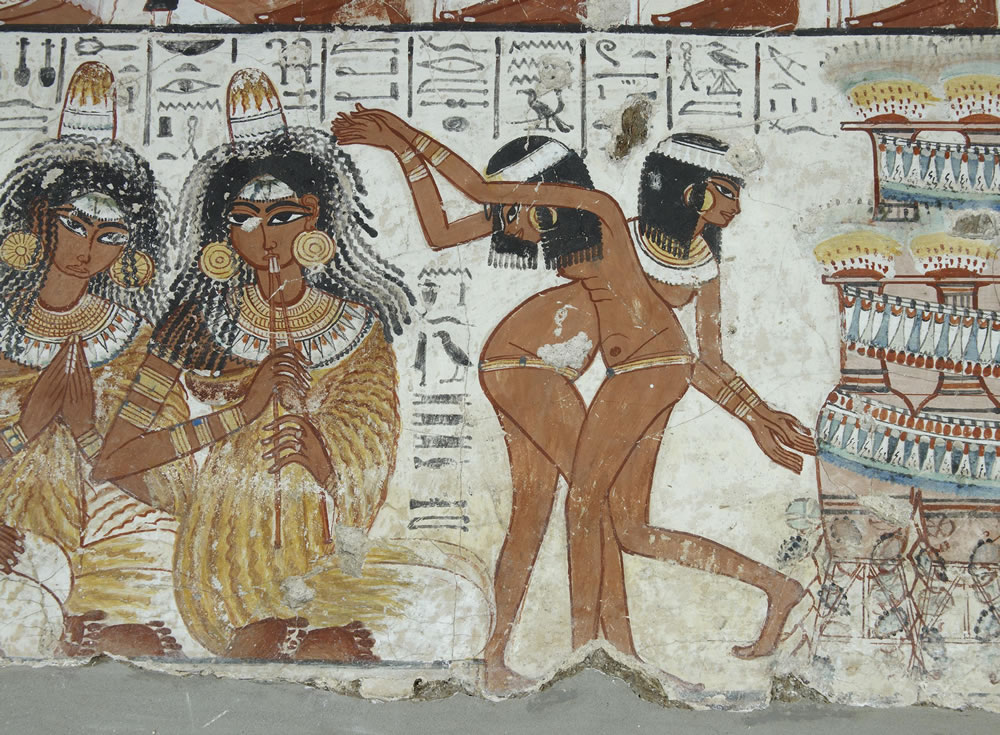
Egyptian Dancing Girls – British Museum
These paintings and carvings were echoed in powerful metaphors in their writings and rituals. Pharaohs eat parts of the gods for strength and power; the sky god Nut eats the morning stars at dawn; Anubis, the loyal jackal god protects the lonely tombs of the dead amidst the empty sands. The pharaohs are kissed and caressed by the gods as they climb ladders to the afterlife – and these cycles repeat and continue for eternity! Of course, things can go wrong – you need spells to protect you – the Pyramid Texts, the Coffin Texts and the Book of the Dead describe magical spells and apotropaic devices – but there is a sense of permanence and continuity. It was ever thus, and ever will be. The continuity of these beliefs, and their elaboration, over thousands of years, from before pre-Dynastic times, through the Ptolemaic period, until the rise of Christianity in Egypt, starting in the first century AD, only adds to the sense of self-assurance.
And yet – we have the Song of the Harpist. Sometimes written in the ugly hieratic script, only good for mundane uses, such as tax receipts (see pic), copies have survived, ironically, in better condition than Ramesses’ tomb goods of gold, statues and unguent oils…
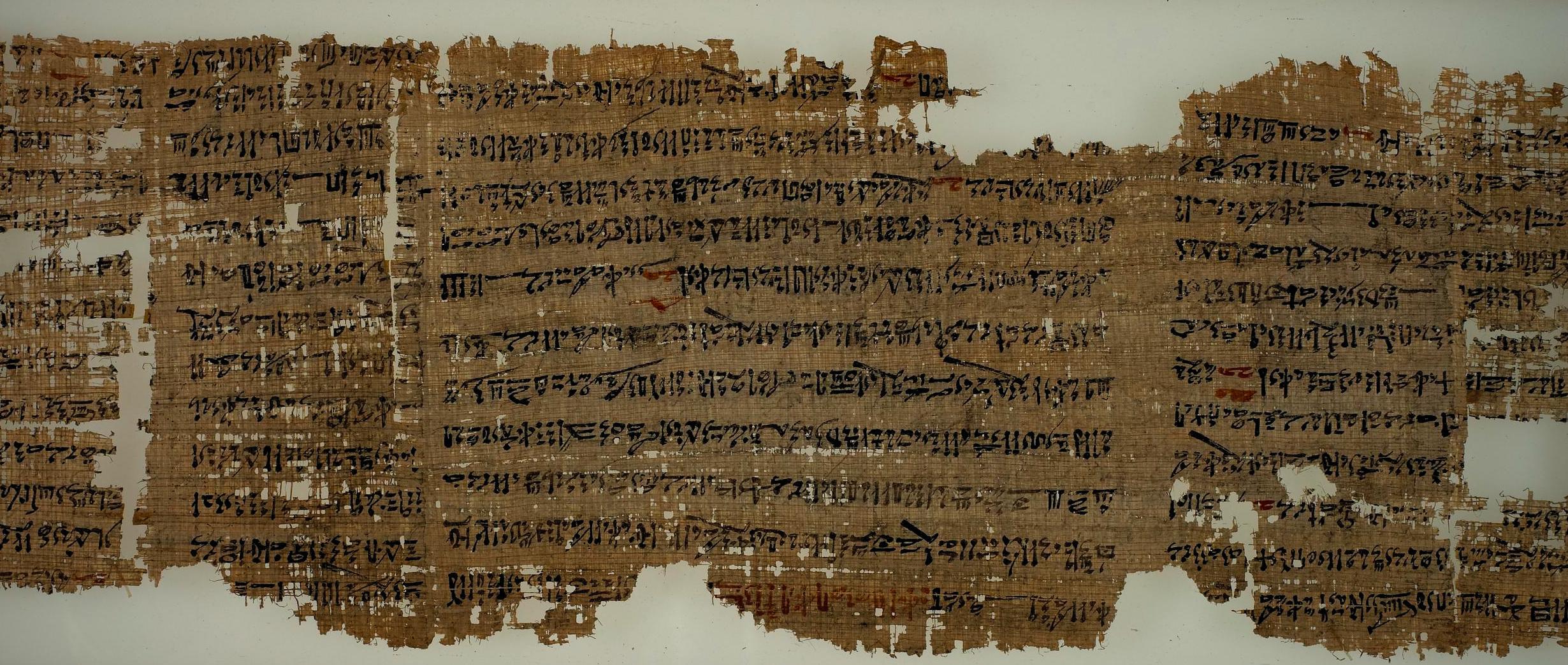
And what does it say? Surprisingly, the version below from the tomb of the Pharoah Intef in the Middle Kingdom makes fun of the great seer, magician, physician, architect (and later, deified), Imhotep, and counsels us to seize the day, and make hay while ye may…’cause, baby, it ain’t gonna last…
He is Happy this good prince:
Death is a kindly fate.
A Generation passes, Another stays,
Since the time of the ancestors.
The gods who were before rest in their tombs,
Blessed nobles too are buried in their tombs.
(Yet) those who built tombs,
Their places are gone,
What has become of them?
I have heard the words of Imhotep and Hordjedef,
Whose sayings are recited in whole.
What of their places?
Their walls have crumbled,
Their places are gone,
As though they had never been!
None comes from there,
To tell of their needs,
To calm our hearts,
Until we go where they have gone!
Hence rejoice in your heart!
Forgetfulness profits you,
Follow your heart as long as you live!
Put myrrh on your head,
Dress in fine linen,
Anoint yourself with oils fit for a god,
Heap up your joys,
Let your heart not sink!
Follow your heart and your happiness,
Do your things on earth as your heart commands!
When there comes to you that day of mourning,
the Weary-hearted (Osiris) hears not their mourning,
Wailing saves no man from the pit!
Make holiday, Do not weary of it!
Lo, none is allowed to take his goods with him,
Lo, none who departs comes back again!
(Translation by Donald Mackenzie, Egyptian Myth and Legend).
Maybe our Egyptians forbears were not so different from us. The harpist even says you cannot take your goods with you, let alone come back. What indeed did they believe in? Versions of this poem are painted on many tomb walls for thousands of years…Fear of death troubled them, too.
I like to think of the harpist in this picture below, painted on the wall of the tomb of the scribe Nakht, circa 1422-1411 BC, singing this poem at the Pharaoh’s feast – when he was alive, and perhaps for eternity, too. If you look closely, you will see he is blind.
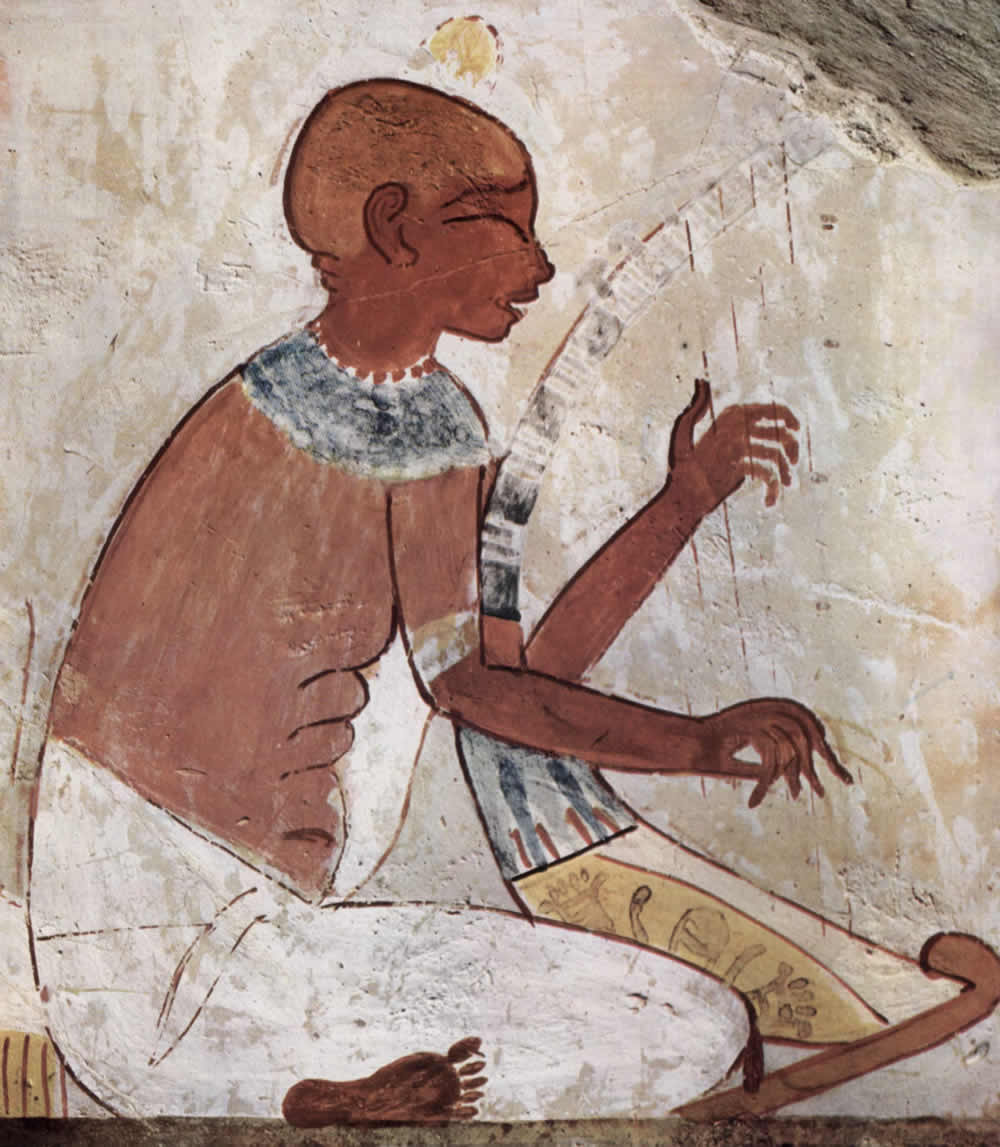
Maler der Grabkammer des Nacht