Königsberg was a jewel on the coast of the Baltic. For centuries the city was renowned for trade and culture. The city generated scientists, musicians and men of letters. Immanuel Kant is perhaps its most famous intellectual, and he never travelled more than 16 km from where he was born. He said that Königsberg was the ‘place for gaining knowledge …(about) the world …without travelling.’
The city suffered in WWII. The Jewish community tended to be a left-leaning, with a strong Haskalah component, and this attracted additional hatred from the Nazis. The conquering Soviets left the city 90% destroyed and then expelled the Germans. Now Kaliningrad, it is a pale shadow of what once was and is largely noted today for its Russian naval base.
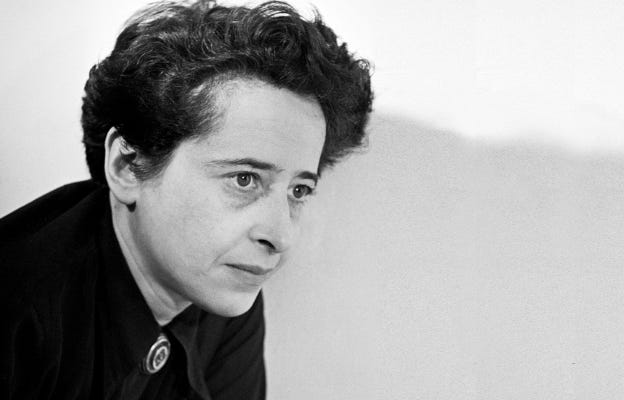
Hannah Arendt was born into a wealthy, highly educated Jewish family. She was a prodigious scholar, learning Greek in the early school years, and had read in Kant, Jaspers, Kierkegaard and Goethe before she was 14. She was expelled from a school at 15 and started her own philosophy and classics club. She was a passionate thinker. Her early poetry describes an intense introspection of alienation, Jewishness, femininity and an ability to find the profound in the banal. Ah, the start of irony!
By 19 she started an affair with the philosopher Heidegger, who was to later betray her (and his own mentor) by becoming a Nazi. The fact that she always loved this man (she wrote she had ‘an unbending devotion’ to him in the 1950s when they met again) further underlines her appreciation of irony. For she knew, firsthand, what the Nazis were. Yet that awareness did not overcome her affection for the man whom she had found to be ‘weak’ and ‘thoughtless.’ She can stand back and weigh alternatives…
When imprisoned by the Gestapo for her research work on antisemitism, Hannah Arendt escaped from Königsberg and became a stateless refugee in Paris in 1933. Here she helped Jews escape the clutches of the closing jaws of the coming ‘corpse factories’, what she called the infamous camps. Finally interned by the French as the Wehrmacht approached, she again escaped – this time to America.
America became her home. She fought against totalitarianism. Her most famous quotation, ‘the banality of evil,’ came from the trial of the Nazi Eichman who was not, as Ben Gurion announced, an evil monster, but rather ‘terribly and terrifyingly normal.’ He was someone who wanted to ‘go along with the flow’, a ‘joiner’, the ‘concentration camp guard’ who was ‘only following orders.’ Here was an ordinary junior sales clerk who became a big wheel in the Death Machine. What irony.
What she is saying is that he was WORSE than a monster, as he represented a kind of disease the unthinking could spread, wildly, through an entire culture, creating a deadlier evil than a simple monster – as it could become an unstoppable flood, enveloping an entire people. Evil could arise from boring inaction – the banal. Thoughtlessness by the many was a kind of loneliness, that led them to think people could be considered unnecessary and be removed on whim. Thoughtlessness encourages people to obey orders without a critical evaluation of the consequences of these orders.
She thought:
1. Everyone was important – every life mattered.
2. Free thought – free speech – was essential – education with critical analysis was of paramount, critical, importance.
3. Love – respect, and tolerance – were always needed.
The fact that she had been a stateless refugee gave her another perspective, one of non-belonging, a pariah, a displaced person, and this differing perspective is essential for irony. It also encourages tolerance of another’s opinions. In her essay On Lying and Politics she shows the dangers of organized lying by a party, and the only defence can be an informed, alert, citizenry. After the Eichman trial, Hannah Arendt became increasingly interested in moral philosophy – what should you do when faced with serious choices and moral dilemmas?

Indeed, we need only turn on the news to-day consider our own moral imperatives. As she considered the Eichman trial a show trial, it is a safe bet to guess what she would have said about Gaza. For Hannah Arendt, her poetry was the distillation of all of her beliefs. Her poem of leaving Europe behind is perhaps captured in this extract from an untitled poem from 1946:
Mournfulness is like a flame lit in the heart,
Darkness, a light that leads us through the night.
We need only ignite our grief,
To find home in the long dark night, like shadows.
The forest is illuminated, the city, the street, and the trees.
Blessed is he who has no home; he still sees it in his dreams.
Although Hannah Arendt understood the weaknesses of the human condition, she knew and wanted idealism – no ideology could adequately explore, explain, or define the importance of “being”:
…But sorrow will not silence
Old dreams or young wisdom.
Nor will it make me give up on
The beautiful pure joy of life.
From Lament, 1925