Nigel Scotchmer describes how two towns in Hesse, Germany, do not hide their times of trouble. They can be seen both as symbols of the horrifying depths of evil to which humankind can sink, and, at the same time, the resilience of the majority of people to try to be kind, just, and reasonable – most of the time. And, refreshingly, the towns acknowledge the evil that happened.
I arrived in Germany in late 1986, young and impressionable. I fell in love. I had a demanding and technical job, a fast car, an expense account, and free weekends. With few speed limits, I was in Munich in four hours; and places like Vienna, Communist East Berlin, and Hamlet’s Elsinore (Helsingør) were simple drives. Best of all, after work during the week, I could explore nearby.
I lived in Bad Orb, a post-card spa town on a hill. It was filled with the wealthy and the elderly. I loved two nearby towns. One was Gelnhausen, and the other, Büdingen.
Five centuries ago, 114 witches were burned alive in Büdingen. Today, Büdingen is idyllic. The town’s encircling mediaeval wall, with 22 towers, are extant, as are its original church, castle and most of its buildings. If you like old things, it’s lovely. However, the town is situated in a swampy valley, and it is built on a foundation of oak planks. The water table is kept high to ensure the air does not rot the wood. For good reason, the Bible exhorts us to build upon firm foundations. This is not to say, of course, that the witches would not have been burned if the buildings had had better footings. But since water breeds mosquitoes, it does help explain why malaria was such a medieval scourge here. Life was hard in the olden days – and that old widow who lives alone and talks to her cat is obviously casting spells to make us all sick.
Would anyone today say that those ladies were witches? Fools can deceive themselves, and ignorance and unfounded fear doomed those women. And, sadly, there is no end to humankind’s heart of darkness. As T.S. Eliot says in The Love Song of J. Alfred Prufrock, humankind is good at self-deception, as we can “…prepare a face to meet the faces that (we) meet.” Sadly, it is so easy to believe anything we want to believe.
It is easy to forget those old women’s screams of pain as they died. It was a long time ago and we are busy with our day-to-day tasks. Standing in that town square today, though, it is not so hard to imagine the sound of the crackling, burning wood, and the high-pitched screams of hopeless despair. No, we cannot imagine their pain. And if you were to look into the faces of the people that pass you by today, the faces you will see will not be very different from the faces of the people that watched the horrific burnings all that time ago – and did nothing. Why can we learn nothing?
The other nearby town, Gelnhausen, was originally called Barbarossastadt, after its founder Fredrich Barbarossa, Holy Roman Emperor, 1122 -1190. Sitting on a hill, the town can be seen for miles. It has a mill, and a gorgeous winding river, shaded with willows. It even has an aerodrome for gliders. Crowning the hill stands the Marienkirche, a splendid church that is both Romanesque (see the single tower to the right, in the picture above) and Gothic (octagonal twin towers, to the left). I loved to walk Barbarossa’s palace ruins, its castle walls, ancient towers, to sit in the central square, and lose myself in the winding, narrow streets. And what a history it has had.
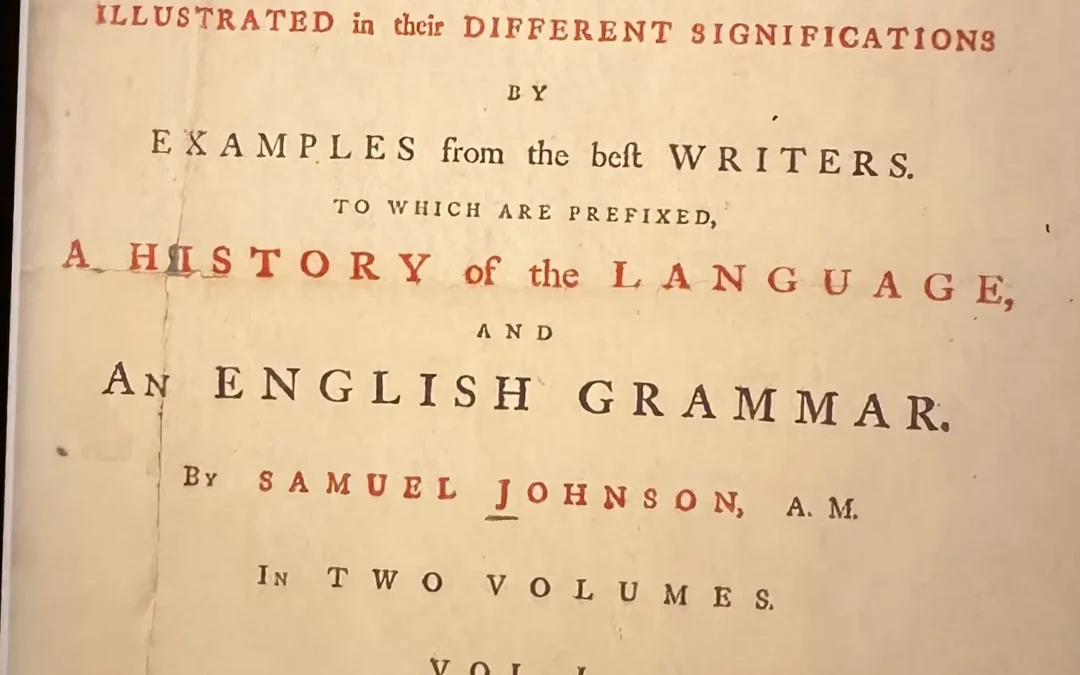
When the Russians freed my father from Stalag Luft IIIB in 1945, he and his friends picked through the Commandant’s ransacked office for souvenirs. One souvenir he brought home was a reprint of the Adventures of Simplicius Simplicissimus, with its (to me, at least), unreadable Gothic script (see the picture of the frontispiece, below). I was captivated by the unintelligible squiggles of the German language. Simplicius is described by Thomas Mann as “immortal in the splendour of its sins.” It is one of the first and most important novels of German literature. It has characteristics of a picaresque novel where the hero is a rogue that eventually redeems himself. But it is much more than that; it is a modern book as it describes both the horror of war and its absurdity.
As a child, I was fascinated with the picture reproduced below, as the character portrayed looks absurd, having the attributes of many animals, birds and fishes. What does the picture mean? And now I was walking the streets where its author, Grimmelshausen, was born.

Grimmelshausen, at the age of ten, witnessed the destruction of his town in the Thirty Years War, 1618 – 1648. The book recounts the horrifying civil war of grotesque proportions, a savage and fanatical war that was followed by famines and disease that accounted for up to three times the per capita loss of life compared to the losses of WWI and WWII. It was largely fought over Catholicism and Protestantism, and shaped Germany’s politics and culture into the 20th century. The Treaty of Westphalia that ended the suffering essentially re-established the status quo at the beginning of the war. What a waste.
While I was in Germany, I discovered aspects of German culture that I had not expected. For instance, Germans are sentimental – every house I went to seemed to have a Disney-esque picture of a “cute” little boy and girl holding hands, or one where a boy was peeing in a pot, with smiles all around, usually hung over the spotlessly clean toilet. (I wouldn’t want to be a black mould fungus in Germany). Germans were painfully protective of their ‘superior’ companies – my travel agent could not believe I would take a direct British Midland flight to Glasgow from Frankfurt over a Lufthansa flight to Edinburgh, followed by the transfers and wait for a tedious train to Glasgow. Back then, the shops were often shut in the middle of the day, most evenings, and, if I wanted anything besides cabbage or parts of a pig I had never heard of, I had to order it a week in advance. Yet they published maps of areas in Germany that had the least polluted earth for growing vegetables. There wasn’t that horrible international sameness that is so typical of travel today.
This was also an age before computer networks, and in my company, there were six young ladies doing sums on adding machines. On Monday, they smelled nice. By Friday, their body odour was less pleasant. When I asked our controller, a stereotypical East German battle-axe of a woman about this, she said they bathed Sunday nights, and the boys liked their smell by Friday nights when courting began again in earnest. It was, indeed, a disappearing world in the late 1980s. I did enjoy the town, its people and the ways in which it was different than what I was used to.
And then I came across the plaque on the wall in the town square. The plaque described that on a certain day in 1938, all the Jews in the town were put on a train and shipped off to be killed. The town of Gelnhausen, and before that, Barbarossastadt, had had a large population of Jews that lived with Christians, peacefully, for a thousand years. It had been a prosperous town, on the main road from Rome to Leipzig.
Within hours of the train leaving, their neighbours ransacked the homes of the Jews. Think about it: you lived cheek by jowl with a different culture for a thousand years. And you do NOTHING when Nazi bullies show up and take them away. These Germans knew the Jews were going to be killed – and so they robbed their homes. Immediately. Milton in Paradise Lost has Satan say “Evil, be thou my Good!” This is conscious evil; there is no desire for redemption. There is no going back.
The wife of a colleague befriended me. She told me how the Jewish community was hounded and driven out of Gelnhausen from 1933 to 1938 by boycotts, reprisals, and finally by the “Gelnhauser Pogrom.” Five years of allowing bullies to slowly take over. She told me how the matzevah, the tombstones, were taken from the Jewish cemetery to pave roads. This cemetery had been used since before the Black Death.
Let’s think about this. Tombstones were taken from graves to pave roads. It is not even enough to kill people and their families, and steal their goods, but they must remove grave markers that were memorials to those that had died decades, or centuries, before. This could not be some passing fad. It took years to build up the resentment and hatred to do this.
Let’s think of those families that were robbed, gassed and disappeared. They had families; they had loved ones; dreams; hopes; lives they were building. Memories that they shared. Children, the elderly; it was a community. Every one of them has a story. And it was all snuffed out. We don’t even know the names of those killed. Memory was extirpated.
So where does this lead us?
Is there a yawning gap between the illusion that we have a civilization, masking the reality of that it is ‘every man for himself’, that there is no collective ‘good’ to strive for, that we live in a type of painted sepulchre, with a rotten and stinking corpse within our hearts? Does this mean that just because we know we can run a red light, and get away with it, we will, or should?
Or should we note that there is actually a plaque on the main square, and a museum, which are eternal reminders to us where Germany went wrong in 1938. And the extent to which it went wrong. Humankind will not change – just listen to the news tonight – but at least the first step is the acknowledgment of the crime.
In J.R.R. Tolkien’s Lord of the Rings, Gandalf cannot destroy the ring himself as the ring will corrupt him. So, the task of destruction of the ring falls to a simple and humble hobbit, who has the freedom to say no. And brave Frodo answers that he will pick up the challenge. “All we have to decide is what to do with the time that is given to us,” says Gandalf. We must answer as Frodo did, to pick up the challenge and fight – and it is a MORAL fight – just as so many of our forefathers did.
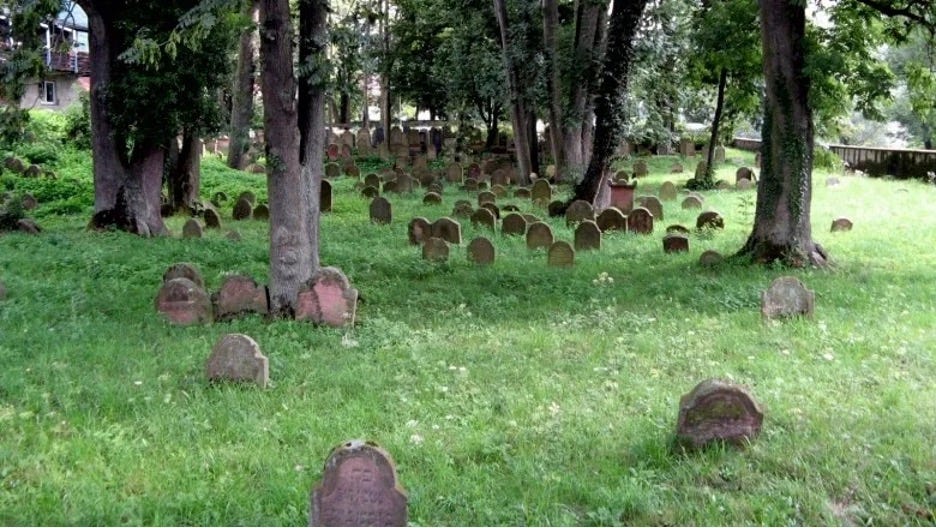
The Jewish Cemetery, showing the rejected tombstones that were too small to use for paving.