In 1729, Jonathan Swift wrote what might be history’s most horrifying dinner suggestion. He wasn’t hungry, just tired of moral hypocrisy.
I discovered Jonathan Swift in school through his masterpiece, Gulliver’s Travels. I was fascinated with the places Gulliver visited – and that’s probably what injected me with wanderlust. In this piece though, I want to talk about another work of his, something of a far greater import.
During his lifelong study of human indifference and cruelty, Swift did what any reasonable person in his place would : he suggested we eat babies.
Author of ‘Mis(s)adventures of a Salesgirl’ and ‘The 13-year-old Queen’, Aashisha moonlights as a marketing strategist and content professional. A computer engineer and MBA with 8 years of marketing experience and a globetrotter with 30 countries stamped on her passport, she is currently working on her third novel and a collection of free verses. She trusts Charles Bukowski when he said,"Some people never go crazy. What truly horrible lives they must lead."
Connect with her @aashisha_themindbin on instagram or visit her at www.aashisha.com.
Peter writes his sixth essay on the 'abusage' of language, an affliction all too rampant today. Polonius: What do you read, my lord? Hamlet: Words, words, words. Polonius: What is the matter, my lord? Hamlet: Between who? Polonius: I mean, the matter that you read, my...
A rambling on language, leisure, beauty, and the business of accepting what we can't control. Some things we think about, some we ignore. And some are more important than others. Does it matter if we fight against the inevitable? Or should we just accept it? Apse of...
Peter Scotchmer's latest short story introduces us to Wilf Wolflinger, apparently the smartest man on the street. My name is Wilf Wolflinger. You might have heard of me. I used to write travel books, but I’m too old for that now. My travelling days-- to Bogota or...
In this short story by Jack Stilborn, a construction executive builds his ten-year-old son a bridge to adulthood. The realization hits Adam as he parks his SUV. Margot’s Lexus is waiting for him in their driveway, a silent accusation. He has missed the meeting. The...
Polonius: What do you read, my lord? Hamlet: Words, words, words. Polonius: What is the matter, my lord? Hamlet: Between who? Polonius: I mean, the matter that you read, my lord. What follows is a review of two outstanding recent books on the value of reading, which...
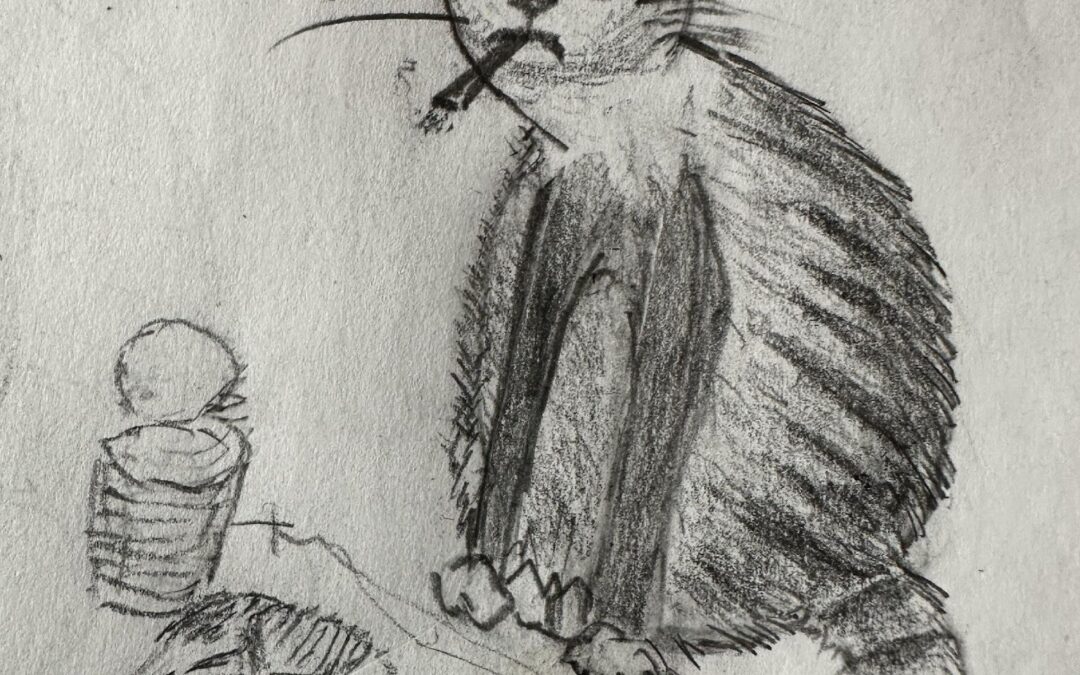
Our newest columnist, Mewubis, lives in a dumpster, judges humanity, and bears a suspicious resemblance to a Greek philosopher who did the same thing 2,400 years ago. Only he wasn't a cat. You ask me why I live in a dumpster? My friend, it’s my choice. Let me explain:...
This final essay traces how artists dressed the divine in imperial robes, gold sashes, and red shoes, and produced, in the Angel with the Golden Hair, one of the most beautiful faces ever painted. In the previous essay, we traced how Pseudo-Dionysius organized the...
Peter writes his fourth essay on the love of reading and the perils of speedreading. Read on! Polonius: What do you read, my lord? Hamlet: Words, words, words. Polonius: What is the matter, my lord? Hamlet: Between who? Polonius: I mean, the matter that you read, my...
Alfaaz means, simply, words. And words, read aloud and in good company, are the whole of what we’re after this month. On the evening of July 26, The Irony Club is opening the mic again, and this time we’re widening it considerably. It will run the way an open mic...
In her third post, Dr. Hara tells us how Seraphim came to outrank Cherubim, and Archangels ended up near the bottom. In the previous essay, we traced the angel’s transformation from local guardian spirit to cosmic warrior under the influence of Zoroastrian dualism....