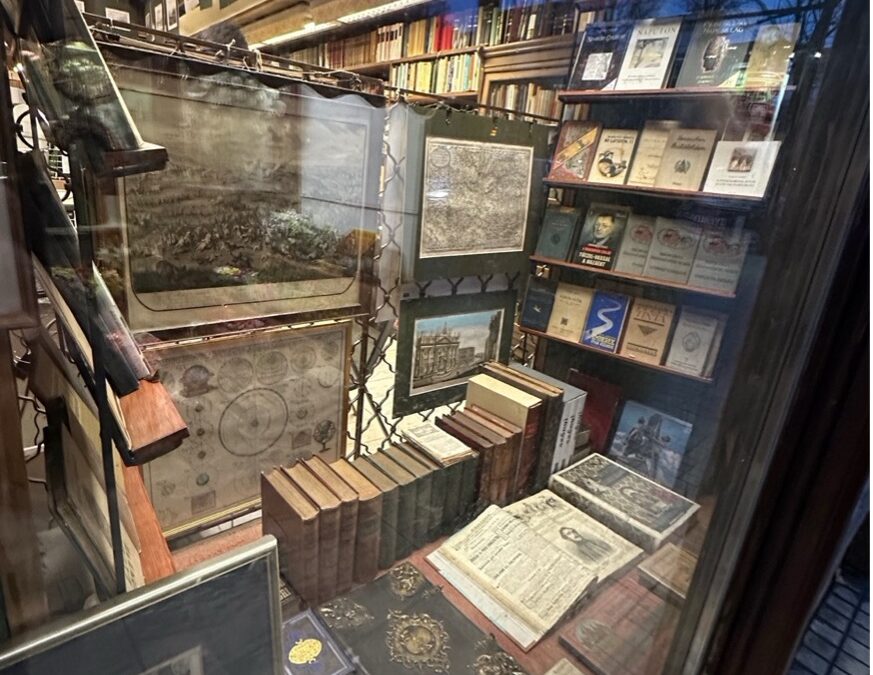
It is a supreme irony that the Ontario public school system, at least in its Peel District school board, should fall victim to wokeist activists of the ‘cancel culture’ persuasion, militants unrepresentative of Canadian majority opinion. Recent news reports of a clandestine assault on library books were made possible by the vigilance of Reina Takata, an alert pupil in one of its schools, who noticed empty shelves in her school library rendered bare by a sly purge of books considered to be insufficiently in tune with the school board’s policy of promoting material that “better reflect cultural diversity” than the board libraries’ current holdings. This underhanded removal renders disingenuous the claim that only worn or outdated books were being removed. A claim that only books published before 2008 (presumably a year of ‘Great Enlightenment’) were removed, and then only in order to “assess” them through “an equity lens” is evidently spurious. While the current director of education for Peel’s school board has denied earlier reports that Anne Frank’s diary and the Harry Potter books have been among those removed from library shelves, questions remain: what has been removed, on whose authority, and why this wholesale eviction? Why, also, the secrecy? Are the zealots ashamed?
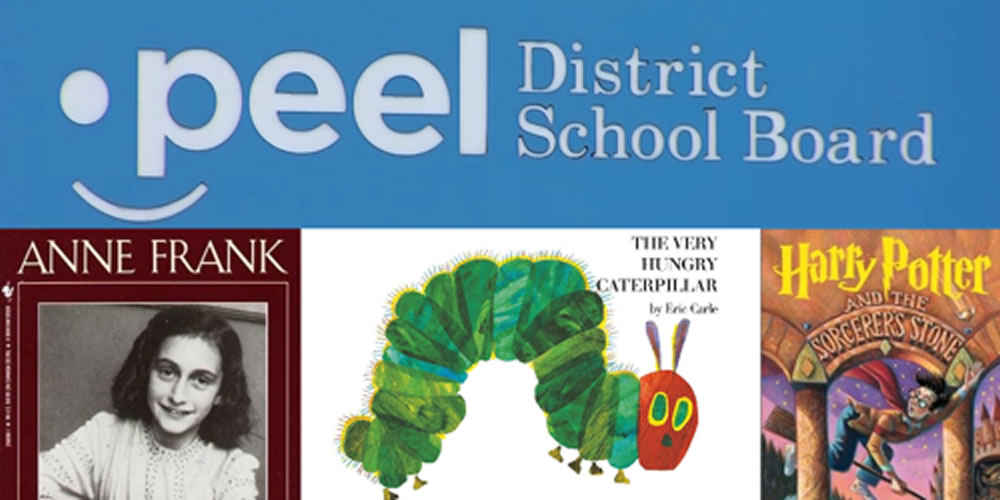
Picture From PM. The Post Millennium, Sept, 13th, 2023
They should be. Such purges are reminiscent of the notorious book-burnings in Berlin on May 10, 1933, in which 25,000 books considered “insufficiently German” were consigned to the flames, to the enjoyment of the crowds who applauded Minister of Propaganda Goebbels’ denunciation in Berlin’s Opera Square and the destruction of works by Einstein, Freud, Hemingway, and many others considered “impure.” The German writer Heinrich Heine was among the dissenters: ”Where one burns books, ”he said, “one will soon burn people.” This was prophetic: when Hitler’s inglorious Reich was itself destroyed, Nazi evil had consumed millions of innocent lives. While international reaction to the bonfires was at the time muted, condemnation by writers such as Helen Keller, Sherwood Anderson and Sinclair Lewis followed, but the damage had already been done. After the war, French activists who wished to erase all traces of Nazi ignominy by holding book burnings of the works of Nazi villains were misguided, as was a congregation in southern Ontario that reportedly recently held its own public bonfire of books allegedly portraying or describing black people in a derogatory manner. Two wrongs do not make a right, and, more importantly, allegations of evil need to be seen and publicly challenged, not buried. This is why Auschwitz exists today, and was not burned to the ground. One must never forget the past, warts and all.
This latest wokeist scandal in Peel is profoundly ironic because up until very recently, Ontario’s public school system was a bastion of opposition to authoritarianism and totalitarian rule, apparently secure in its affirmation of the need for critical thinking, independence of thought, the rule of law, and its commitment to freedom to read and make one’s own mind up about the reading material, something now denied Reina Takata and her friends. Freedom of speech and democratic government are also Canadian birthrights. Debating is encouraged. Matters of public interest are freely discussed. My high-school library even contained two copies of Hitler’s Mein Kampf, unexpected in a school with many Jewish students. Both the English and history curricula made and still make commitments to thoughtful enquiry clear in books recommended for study in the province’s high schools. A few well-known examples will suffice:
-George Orwell’s 1984 and his Animal Farm have long been on the English curriculum. 1984 is an expose of totalitarianism written in the shadow of Communism, whose repressive regimes held sway in eastern Europe for more than 40 years after the end of the Second World War. It depicts the citizenry of ‘Oceania’ in the grip of a duplicitous regime bent on falsifying the past, distorting the meanings of words, and monitoring the actions and even the thoughts of its subjects. Winston Smith, its protagonist, is hounded by the authorities for the ‘irregularities’ of his private life, just as homosexuals here were also, until recently. Animal Farm is a fable about the deceptions of politicians posing as champions of progressive thought who turn out to be worse than those of the regime they replace. I vividly recall a Vietnamese student telling her English class of the evil suffered by her family after the fall of Saigon in 1975 to Communists, and of the family’s horrific escape to freedom in Canada. Another refugee, fleeing Iran’s repressive regime under the Ayatollah Khomeini, was likewise inspired by Orwell’s commitment to truth, gained by his conscientious journalistic knowledge of the nature of such regimes.
-Ray Bradbury’s Fahrenheit 451 is a nightmare vision of the future, in which the reading of books is prohibited. “Firemen” are summoned to offenders’ homes to burn their books because the authorities fear the ideas contained in them. Citizens are encouraged instead to watch mindless soap operas on giant telescreens. The salvation for such a society lies in its outcasts, eccentrics who live a twilight existence on the fringes of society, and whose purpose it is to memorize entire books worth saving for the benefit of posterity.
-William Golding’s Lord of the Flies is a corrective to the naïve belief that good intentions alone are sufficient for the health of society. Ralph is a decent, well-meaning and legitimately-elected leader of a group of castaways on a tropical island who comes to the painful realization that all human beings, himself included, are ’fallen,’ and capable of evil acts. Written at a time of peace and hopes for a better future for mankind, the book is a study of the threat to democracy and civilization by those bent on the acquisition of power by threat, fear, and violence.
High-school history properly stresses the development of responsible government in Canada from her pre-colonial and colonial past to her emergence as a self-governing democracy, a friend to nations that respect the dignity of others, and a foe of terrorist expansionism. Attention is correctly given to the formative influences of Magna Carta, the parliamentary system, common law, the contribution of the ‘French fact’ to national life, and the legacy of two world wars in which Canadian forces distinguished themselves in the fight against oppression by bullying warmongers. Canada is a country where debate, informed discussion and compromise have produced a polite, law-abiding, moderate, and tolerant society that has, until very recently, welcomed refugees, avoided civil war, and shunned revolutionary sentiment and extremist behaviour, which is why woke tactics in Peel have been secretive. History teaching reminds us of commitments to safeguard citizens’ rights within Canada, and of peacemaking initiatives abroad. While U.S. history celebrates “life, liberty, and the pursuit of happiness,” Canada’s own trio of aims consists, less histrionically, of the maintenance of “peace, order and good government.” Long may Canada remain dedicated to these convictions. Restore to Reina and her classmates the freedom to read what was surreptitiously removed by the servants of totalitarian bigotry who have acted as they have simply because they believed that no-one would notice the extent of their arbitrary and unilateral vandalism. These students, in consultation with their parents and the advice of wise, trusted teachers if necessary, are intelligent enough to make their own decisions about the truth, and about what to read, about what matters to them.
Leave those kids alone. Return those books to their shelves. Cease the Nazifying of our schools, their families, and, above all, their students. Division is not “diversification,” intimidation is not “inclusion,” but exclusion, and exclusion itself is manifestly not in the interests of “equity.” The cancel-culture acronym is, in fact, aptly enough, “DIE,” not DEI. They can’t spell, either.