“I’ve often wondered why you don’t return to America.”
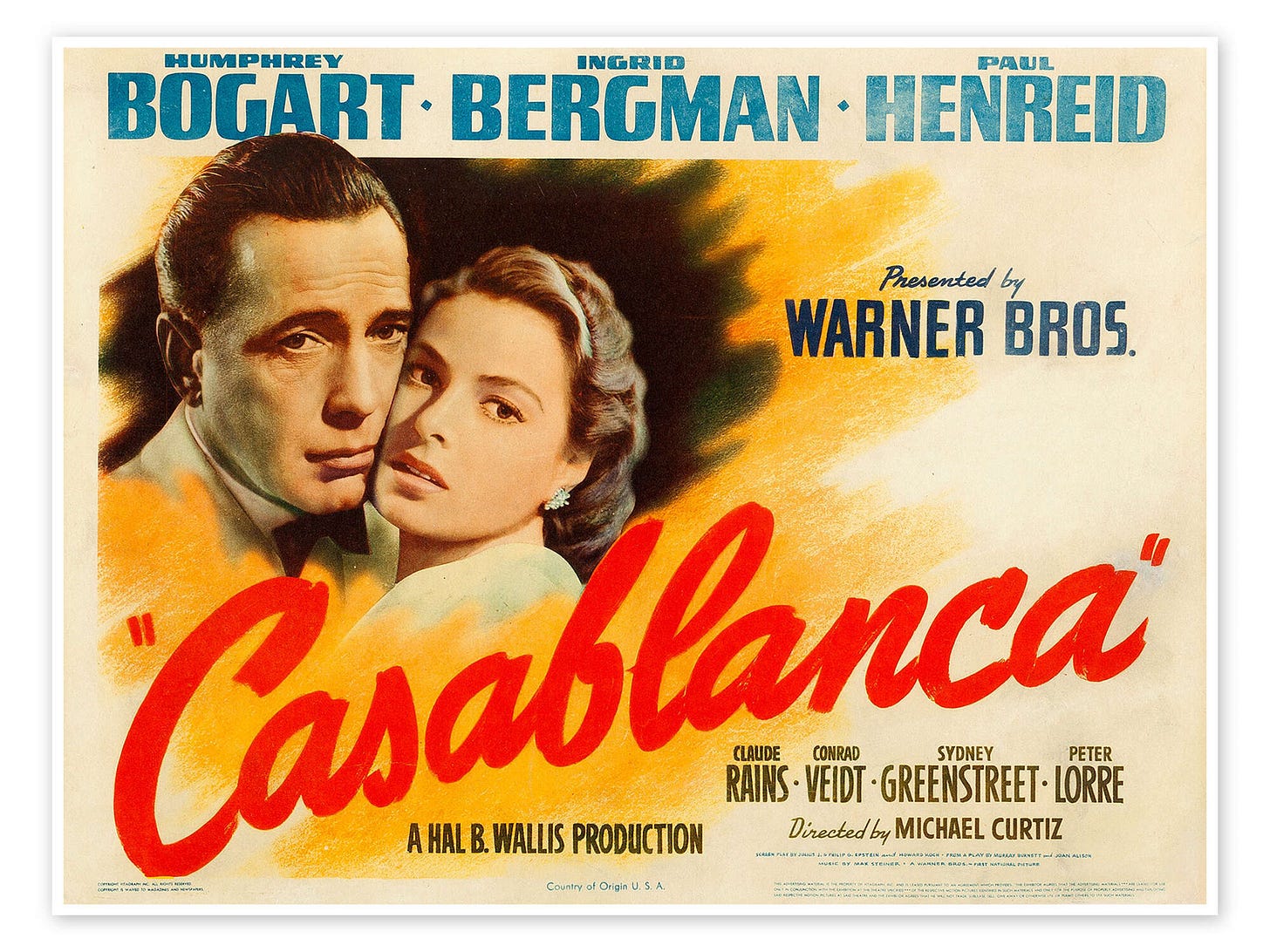
When the French police chief says this to Rick, we learn he’s an exile. We never learn why, but we get hints of communist leanings. “You ran guns to Ethiopia. You fought the fascists in Spain.” Many members of the anti-fascist Abraham Lincoln Brigade, which fought in Spain, were communists.
The Golden Age of Hollywood and the Foundation of American Power
Casablanca came out of the 1940s Hollywood golden age as America was realizing it would have to abandon isolationism. Ten years later, America carried itself with a new national confidence. It was victorious.
Today swaths of the anti-immigration right idolize the 1950s. Most of them were born recently, and seem to view the 1950s through marketing ads of the time. Like someone in the 2090s imagining what the 2020s were like using today’s popular Instagram profiles. Return (or “RETVRN”) to the 2020s when every man was a Sigma Male driving a Lamborghini and the women lived cottage-core lives with designer handbags.
For those of you who aren’t terminally online, “RETVRN” was a term used by right-wing posters who wanted the world to go back to a previous era culturally, economically, and politically. They’re usually male posters, and there’s often a gendered element where they want to “RETVRN” to a time “when men were men”. Usually it’s the 1950s, but the term could be used for any era. It was a play on ancient Roman lettering that didn’t have the letter “U” and instead used a “V” in its place. As online terms go it’s already out of date–mocked by their opponents to the point that it’s now used ironically to make fun of reactionaries.

Yet the confidence of the 1950s was real. What the RETVRN right forgets is what served as the foundation: the anti-fascist liberalism of the 1940s. The RETVRN crowd wants the 1950s without the 1940s foundation.
What kind of an Ironist are You?
The Refugee View
Casablanca is the story of refugees and immigrants on and off screen. Of the seventy-five credited actors, almost all were immigrants and only three were born in the United States. The director, Michael Curtiz, was Jewish-Hungarian and came to the United States in 1926. He still had family in Europe fleeing the Nazis.
Many of the actors had fled Nazi brutality. The waiter Carl, played by S.Z. Sakall, was Jewish-Hungarian and fled Germany in 1939. His three sisters died in concentration camps. The Bulgarian roulette player, Helmut Dantine, had been in a concentration camp. Madeleine Lebeau, Rick’s situationship, had fled France to escape Nazi occupation. Conrad Veidt who played the Nazi, Major Heinrich Strasser, was German and fled his homeland with his Jewish wife.
Aljean Harmetz in Round Up the Usual Suspects: The Making of Casablanca, wrote that this unique cast “brought to a dozen small roles in Casablanca an understanding and a desperation that could never have come from Central Casting.”
In the dueling German and French national anthems scene, Harmetz writes that a witness to its filming saw actors crying. He “realized that they were all real refugees.” The tears streaming down Madeleine Lebeau’s face as she sings La Marseillaise were real.

The Bogart Problem
Humphrey Bogart remains an archetype of classic masculinity. Even in his own time he was viewed as an unrealistic ideal. Try as we might, almost no man can sound like him. He spoke with a blend of growling street toughness and weary elegance. Almost no man can grimace like him. Almost no man can attract women like he did by carrying himself, as Lana Turner called a gentleman, “a patient wolf.”

Humphrey Bogart in a 1940s Warner Bros. publicity still (H.B. 268). A patient wolf.
As much as RETVRN American men try to recapture older masculinity, they can’t live up to him. Can any man? Unrealistic ideals aren’t strange. The manosphere today often takes James Bond as a paragon of masculinity. But Humphrey Bogart and Rick rarely come up on the political right. They’re inconvenient: Rick as a refugee-helping anti-fascist fighter, and Humphrey Bogart as a Hollywood liberal Democrat who marched against the House Un-American Activities Committee.
RETVRN Americans might like the image of Bogart, but they’d have to throw away the man underneath.
Tradition vs. RETVRN
This traditional film will continue to be part of the foundation of American culture and yet is an antithesis to the supposedly traditional American right. The Casablanca view of America was the view of refugees and immigrants. The film’s two only American characters are Rick and Sam. One is a jaded down-and-out, and his only connection to home is a Black man during a time of strict racial hierarchy. While RETVRN Americans crave a monoculture, the traditional all-American movie features a partnership of a white exile and a Black musician.
What we find is the story of a man who became a refugee and abandoned his ideals as failures mounted in life living with refugees fleeing in the other direction. There are echoes of young men abandoning America’s ideals on the political right today as they’ve lost status, respect, and opportunity.
Rick doesn’t return to America in the film, but when he sees what other refugees will endure, and gains closure from the woman who hurt him, he returns to the ideals America gave him and sacrifices his love for Ilsa for what RETVRN Americans would call a globalist cause–resistance to global tyranny.
–
Contributed by
Noah Mullins
About Noah:
Noah is an administrator, digital educator and a writer, hewn from studying the classics and anthropology. He explores the intersection of history, culture, and virtue today, with the aim of fostering tomorrow’s goals. Whether managing campus operations, or exploring the backcountry, he is driven by the elusive search for knowledge, improvement, and excellence – underwritten by a belief in the power of our inherited cultural traditions. When not writing The Lore Street Journal or crafting fantasy fiction, you will Noah somewhere on the Bruce Trail or researching the timeless ideals that build character.