An overdue retrospective
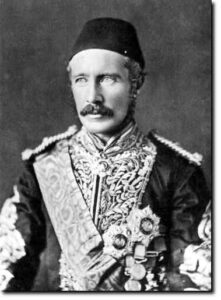 Major General Charles George Gordon, CB, 1833-1885
The Victorian Age was an idealistic age, beginning with the might of the Royal Navy breaking the thralldom of slavery outside the British Empire. There was a dawning acceptance of Darwin’s model of evolution, and the speed at which science was understanding and conquering diseases was increasing. The world was becoming a smaller place, just as popular imagination was expanding. It seemed as though suffering could be reduced.
It was with this backdrop Gordon accepted a military assignment in 1881 to investigate sites for defensive positions off the coast of Africa for British crown colonies. Clearly impressed by the lack of malaria in the Seychelles, its soil and its climate, he was particularly taken with the flora and fauna of the Vallée de Mai on Praslin Island. The General found time to both complete the first serious study of the coco-de-mer palm, a unique tree here with an immense odd-looking fruit, and then lobby the UK government for the protection of this untouched primary forest from development – nearly a hundred years before it was fashionable.
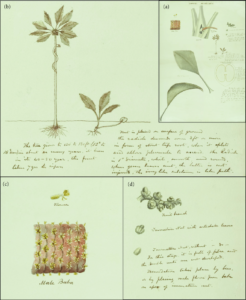 A page from Gordon’s manuscript, at the Royal Botanic Gardens, Kew
He also proposed – this was a time before plate tectonics – that this could be the original site of the Garden of Eden, that he may have identified what were the four river of the Book of Genesis, that the coco-de-mer palm was perhaps descended from the Tree of Knowledge or Life, and that its legendary fruit, (mentioned in Arab manuscripts from AD 851, which look like parts of the female anatomy, down to pubic hair) was perhaps likewise descended from the Fruit of the Tree of Knowledge. Here was a man of imagination and of frenzied enthusiasm – and clearly a man of action.
What I hadn’t expected was his whimsy. I knew him to be religious and earnest, but I had not expected him to have a sense of humour, drawing little serpents climbing trees, to tempt Eve, so to speak. It’s playful and delightful – and has brought many a smile to scholars reading his reports. Take a look at the picture above; a scholar pointed to the serpent, I didn’t see it at first.
Gordon had that Victorian “muscular” desire for self-improvement and inquisitiveness. I can see him sitting in either the high-ceiling, heavy canvas tent of a British army Campaign tent, writing at the military-issue, slim-legged folding table beside a low bed, sweating in the 40-degree sultry air of the Indian Ocean (or beside the Nile), or, perhaps, as my brother Peter described it:
writing that Victorian ‘occasional’ piece, suggestive of vagrant thoughts made more significant by apparently whimsical connections made by an armchair philosopher in the calm, induced by thoughtful reverie in a book- lined study, away from the ‘madding crowd’s ignoble strife.¹
Like many people, I did not know much about Gordon, his achievements, or his life. This is a mistake, as we can learn a great deal from some flaws in his character, as well as admire his idealism, his burning desire to lessen suffering in the world, and his unflagging ability to inspire and lead others. He was a man who, quite literally, never tired of trying to make things better for the less fortunate. And, unusually, a man who avoided fame.
Let’s start by remembering his life-long desire for martyrdom. He seems to have had a desire for a glorious death in his first war, the Crimean. It is plausible he even sought his own death when he disobeyed orders to evacuate the Sudan, which was suffering from the predations of Muhammad Ahmad in the Mahdist War between rebellious Sudanese and the Khedivate of Egypt, (1881-1899). There is a film starring Charlton Heston and Laurence Olivier, Khartoum, where the climax is his martyrdom at the top of the stairs, captured in the famous painting in the Leeds Art Gallery:
¹ Thomas Gray, An Elegy written in a Country Churchyard,
https://www.thomasgray.org/texts/poems/elcc
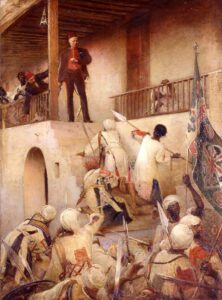 General Gordon’s Last Stand, by George Joy
It is a ‘big-action’ 1960s film, and I enjoyed it as a small boy as it has many battles and a simplified plot. Here is a link to some trailers:
I think it is worth noting that Gordon never tried to convert the Muslims of the Sudan to Christianity, whereas the Mahdi was an Islamic extremist who believed he would establish a worldwide caliphate by force.
Gordon’s earlier life, however, is considerably more interesting – and both impressive and daunting. He came from a military family of some five generations, and from an early age assumed that if he received orders or instructions that he thought were unjust or unfair, they were to be disobeyed. This, you would think, would not be particularly appreciated in the army by his superior officers. In fact, he was held back from graduation from the Royal Military Academy for two terms in the hope that he would learn to obey. It says something about the inspired leadership at the school that he was accepted into the Royal Engineers in spite of his continued obduracy. Once there, he excelled as a sapper, immediately showing talent in engineering works and leadership. Apparently, he was always able to command undivided loyalty and devotion, a skill held by few – and very useful in the military. He tobogganed down Mt. Arawak on a dare, loved amateur photography – and his love of biology was already noted. He was decorated by the French and the British army for his bravery in the Crimean War, becoming good friends with both Alfred, Lord Tennyson and Florence Nightingale. Clearly, he was a remarkable man.
International fame came to him in the service of the Emperor of the Qing dynasty, where, as a mercenary, he commanded the Ever Victorious Army, winning 33 battles in a row and defeating the Taiping Rebellion. Sadly, not much is known about this war in the West, a devastatingly serious war where approximately 20 to 30 million died of war, famine and the plague – possible 10% of the population of China. Led by Hong Huoxiu, the rebels believed Hong was the brother of Jesus Christ and the son of God the Father. Missionaries were very active in China, and luckily no missionary would baptize Hong or it might have been even worse. Gordon stood out in this horrible war of some 14 years as incorruptible and honest (he refused all financial rewards for himself). He is renowned for reducing the slaughter of soldiers and innocents by careful military planning and execution. He became known as ‘Chinese Gordon’, with the journalist Mark Urban saying “People saw a brave man who acted with humanity in an otherwise ghastly conflict, standing out from the other mercenaries, adventurers, and cut-throats in wanting almost nothing for himself.”
His adventures in China ended when he bluntly told the Manchu, the minority ethnic rulers of the Qing, that unless they lived and worked with the Han, the ethnic majority of China, there would be a revolution, and that the Manchu would be replaced, which, eventually of course, they were. As was he – but he said what had to be said. Honesty was a hallmark of his.
After this, he returned to the UK, where he tried to convince Prime Minister Gladstone to buy the land from the Protestant Ascendancy in Ireland to relieve the suffering and poverty of the Irish – which he believed was the worst scandal he had ever seen. He said, “The peasantry of the Northwest and Southwest of Ireland are much worse off than any of the inhabitants of Bulgaria, Asia Minor, China, India, or the Sudan.” He failed in this endeavour. But he had the courage to try and make a difference by proposing solutions.
Another of his fiery convictions to do good was to take on the ever-present Arabic slavers when he was worked for the Khedive of Egypt (1873-1877) and was appointed Governor General of the Sudan (1877-1879). The Royal Navy’s work on the seas supressing the slave trade needed support on land, and there was much that was impressive in Gordon’s zeal and drive over the years that never abated. He was an evangelical Christian, belonging to no particular denomination who considered the British army’s regimental system akin to Christian denominations. He did what he could to reduce slavery. Every year he gave away 90% of his salary to charity.
Gordon was a gentleman, but he was no saint. His whimsy, his eccentricities, his contrariness, his bluntness verging on rudeness, complemented by his impulsiveness, incoherence and his frequent appeals to the Prophet Isaiah, which, undoubtedly, were annoying to many. He was weighed down with a sense of his own guilt and unworthiness. I am sure he was insufferable at times, and yet strove, wholeheartedly, to do what he thought was right – and that these qualities were what men recognized in him and would gladly follow. There was depth and reason for Gordon to be considered a great man of his age.
Let’s consider one of Gordon’s critics, Lytton Strachey. He was a founder of the Bloomsbury group, and attacked Gordon in his Eminent Victorians. Strachey was gay, wheezy, a pacifist, a snob, an atheist, most likely a paedophile, and completely in love with himself. Excepting that they were both Victorians, Strachey could not be more unlike Gordon. Today we read that Strachey controlled and abused his primary female partner in his homosexual threesomes, the gifted artist Dora Carrington. We hear how he and his aristocratic friends had a “higher sodomy”, of how his rich university boys had “superior” sex than poor folk, and in his letters we read that there are references to strange acts of mock crucifixions, “cutting”, and other less common sexual acts.
When Strachey never obtained the university position he lusted after, and thought he was owed, (it was not just the young men at Oxbridge he wanted, he was a clever stylist, and a brilliant ironist), it has been suggested Eminent Victorians was his jealous answer and revenge to the absurdities and failures of his own life, and that Strachey wrote this book as a wholesale assault on Victorian mores and culture. Of course, perhaps his failure to obtain the posting he wanted was caused, in part, by an awareness, not openly acknowledged, of the unacceptable excesses in Strachey’s, and his group’s, collective behaviour.
Now great homosexual artists – and that is not to say Strachey was one – are often, and have to be, circumspect in what and how they express themselves, employing ambiguity, mystery, artistry and genius. They are outcasts, contrarians, ironists, and greater artists themselves as a result of the very suffering they endure from a hostile world. But Strachey’s bitterness by belittling Gordon in unfounded and false innuendos of supposed, (and now discredited), “excessive drinking” and “homosexuality” is just sour grapes and patently false. Strachey’s wit is mordant; not mellifluous; its overall effect is debilitating. It is as though his own convoluted and unhappy sexual life reflected his own inadequacy and absurdity, he knew this, and he could only find happiness and consummation in his writing style to mock people he knew were better than he. What a waste of talent; what waste of a man Strachey is.
In conclusion, could you see Lytton Strachey giving 90% of his salary away every year to the poor, of considering his own insignificance, or of inspiring men to lay down their lives for a cause – let alone thinking about, or of trying to help, others? I ask you, what is a great man if it is not a General Gordon?
Contributed by Nigel Scotchmer