Finding Her Voice
Lou-Ellen Lewis was a quiet girl given to reading. She was not shy, but her reflective disposition discouraged her from revealing her inmost thoughts openly in class. Unlike so many of the other girls, enthusiastic and vital as they tended to be, ‘Lulu,’ as they called her, seldom volunteered to join literary discussions, although she was clearly a calm and patient listener whose clear and exceptionally compelling writing revealed unusual maturity and depths of moral seriousness. She was a part of the class, yet apart from it. She thought for herself, yet did not wear her heart upon her sleeve. The energetic and self-dramatizing personal disclosures typical of teenage girls were so much in evidence that Mr. Matthews, their senior English Literature master, was disappointed that the boys seemed tongue-tied by contrast. As it was a school for the arts, entrance to whose elite English Specialist program was limited by examination and audition, it was not traditional male indifference to the humanities that limited their contributions to classroom discussion. Perhaps they were intimidated by the girls’ disproportionate numbers: boys were outnumbered three to one. Matthews was nevertheless disheartened by their lacklustre performance. Lou-Ellen’s reticence made her seem to him a natural ally for them. For the boys, her allure was obvious, but her banter with them was always cheerfully innocent. She saved her passion for writing and for books, not boyfriends.
“Do you mind being called ‘Lulu’?” Mr. Matthews asked her one day. He had always called her Lou-Ellen.
“No, not at all. Should I?”
“I know it’s a nickname, but it seems one for someone much younger, somewhat empty-headed, perhaps, very much what you are not.”
She smiled. “I’m glad I’m not empty-headed. No, Lulu is fine by me, Mr. Matthews. ‘A rose by any other name…’”
“’Would smell as sweet…’ “He finished the allusion for her. “Yes, very true,” he agreed.
“Adults call me Lou-Ellen…”
“Then I’ll continue to do likewise.”
She smiled her acquiescence.
As the semester wore on, Mr. Matthews became concerned about Lou-Ellen’s slow progress with her independent study project. Each student had to choose an individual literary topic, do the assigned reading, and develop an argument for a final essay based on his or her understanding of the text or texts chosen. Each was either to write two or three informal progress reports or submit to the same number of oral interviews with him. Most chose the interviews, thinking them less work, but not Lou-Ellen. She wrote well, as always, but had trouble choosing a topic. She abandoned Wuthering Heights after she found she “detested Heathcliff for his mistreatment of Cathy and others, for which there is no excuse,” called the romantic plot “melodramatic and unconvincing” and could not decide on whether to examine a comparison between two dystopian novels, 1984 and Brave New World, both of which she had read sympathetically, or study the role of women in novels by Margaret Atwood and Margaret Laurence. “I dislike the label ‘feminist,’ because I disapprove of any activist aggression and misanthropy, but I might make an exception for these two…” She gave good reasons for her indecisiveness. Matthews commended her for her work, but reminded her that time was passing quickly. “She who hesitates is lost,” he wrote. “You need to make your mind up!” He did not comment directly on her last paragraph, in which she had written, unexpectedly chattily,
“You asked me if I liked my nickname. My mother was Welsh and had always wished for a boy. When I turned out to be a female ‘disappointment’ to her (her word!), she had to abandon the name ‘Llewellyn’, but settled for Lou-Ellen instead. It was close enough, I guess. She disapproved of ‘modern life’ and modern writing, and was an angry and frustrated writer herself. My home life was not easy, so I found escape and solace in reading, away from the bitter, often violent, conflict between my parents. As I have no siblings or extended family, I kept all of this within. My father was remote and unsympathetic, and ‘took to drink,’ as they used to say. My parents fought continuously. They were, sadly, weak and broken. I bear them no malice, but have always needed to find my own way. I tell you this because I think you understand me. Few people do.”
He noticed her use of the past tense. Was the conflict now at an end, then? He doubted it. He added an encouraging neutral note as a postscript and moved on to the next student’s work, wondering why she had not spoken to him in person rather than confessing private difficulties in print, but perhaps she could speak her mind more freely to him in non-committal written form than in speech, with its essentially intimate eye contact and accompanying body language. Some people were like that, he conceded.
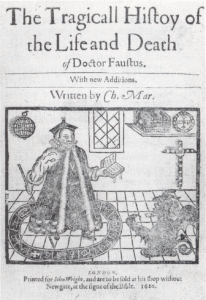
When it came time for the next report, he was quite unprepared for it. Lou-Ellen had made up her mind for another topic altogether. She had made an odd choice of the play Doctor Faustus, by the sixteenth century playwright Christopher Marlowe, a contemporary of Shakespeare’s. She had read it three times, awestruck by its story, and had also read a sympathetic biography of Marlowe’s tempestuous life and violent death. This was a play with a traditional theme about sin and damnation, written in a bygone Christian era by a rebel against conventional behaviour, now embraced by a modern girl in a post-Christian society, inevitably influenced by the religious skepticism of her own time. Matthews had no reason to think she was religious herself. Perceptive as her understanding of the play was, Matthews felt as he read her report much as a priest must feel listening to a penitent’s confession, for she had written :
“I live in a group home outside the city. It is chaotic working there, with constant fights, arguments, chaos and confusion, but I manage. I use the local library a lot. My housemates are druggies, ‘troubled kids’ from broken homes, just like me, and other lost souls. I am there because I lost my home, my parents, and, at one point, even my voice, lost, doctors say, as a result of ‘domestic trauma.’ My father assaulted my mother and then me. The details are unimportant, but I could not speak for months. I was ‘voiceless’. Even now, I am afraid of being unable to use my vocal cords, and prefer ‘self-revelation’ by way of writing. I know I am not a conversationalist. I have always wanted to be a writer, but never to stand on a stage and spout. I am not an exhibitionist. I now sleep next door to a ‘very disturbed’ young woman. She screams at night, steals things, and lies about it. I don’t dwell on any of this, and am not seeking pity, but merely explaining the context for my slow progress with my project. No one else knows any of this. I tell you it in confidence. I am drawn to Faustus because I well understand the temptations he succumbed to, and the reason for the playwright’s interest in his character, given his own difficult life. I will prove this to you. Please trust me to find my own way. I know I can rely on your help if I need it. Right now, I need only your mentorship and gentle corrections. I have had more than enough of well-meaning but powerless social workers and guidance counsellors. They talk and talk and it is all so empty! Real change must come from within; it cannot be imposed from without. They have not learned this, for all their ‘expertise’, degrees, and ‘winning’ smiles. I know I WILL rise above my difficulties. I WILL be self-sufficient. My inner voice tells me so.”
There was no self-pity here, nor a plea for special treatment. It was an explanation, not a justification. Matthews had no reason to distrust her story. He respected her dignified and mature request for non-intervention, and was prepared to defer to her wish for him to keep his distance. The report continued with her analysis of the play:
“Doctor Faustus is a play about a man who sells his soul to the Devil in return for power and influence. I admire his rebel stand, but deplore the tragic consequences of it. Such a waste of his education, knowledge, and talent! We see his initial arrogance crushed in the end by his desperate desire to escape his doom: ‘O lente, lente, currite noctis equi! [1]’ he cries, dreading the imminent arrival of ‘night-mares’ (get it?). My hair stood on end! Earlier, the Devil’s emissary, Mephistopheles, who relays Faustus’ desire to his boss, and concludes the agreement between the two of them, is mocked by Faustus, who initially doubts the Devil’s own power to carry out his threat to deprive Faustus of the everlasting salvation he would have if he lived a sinless life. After all, claims Faustus, then reveling in his life of self-indulgent debauchery, even you can escape from Hell, as you come here and go there at your own free will, so I have nothing to fear. But Mephistopheles tells Faustus he is wrong: he himself is in hell no matter where he is: ‘Why, this is hell, nor am I out of it,’ he says.
In truth, Hell can be wherever we are. We all create our own hells. We can make the best or the worst of our difficulties. I want to make the best of mine. At the end of the play, Faustus, having frittered away his life so pointlessly, realizes that a bargain is a bargain, even one made with the Devil, and he is carted off by the Devil’s agents to his eternal torment, having to pay the price for his foolishness in defying the harmful power of the diabolical…”
That was it, exactly! Poor decisions have fatal consequences. She had understood the play and even more importantly, could apply its lessons to her own life. Few teenagers were capable of such thoughtful introspection, not even in this school, a haven for aspiring truth-seekers. Matthews idly speculated about the power of her imagination and ability to empathize, and about how much in her young life she had had to absorb of the Devil’s works in order to write convincingly of the power of evil. He praised her work and reassured her that he would leave her to her own devices. As time was of the essence, he relieved her of the necessity to write a further report. He could see that she had seen in him, despite their differences of age, sex, circumstance, and temperament, a kindred spirit, but she did not need his help now. Her final essay was likely to be a triumph. She would “make the best” of her circumstances.
Such proved to be the case, with a minimum of assistance from him. The essay would turn out to be the best piece of writing Lou-Ellen had submitted to him. With her permission, he kept a copy of it for posterity. Her final mark of A+ was well-deserved. She was quietly gratified by the admiration of her classmates.
Voted to her surprise school valedictorian by her peers, she had suffered from laryngitis on the night she was to give her speech, and it had had to be delivered by the Principal. It was well-written and topical, but revealed nothing personal about its author, let alone her inner torment. Not for her, thought her teacher, the garrulous and embarrassing self-disclosure of popular celebrity culture, the insincere platitudes of posturing narcissists, opportunistic politicians pre-eminent among them, basking in the limelight, drinking in with greedy gulps the attentions of adoring fans. She was, as she said, no ‘exhibitionist.’ In the frenzied gaiety that was the graduation ceremony, Matthews missed the chance to say a heartfelt farewell to her. But somehow he felt in hindsight that it was likely that she preferred the silent personal valedictory address she left for him in a note he found on his desk the next day.
“Dear Mr. Matthews,
I guess I lost my voice, I mean my ‘outer’ voice of course, once more last night. I know I’ll find it again. I always do. Thank you for respecting my wishes. I will not have you to help me on the next stage of my journey, but I do have a good friend in William, better known as ‘WILL’, surname ‘POWER.’ He has been my inner voice and mainstay, has never deserted me, and I know I can depend on him, just as I was able, in our brief time together, to depend on you. My gratitude is everlasting. Farewell. Think well of me, as I will of you. / Lulu. “
Yet, Matthews reflected, you had agreed to “stand on a stage and spout.” Then came the sudden revelation: she didn’t do so, not in the end. Perhaps the ‘laryngitis’ was sham, and deserved her frequent jokily arch use of ‘inverted commas’ suggestive of disdainful disbelief. She had written the words, but she had not spoken any of them herself. It would be just like her to remain enigmatic, perhaps only ever really comprehensible in her writing, guarding her personhood from unwanted intrusion. He would never know if she had deliberately shunned the spotlight. But if she had, his admiration knew no bounds.
He would keep an eye out for her first published appearance, but he wondered if he would ever hear her inner voice again. Some writers, after all, keep secret their identities from their public by means of pseudonym– ‘Mark Twain , ‘John Le Carre,’ ‘George Eliot’ among many others; all had their own reasons for concealing their true selves. Would she become one of them herself, or would her early promise fade away, with a loss of interest in later life? Idle speculation of course, all of it. He knew he would always ‘think well’ of her.
She had now moved on, and so, with some regret, did he. It was the nature of the job, after all.
[1] Oh run slowly, slowly, horses of the night