On First Looking into Perry’s Podcast
Much have I travell’d on the internet,
And many goodly vids and jpegs seen;
Round many reels & tik toks have I been
Which bards in fealty to Osiris hold.
Oft of one wide expanse had I been told
That deep-brow’d Horus ruled as his demesne;
Yet did I never breathe its pure serene
Till I heard Perry speak out loud and bold:
Then felt I like desert Anubis
When a newly dead Pharoah wends to his tomb
Or like Carnarvon when with eagle eyes
He star’d at Tutankhamun—and with Carter
Look’d at each other with a wild surmise—
Silent, in the Valley of the Kings.
(with apologies, https://www.poetryfoundation.org/poems/44481/on-first-looking-into-chapmans-homer)
Once, departing Peking (yes, sometimes I use archaic forms as it highlights either our ignorance, our knowledge, or the follies of current, or former, fashion) Chinese officials were searching everyone’s bags for contraband. A young officer opened my bag and saw the plaque that I had just been given by Tsinghua University for chatting about welding. When he saw it, his eyes opened wide with awe and reverence, and he said, “Oh! You’re a teacher!” He closed the bag, carried my bag, and took me to the head of the line.
It is with such awe and reference I recommend Dominick Perry’s podcast on the history of ancient Egypt, https://www.egyptianhistorypodcast.com/. I have just listened to episode 188 (he also provides an excellent bibliography with pictures with every episode) on the Osirieon in Abydos. This is a temple constructed underground with channels of ground water that rise and fall with the Nile, and the temple itself is constructed inside an excavated pit, and then roofed over with a garden with trees. Built in the 19th Dynasty for Seti I, circa 1290 BC, its exact purpose and function is not fully understood. It is this sense of mystery, coupled with Perry’s passion for his subject, that makes his podcast so enjoyable, so educational and, well, just so much fun.
We have all looked up (away from polluting city lights) and seen the myriad of magical stars forming the band of the Milky Way across the night sky. It is easy to have awe and reverence for nature. Ancient Egyptians did likewise, imagining that vaulting arc above their heads to be their goddess Nut. The goddess Nut, the Milky Way, rotates around the ‘imperishable stars’ (the circumpolar stars that never rise and set) is both the sky, the cosmos and the universe. Daily, she eats the sun at sunset and gives birth to the sun in the morning. Below, there is a photograph of her on the ceiling of the Osirieon with long, graceful arms and fingers about to eat the disc of the sun (top right). If you look below the disc, you will see half the barque that carries the sun upon this river of stars, the Nile at night, until he is reborn at dawn.
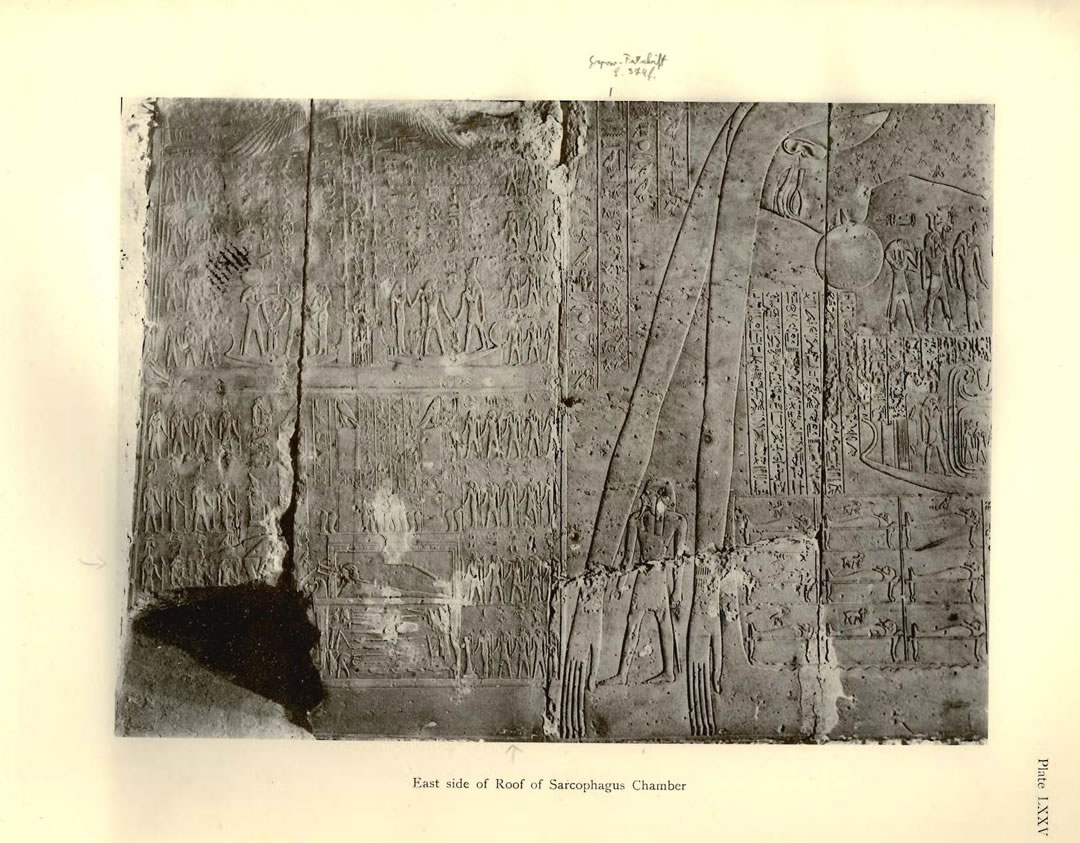
To the left of her long arms you can see other boats. It is Nut that gives birth to us and takes us back upon our death. The stars in Milky Way themselves are like the life-sustaining, moving, annually flooding, Nile. The cool depths reaching out to eternity, and the rising heat of the summer, are all part of the needed cycles of life itself. Nut incorporates the intangibles of the above and below, of light and dark, and even of good and evil. She is held up by her father, the god Shu as is shown in this depiction:
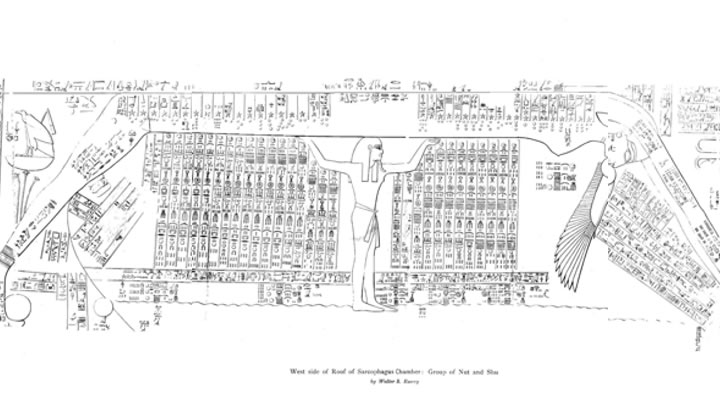
The star map of the west ceiling of the sarcophagus chamber in the Osirieon. Credit H. Frankfort, The Cenotaph of Seti I, 1934.
The hieroglyphs in this line drawing give the locations of the stars; Egyptians were clearly good astronomers, too. Their awe and reverence clearly drove them to map and explain the world around them. The inspiration they received and understood from the world around them drove their creativity. The temple they built is architecturally brilliant, from the intricate granite dovetails to the carved ledges on the battered walls holding the massive roofing slabs and capping stones. They strove to excel; to prove they were worthy.
This sense of striving, this desire to prove we are worthy, is fundamental to the human psyche; it allows us all to be part of something greater than ourselves. We want to belong. When we hear John F Kennedy’s famous antimetabole, “ask not what your country can do for you, ask what you can do for your country,” we are inspired. Inspired, we create.
We are all seeking awe and reverence, to be a part of something larger than ourselves. That is why the current fad to pull down statutes, to change street and building names, and the burning of buildings will ultimately fail. It is only destructive. The Russian and French Revolutions, the Holocaust, were likewise only destructive, killing for jealousy and hate. It is only when we have awe and reverence that we are inspired, that we believe, that we create, and that we are happy.
Listen to Perry’s podcast and feel how Nut’s revolving cycles above our heads capture Man’s repeating cycles of life and death, success and failure, for 4,000 years in Egypt’s past.